


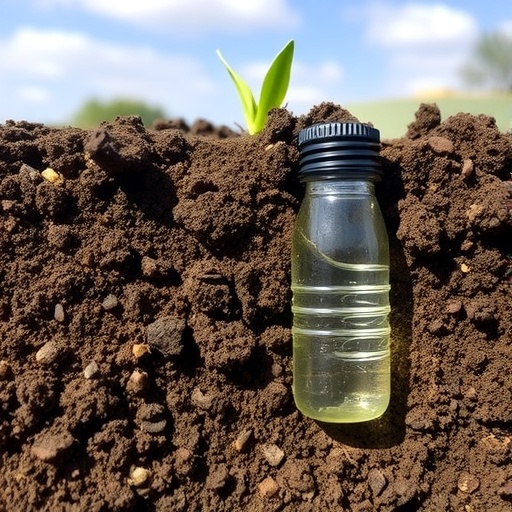
For decades, farmers, gardeners, and scientists alike have observed a curious phenomenon: soils enriched with organic matter retain moisture far better than their barren counterparts. This simple agricultural wisdom has long been embraced, yet the exact molecular underpinnings driving this enhancement in soil water retention have remained elusive. In groundbreaking research conducted by Northwestern University, scientists have now peeled back the layers of this mystery, revealing how carbohydrates—ubiquitous components of plant and microbial life—actively forge molecular bonds with soil minerals to trap water, even in the most arid environments.
At the heart of this discovery lies a nuanced dance of chemistry involving carbohydrates, soil minerals, and water molecules. Carbohydrates, long recognized as essential biomolecules, function far beyond their nutritional role. The research shows they serve as adhesive agents, forming intricate “molecular bridges” that tether water molecules to soil mineral surfaces. These interactions effectively immobilize moisture, preventing it from evaporating and thereby sustaining soil hydration under drought conditions or desert climates.
Led by Ludmilla Aristilde, associate professor of civil and environmental engineering at Northwestern’s McCormick School of Engineering, the team employed an interdisciplinary suite of molecular simulations alongside rigorous laboratory experiments. Through precise manipulations involving smectite clay—a common and globally distributed soil mineral—and three carbohydrate types (glucose, amylose, and amylopectin), the scientists simulated and observed the fundamental interactions at the nanoscale. Their integrative approach combined principles of quantum mechanics and molecular dynamics, enabling a detailed look at how water molecules behave when ensnared between carbohydrates and mineral surfaces.
Central to the mechanism identified is the role of hydrogen bonding—a relatively weak but collectively powerful force that governs much of the behavior of water. Typically, hydrogen bonds cause water molecules to cohere, giving it unique properties such as surface tension and high boiling point. This research reveals that water molecules simultaneously form hydrogen bonds with carbohydrate molecules and the minerals’ surfaces, thereby creating stable “bridges” that secure moisture deep within soil nanopores. These water bridges exhibit significantly stronger binding energies than water molecules interacting only with mineral surfaces, making the water less prone to loss by evaporation.
Of particular interest is the magnitude by which carbohydrate polymers bolster water retention. The study quantifies that complex sugars—namely amylose and amylopectin—can amplify the binding strength of water to soil minerals by up to fivefold compared to mineral surfaces alone. These polymeric carbohydrates, structured as long chains and branched trees, not only trap water but bolster the clay’s pore architecture. As soils dry, clay particles typically contract and nanopores collapse, expelling water; however, the presence of these carbohydrate polymers prevents full pore collapse. This microstructural preservation affords soils an enhanced ability to hold moisture over extended drought intervals.
Such findings carry profound implications for agriculture and ecosystem resilience in the face of climate change. Engineering soils with targeted organic amendments could transform them into moisture-retentive sponges, protecting crops from water stress and reducing the frequency and severity of irrigation needs. Moreover, understanding this molecular glue advances sustainable agricultural chemistry and suggests pathways to modify or synthesize organic matter that optimally stabilizes soil water.
Beyond terrestrial concerns, this research has cosmic relevance. The discovery of these water retention mechanisms at carbohydrate-clay interfaces provides a tantalizing window into extraterrestrial geology and astrobiology. Planetary bodies like Mars, known to harbor clays and organic compounds, might have trapped water via similar molecular bridges, offering clues about the persistence of liquid water and the viability of ancient life beyond Earth. This cross-disciplinary impact accentuates how fundamental chemistry underlies both earthly ecosystems and planetary science.
The investigation’s methodology stands out for its precision and innovation. Molecular dynamics simulations enabled the researchers to visualize how hydrogen bonds form and break in response to temperature variations and molecular structures. Meanwhile, laboratory experiments provided empirical validation, demonstrating that soils containing carbohydrates required higher temperatures to lose moisture, confirming the theoretical models. This synergy of computation and experimentation exemplifies modern environmental chemistry approaches.
Carbohydrates’ chemical simplicity was also a strategic choice in these studies. By focusing on clear-cut carbohydrate molecules and their polymers, the team avoided confounding factors from more chemically complex organics such as lignins or humic acids. This clarity allowed a direct assessment of carbohydrate contributions to moisture retention without side reactions muddying the results, thereby advancing mechanistic understanding from the ground up.
The research study, titled “Mechanisms of water retention at carbohydrate-clay interfaces,” was published in the August 9, 2025 issue of PNAS Nexus. Supported by the U.S. Department of Energy and Northwestern’s International Institute for Nanotechnology, this work represents a significant leap in our molecular understanding of soil science—a field critical to food security, environmental sustainability, and planetary exploration. Ludmilla Aristilde and her team’s pioneering discoveries not only illuminate the chemistry beneath our feet but might also inspire novel approaches to managing water resources amid a changing climate.
Looking forward, this research opens new investigative avenues. For instance, how do varying soil mineralogies or microbial-produced carbohydrate variants alter water retention dynamics? Can synthetic analogues mimic natural carbohydrates to enhance arid soil hydration artificially? Answers to these questions could revolutionize agricultural engineering and soil chemistry, propelling efforts to mitigate desertification and optimize crop yields.
Ultimately, this study bridges microscopic chemical interactions and macroscopic environmental phenomena, illustrating the profound interconnectedness of life’s molecular fabric and global ecosystem health. As the planet confronts the mounting challenges of drought and resource scarcity, insights into how humble sugars glue water to soil grains may prove vital in sustaining life both here and among the stars.
Cite Scienmag News
Alan Morgan. (August 11, 2025). How Organic Matter Retains Water in Soil — Even Under the Driest Conditions. Scienmag. https://scienmag.com/how-organic-matter-retains-water-in-soil-even-under-the-driest-conditions/
Alan Morgan. "How Organic Matter Retains Water in Soil — Even Under the Driest Conditions." Scienmag, 11 August 2025, https://scienmag.com/how-organic-matter-retains-water-in-soil-even-under-the-driest-conditions/. Accessed 4 September 2026.
Alan Morgan. "How Organic Matter Retains Water in Soil — Even Under the Driest Conditions." Scienmag. August 11, 2025. https://scienmag.com/how-organic-matter-retains-water-in-soil-even-under-the-driest-conditions/


