


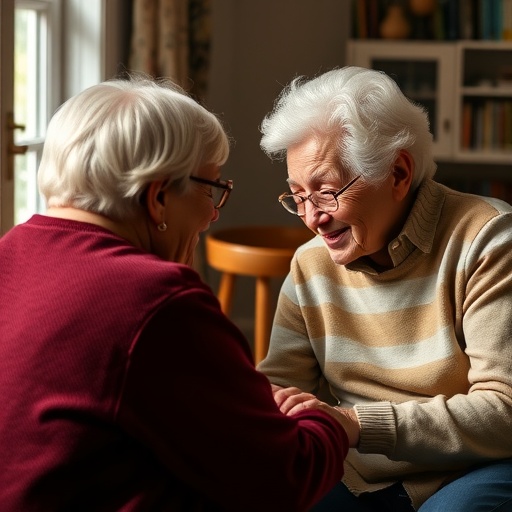
Caring for a family member with dementia represents one of the most demanding and emotionally taxing roles a person can undertake. The chronic nature of the caregiving burden exposes individuals to prolonged stress, social isolation, and profound feelings of loneliness. Recent pioneering research conducted at the University of Michigan Institute for Social Research reveals that brief but regular social interactions, even through simple gestures like texting friends, substantially diminish momentary loneliness among dementia caregivers. This finding underscores the importance of embedding social connectivity within caregiving routines to foster mental wellbeing.
Dementia caregiving presents unique challenges that foster social withdrawal. The intensive demands of monitoring, assisting, and supporting a cognitively impaired loved one often consume much of a caregiver’s day, leaving minimal opportunities for socializing. This isolation can engender acute bouts of loneliness, a subjective state characterized by the distressing perception of social disconnection. Loneliness has been linked to detrimental health outcomes including depression, cardiovascular disease, and cognitive decline, making its mitigation a critical public health priority.
In a novel methodological approach, Crystal Ng and collaborators enrolled 223 dementia caregivers in a study designed to capture the dynamic nature of loneliness with high temporal resolution. Unlike traditional survey methods which rely on retrospective accounts spanning weeks or months, this study employed ecological momentary assessment (EMA) techniques. Over a period of five days, participants provided self-reports of their social interactions and loneliness every three hours during waking periods. The granular data harvested allowed the researchers to observe fluctuations in loneliness contingent on recent social contact.
The results, recently published in the Journal of Gerontology, are compelling. Caregivers reported engaging with friends in over 20% of survey prompts. Critically, these interactions correlated with statistically significant reductions in immediate feelings of loneliness. The protective effect prevailed even when interactions were with acquaintances or less emotionally close friends, highlighting the power of positive social engagement irrespective of relationship depth. These moment-to-moment social connections appear to counterbalance the emotional burden inherent in caregiving.
Of particular note is the amplified benefit observed in “high-burden” caregivers—those facing more intensive and challenging care responsibilities. This subgroup is often at elevated risk for social isolation due to limited respite opportunities. The data indicated that social interactions exerted the strongest mitigating effects on loneliness among these individuals, suggesting targeted interventions promoting friend-based engagement may be particularly valuable. For caregivers navigating the most strenuous circumstances, even minor social exchanges provide a vital emotional reprieve.
This research represents a paradigm shift in understanding loneliness as a fluctuating state rather than a fixed personality trait. By leveraging EMA to capture the ebb and flow of loneliness throughout the day, Ng and colleagues demonstrated the fluidity of emotional experiences in caregiving contexts. This nuanced perspective enables a more precise identification of moments when social support is most needed and effective, paving the way for timely, personalized interventions to alleviate psychological distress.
Moreover, the findings emphasize the feasibility and potential impact of low-effort social contact strategies. In an era where digital communication platforms abound, sending a brief text or initiating a phone call constitutes an accessible means to nurture social bonds without necessitating extended time commitments. This approach offers a scalable solution to combat loneliness, adaptable even under the constraints posed by caregiving duties.
The implications for clinical practice and caregiver support programs are profound. Interventions designed to integrate scheduled social interactions with friends into daily caregiving routines could be instrumental in reducing loneliness. These programs might leverage digital reminders, peer support networks, or facilitated social engagement opportunities to ensure caregivers maintain vital social connections. The psychological uplift derived from such interactions may enhance caregiver resilience and overall quality of life.
The study also contributes to the growing body of literature advocating for social connectivity as a critical determinant of health in aging populations and chronic disease contexts. By focusing on the real-time dynamics of loneliness among dementia caregivers, it enriches conceptual frameworks that seek to unpack the psychosocial dimensions of caregiving stress. It further underscores the importance of incorporating social variables into comprehensive strategies aiming to support caregivers’ mental health.
Funding support from the National Institute on Aging and the Michigan Center on the Demography of Aging underscores the institutional prioritization of dementia caregiver wellbeing. Collaborative efforts between social scientists Angela Turkelson, Anna Kratz, and Kira Birditt alongside Ng have culminated in robust, interdisciplinary insights that blend epidemiological methods with psychological science to tackle loneliness pragmatically.
In conclusion, this study elucidates the crucial role of daily social interactions in alleviating transient loneliness among caregivers of people with dementia. By spotlighting the efficacy of even minimal contact with friends, it offers a hopeful and actionable avenue to mitigate one of the most pervasive emotional challenges in dementia caregiving. Future research and policy initiatives would do well to integrate these findings to support caregivers’ mental health at both individual and systemic levels.
Cite Scienmag News
Cassandra Pierce. (October 29, 2025). How Friendships Alleviate Loneliness in Dementia Caregivers: New Insights. Scienmag. https://scienmag.com/how-friendships-alleviate-loneliness-in-dementia-caregivers-new-insights/
Cassandra Pierce. "How Friendships Alleviate Loneliness in Dementia Caregivers: New Insights." Scienmag, 29 October 2025, https://scienmag.com/how-friendships-alleviate-loneliness-in-dementia-caregivers-new-insights/. Accessed 3 September 2026.
Cassandra Pierce. "How Friendships Alleviate Loneliness in Dementia Caregivers: New Insights." Scienmag. October 29, 2025. https://scienmag.com/how-friendships-alleviate-loneliness-in-dementia-caregivers-new-insights/


