


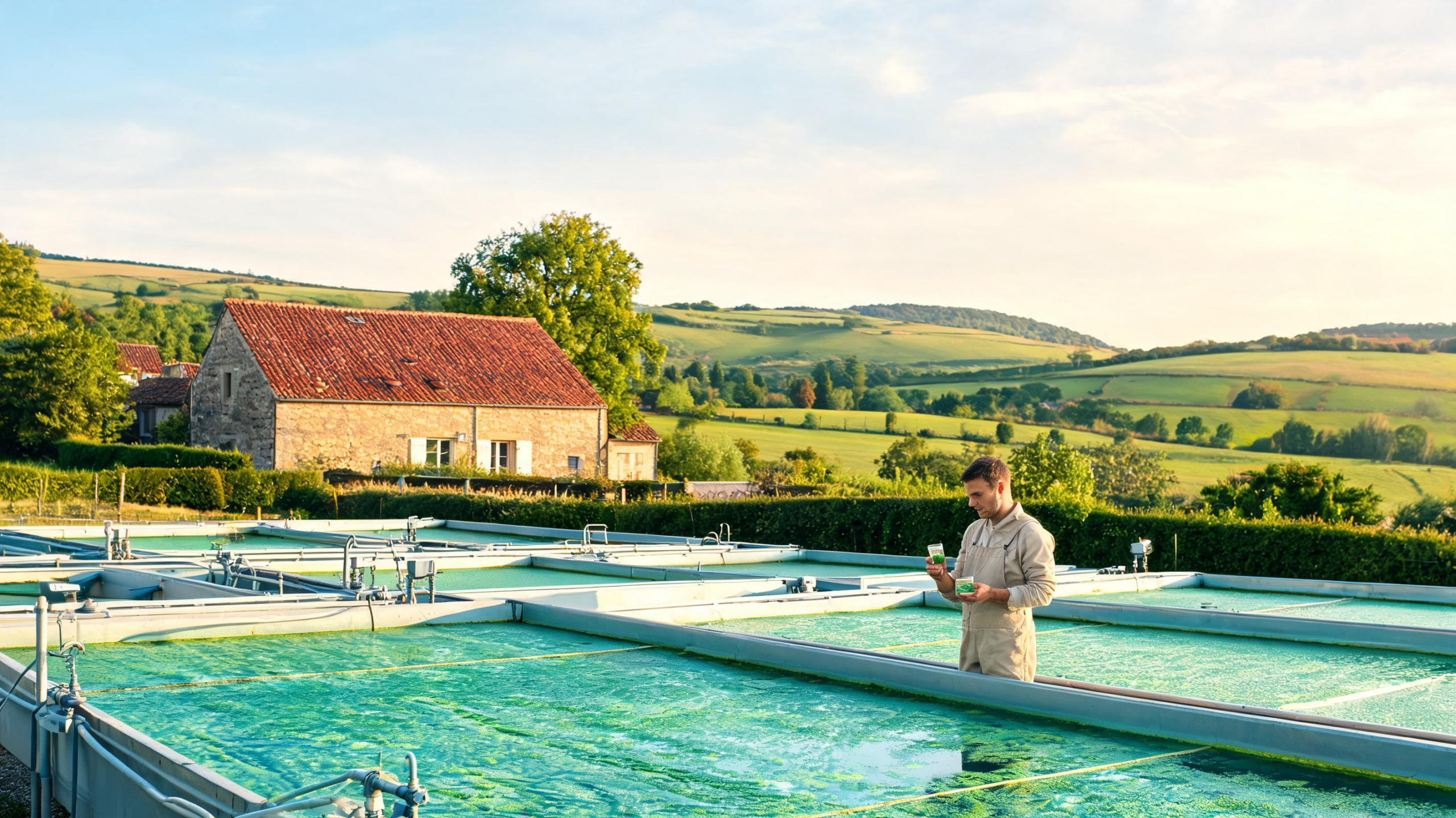
France’s spirulina farms are turning a traditionally warm-climate crop into a distinctly temperate form of biotechnology. A survey of 45 production facilities across 29 departments shows that small-scale growers have converged on a practical system for cultivating Limnospira—the cyanobacterium commonly sold as spirulina—despite major differences in geography, weather and farm experience. Most facilities use shallow open raceway ponds beneath greenhouses, circulate the cultures with relatively simple mechanical equipment, and harvest the biomass several times a week or less, depending on local conditions. The findings offer the most detailed farm-level snapshot yet of French production practices, but they do not rank farms or identify the most productive methods. The study recorded infrastructure, cultivation routines, harvesting and processing rather than standardized yields, energy use, economic performance or environmental footprints. That distinction matters: the survey describes how producers operate, not which system definitively performs best.
Limnospira is a filamentous photosynthetic cyanobacterium rather than a true alga, although “microalga” remains common in commercial and food contexts. Its alkaline, saline growth conditions can discourage some contaminants, while its biomass is valued for protein, pigments and other nutrients. The French sector has expanded alongside interest in locally produced foods and the wider bioeconomy, but the country’s climate imposes limits that are less severe in tropical production regions. Greenhouses help capture heat, shelter ponds from rain and extend the growing season, yet they generally cannot provide enough warmth and light for continuous winter growth in northern or mountainous areas. Producers must therefore manage a narrow biological window: enough sunlight to drive photosynthesis, enough warmth to sustain metabolism, and sufficient circulation to keep the filaments suspended without damaging them.
That balance is reflected in the strikingly consistent physical design reported by the farms. Roughly 85 to 90 percent of facilities operate shallow open raceway ponds, usually 12 to 15 centimeters deep, and all surveyed producers reported greenhouse coverage. Individual ponds were commonly centered near 180 square meters, with many ranging from 90 to 270 square meters; farms typically operated two to four ponds. No respondents reported unlined earthen ponds. Instead, 40 percent used ethylene propylene diene monomer, or EPDM, liners, 33 percent used polyethylene and 18 percent used polyvinyl chloride, with a small remainder using other materials, including bare concrete. Impermeable surfaces make ponds easier to clean and drain, reduce contact with soil, and help producers control salinity and nutrient concentrations. The shallow water column also improves light penetration, an important advantage where cloud, low sun angles and short growing seasons restrict the energy available for photosynthesis.
The greatest surprise concerned mixing. Large industrial systems are often associated with paddlewheels, but lateral agitators were the primary circulation technology for 53 percent of surveyed facilities, compared with 27 percent relying primarily on paddlewheels. Producers described wall-mounted helical mixers, submersible turbines, small pumps and modified aquarium equipment that can be installed and repaired without the cost of custom-built machinery. Hybrid systems combining paddlewheels and lateral agitators accounted for about 11 percent of facilities, particularly where large or elongated ponds risked developing poorly circulated zones. Among paddlewheel users, wheel diameters averaged about 45 centimeters and rotation speeds clustered near 35 revolutions per minute. The objective is not vigorous turbulence. Circulation keeps cells and filaments from settling, distributes nutrients and light, and reduces local differences in pH and temperature, while excessive shear could break the delicate filaments. The authors note that typical flow conditions are expected to be transitional or weakly turbulent, although these hydrodynamic values were not measured directly at the surveyed farms.
Producers monitored temperature and pH universally, while most also tracked water depth, turbidity and salinity or conductivity. These measurements reflect the chemical logic of the culture: changes in evaporation, nutrient uptake and carbon availability can shift pH and salt concentration, potentially affecting growth or culture stability. Water management was strongly seasonal. In summer, one-third of respondents added water daily and another 44 percent renewed it two or three times each week. In spring and autumn, most renewed water weekly or less often, while winter replenishment was commonly biweekly or less frequent. Evaporation is particularly important inside greenhouses because water loss depends on temperature, humidity, solar radiation and air exchange. Opening greenhouse panels can increase ventilation and cooling but also accelerate evaporation; closing them conserves water while increasing the risk of overheating. Only three facilities reported automated water addition based on level sensors, indicating that most farms still depend on manual observation and intervention.
Biology provides another layer of regional adaptation. After standardizing the varied names used by producers, the survey found that Limnospira platensis accounted for approximately 80 to 85 percent of cultivated strains, while Limnospira maxima represented roughly 10 to 12 percent. Strain choice was shaped by climate, but also by the practical availability of starter cultures from neighboring farms or suppliers. L. platensis predominated in northern and western coastal regions and in some mountainous areas, where tolerance of temperature fluctuations is valuable. L. maxima was more frequent in warmer regions, although the survey’s regional counts were small and should not be treated as a controlled comparison of strain performance. Mediterranean producers emphasized shading and ventilation to limit heat stress and evaporation, whereas mountainous farms more often used staged inoculation and cold protection to establish cultures during shorter seasons. A tropical site in Guadeloupe reported conditions compatible with year-round cultivation, but one overseas response is insufficient to characterize tropical French production broadly.
Nutrient management was less standardized than pond construction. Jourdan medium, either in its standard form or with farm-specific modifications, was used by about 60 to 65 percent of facilities. Custom formulations accounted for 20 to 25 percent, while smaller groups used Zarrouk medium, BG-11 or hybrid recipes. Common ingredients included sodium bicarbonate as a carbon source, sodium chloride for salinity, nitrate and sometimes urea for nitrogen, iron, phosphates and trace-element mixtures. Nutrients were delivered through several approaches: drip feeding was most common, followed by localized addition near mixing equipment, manual distribution across the pond and a small number of sensor-controlled dosing systems. Some producers combined daily low-dose urea with periodic nitrate additions, attempting to provide immediately available nitrogen while preserving longer-term medium stability. Such practices may embody valuable operational knowledge, but the survey did not test their effects on biomass yield, nutritional composition, contamination or cost. Similarly, many farms renewed the entire culture medium only annually or every two to three years, while others waited for salinity drift, turbidity, pH instability or contamination to trigger renewal.
Harvesting and processing were the most uniform stages after pond construction. About 60 percent of farms harvested once or twice a week, 30 percent three or four times weekly, and roughly 10 percent five or six times weekly. More frequent harvesting tended to occur in warmer or larger operations, although the study did not independently verify the reported quantities. More than 95 percent used fine-mesh filtration, gravity drainage and manual or mechanical collection to concentrate the wet biomass; only a minority added pressing or surface skimming. Nearly every producer—about 98 percent—extruded the paste into spaghetti-like strands before drying. The shape provides a relatively consistent surface area for airflow and moisture removal, which helps small operations process biomass with simple equipment. Drying temperatures generally ranged from 35 to 42 degrees Celsius, with 40 to 42 degrees the practical standard for about 60 percent of respondents. Hot-air convection and air-dehumidifier systems were common, while solar drying was more vulnerable to seasonal humidity and became impractical in winter. Producers typically stored the dried product in vacuum-sealed bags, opaque airtight containers or temperature-controlled rooms to limit exposure to moisture, oxygen and light.
The survey’s central message is that French spirulina production depends less on a single sophisticated technology than on coordinated climate management and accumulated farm experience. Temperature was among the most frequently reported constraints, followed by solar radiation and humidity; nutrient control, biological contamination, mixing and labor also shaped operations. Yet the study cannot establish whether a lateral agitator is more energy-efficient than a paddlewheel, whether one liner lasts longer under equivalent conditions, or whether a particular strain produces more biomass in a given region. Its data came from anonymous self-reports collected between December 2024 and May 2025 through the French Federation of Spirulina Producers, representing about half of the federation’s approximately 90 members. Established commercial farms may therefore be overrepresented, while very small, experimental or non-federated operations may be missing. The authors point to the next research priorities: multi-season monitoring, direct measurements of productivity and resource use, systematic strain trials, and better documentation of winter culture strategies. French producers have demonstrated that Limnospira can be cultivated beyond its most favorable climates. Determining how efficiently and resiliently it can do so will require turning this shared practical knowledge into comparable experimental evidence.
A useful way to interpret the survey is as a map of shared operational practice rather than a protocol for optimization. The questionnaire combined fixed response categories with structured free-text entries, and the researchers harmonized equivalent answers without imputing missing values. That approach improves comparability across farms, but it cannot resolve whether differences in equipment, nutrient recipes or harvest timing reflect climate adaptation, farm scale, historical preference or access to suppliers. Because responses represented about half of the federation’s membership and were collected during one production period, the results are best treated as a baseline for designing more controlled studies. Future comparisons would be stronger if farms recorded the same variables continuously, including culture temperature, irradiance, pH, conductivity, biomass concentration and daily harvest mass.
The food-use context also makes process control important beyond biomass production. Limnospira is a cyanobacterium, so species identification and monitoring of culture purity are relevant to product quality even when alkaline, saline media reduce some contamination pressures. The source notes that investigations of cyanobacterial toxins in French systems have generally found concentrations within regulatory safety thresholds, while also noting that several commercial spirulina products have received U.S. GRAS status. These statements support the sector’s food applications but do not make safety automatic: regulatory status applies to specified products and uses, and routine quality assurance remains necessary as cultivation and processing conditions vary.
Subject of Research: Small-scale Limnospira cultivation practices in France
Article Title: Limnospira spp. production practices in France
Article References: Skifa, I., Chauchat, N., Cocquet, P.-H., & Guer, Y. L. (2026). Limnospira spp. production practices in France. Blue Biotechnology, 3(1), Article 11. https://doi.org/10.1186/s44315-026-00062-0
Image Credits: AI Generated
DOI: 10.1186/s44315-026-00062-0
Keywords: Limnospira, Spirulina, Cyanobacteria, Raceway ponds, Algal biotechnology, Greenhouse cultivation, Microalgae, France, production, practices, scientific research
Cite Scienmag News
Drew Townsend. (August 28, 2026). How French Farms Are Rewriting Spirulina Cultivation for Temperate Climates. Scienmag. https://scienmag.com/how-french-farms-are-rewriting-spirulina-cultivation-for-temperate-climates/
Drew Townsend. "How French Farms Are Rewriting Spirulina Cultivation for Temperate Climates." Scienmag, 28 August 2026, https://scienmag.com/how-french-farms-are-rewriting-spirulina-cultivation-for-temperate-climates/. Accessed 5 October 2026.
Drew Townsend. "How French Farms Are Rewriting Spirulina Cultivation for Temperate Climates." Scienmag. August 28, 2026. https://scienmag.com/how-french-farms-are-rewriting-spirulina-cultivation-for-temperate-climates/


