


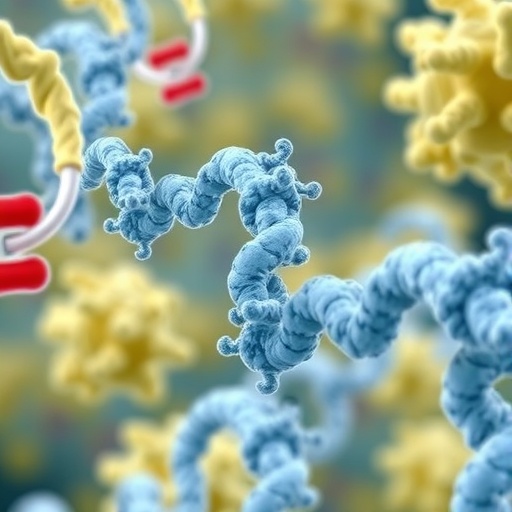
In a groundbreaking study published in Nature Cell Biology, a consortium of researchers from Ludwig-Maximilians-Universität München (LMU), Technical University of Munich (TUM), Helmholtz Munich, and Washington University in St. Louis have unveiled new insights into the enigmatic behavior of intrinsically disordered protein regions (IDRs). These flexible protein segments, which defy the classical understanding of stable three-dimensional protein structures, have long posed a biological mystery due to their essential cellular functions despite exhibiting little conservation in their amino acid sequences throughout evolution. The study illuminates how these disordered regions maintain their biological roles through a complex and nuanced interplay of short linear sequence motifs and the broader chemical environment within these proteins.
Unlike stably folded protein domains, intrinsically disordered regions lack a fixed 3D conformation. Despite this flexibility, IDRs fulfil critical roles in cellular processes such as signal transduction, molecular recognition, and the formation of biomolecular condensates—dense, membrane-less organelles that orchestrate biochemical reactions. Roughly one-third of all protein regions fall into this category, highlighting their prevalence and significance in cellular biochemistry. However, the absence of a definitive spatial structure combined with low sequence conservation across species has historically hindered detailed functional predictions based solely on motif recognition.
The research team focused their investigation on a particularly essential IDR in the yeast protein Abf1, a model system that allows for versatile experimental manipulation. By engineering and testing over 150 distinct variants of Abf1’s disordered domain, the team systematically dissected which alterations disrupted or preserved its native function. Their high-throughput mutagenesis approach was designed to test not only naturally occurring motifs but also newly synthesized sequences, enabling a broad exploration of the functional landscape accessible to these flexible regions.
The results revealed that functionality within IDRs does not derive solely from the presence of specific linear sequence motifs—short, defined stretches of amino acids that mediate precise molecular interactions. Equally crucial is the underlying chemical context of the disordered region, including properties such as net negative charge and the hydrophilicity or hydrophobicity of constituent amino acids. This chemical milieu modulates the physical behavior of the IDR, influencing how it interacts with binding partners and participates in cellular assemblies. It is the nuanced balance between discrete motif presence and the holistic biochemical environment that ultimately dictates protein functionality.
One of the study’s most striking discoveries was the functional redundancy afforded by the chemical context within IDRs. The researchers demonstrated that an otherwise indispensable short linear binding motif could be rendered nonessential if the surrounding amino acid composition was adjusted accordingly. For instance, enhancing negative charge density or altering solubility characteristics could compensate for the loss of a critical motif, preserving the protein’s overall activity. This finding challenges the traditional dogma that discrete motifs must be absolutely conserved and underscores the adaptive flexibility of IDRs.
Conversely, the study found that simply preserving the overall amino acid composition without maintaining key motifs or a complementary chemical context was insufficient to retain function. The interplay is therefore bidirectional and complex: linear sequence motifs require a supportive chemical environment, and the broader chemical characteristics depend on the positioning and presence of specific motifs to realize biological activity. This multifaceted relationship constructs a “functional landscape,” where multiple molecular solutions can achieve the same cellular outcome.
Professor Philipp Korber, leading the LMU research group, emphasizes the paradoxical nature of IDRs: “They are biologically indispensable yet defy straightforward classification by classical sequence alignment or structural analysis.” His collaboration with Alex Holehouse, a prominent figure in biochemistry and molecular biophysics at Washington University, helped elucidate the physicochemical principles underlying this paradox. Their joint efforts underscore the necessity of integrating chemical physicochemical parameters alongside primary sequence motifs when investigating protein function.
This conceptual breakthrough expands the theoretical evolutionary space in which intrinsically disordered regions operate. Prior to this work, evolutionary interpretations focused predominantly on motif conservation; however, this study reveals that IDRs can tolerate a wide spectrum of sequence variability by leveraging compensatory chemical properties. Such plasticity likely facilitates rapid adaptation and diversification of protein functions throughout evolution without detrimental loss of biological roles, an insight with profound implications for evolutionary biology.
From a biomedical perspective, these findings offer novel avenues for understanding disease-associated mutations within IDRs. Many pathogenic mutations affect these flexible segments, complicating efforts to predict their functional consequences using traditional bioinformatics tools. Recognizing that IDR function arises from a combination of motifs and chemical environment equips researchers with a more holistic framework to interpret variant effects. This advance could enhance predictive models for protein dysfunction in diseases ranging from neurodegenerative disorders to cancer.
Furthermore, the study paves the way for rational design of synthetic proteins with customized disordered regions. By tuning motifs and their chemical context, protein engineers can create flexible domains tailored for specific interactions or assembly properties. Such synthetic IDRs may find applications in biotechnology, therapeutic protein design, and synthetic biology, where conventional folded protein domains may lack the necessary versatility and dynamism.
In essence, this research reframes our understanding of intrinsically disordered regions as dynamic, adaptable landscapes shaped by an intricate balance of discrete sequence motifs and the physicochemical nature of surrounding residues. The functional plurality and robustness endowed by this balance elucidate how cells exploit protein disorder to regulate complex processes, maintain resilience, and evolve innovative biological functions. As the field of protein science continues to evolve, the integration of sequence and chemical specificity promises to yield richer insights into the molecular fabric of life.
The study’s comprehensive approach also advances methodologies in protein biophysics, combining mutagenesis, biochemical assays, and computational analyses that interrelate molecular structure, chemistry, and functional output. Such interdisciplinary collaboration exemplifies the transformative potential of merging theoretical and experimental paradigms in modern molecular biology, heralding a new era of precision understanding of the cellular proteome’s most elusive components.
Cite Scienmag News
Drew Townsend. (March 13, 2026). How Flexible Protein Regions Maintain Their Function. Scienmag. https://scienmag.com/how-flexible-protein-regions-maintain-their-function/
Drew Townsend. "How Flexible Protein Regions Maintain Their Function." Scienmag, 13 March 2026, https://scienmag.com/how-flexible-protein-regions-maintain-their-function/. Accessed 3 September 2026.
Drew Townsend. "How Flexible Protein Regions Maintain Their Function." Scienmag. March 13, 2026. https://scienmag.com/how-flexible-protein-regions-maintain-their-function/


