


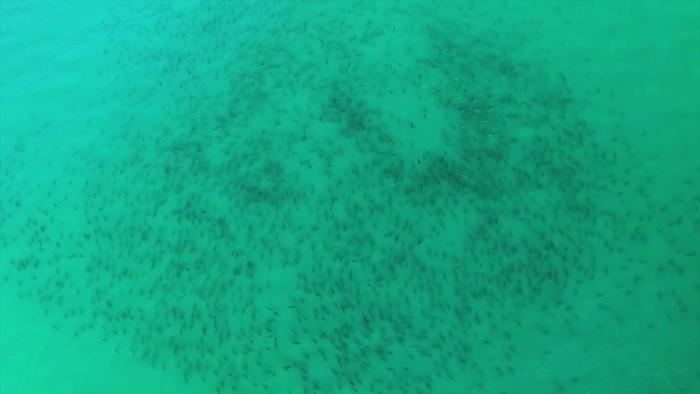
When scientists want to study the long-distance movement of marine animals, they will instrument them with a small device called an acoustic transmitter – or tag – which emits unique signals or “pings.” These signals are picked up by receivers anchored to the seafloor that record the date and time of each detection when the tagged animal comes within range.

Credit: Florida Atlantic University
When scientists want to study the long-distance movement of marine animals, they will instrument them with a small device called an acoustic transmitter – or tag – which emits unique signals or “pings.” These signals are picked up by receivers anchored to the seafloor that record the date and time of each detection when the tagged animal comes within range.
Data collected by the receivers are stored until they are retrieved by researchers and shared across members of cooperative acoustic telemetry networks. This information provides valuable insights into animal behavior, migration patterns, habitat preferences and ecosystem dynamics – all of which are vital for conservation and wildlife management efforts.
However, this method is not without limitations. Receivers must be physically retrieved to access the data they have collected. For use in marine animals, receivers are often placed near the coast for easy access, but the distribution of receivers can be uneven, with some areas having few receivers and others having many. This can lead to biased data collection, especially for animals that move across large distances.
A pioneering study by researchers at Florida Atlantic University and the Smithsonian Environmental Research Center addresses these limitations by filling in the gaps in sporadic detection data and tackles the tradeoff between spatial coverage and cost. Using a movement model, researchers reconstructed animal tracks and leveraged an iterative process to measure the accuracy and precision of these reconstructions from acoustic telemetry data.
Results of the study, published in the journal Methods in Ecology and Evolution, demonstrate how researchers can apply these techniques and measure the accuracy and precision of the methods to their study sites.
For the study, researchers simulated animal tracks on a computer, then tested how well their method could accurately reconstruct the tracks if they received detection data only from a cooperative acoustic telemetry array. While most of the data used were simulated, they further tested their methodology with data from highly migratory blacktip sharks (Carcharhinus limbatus) to demonstrate how this method can be applied ecologically.
Findings demonstrate that their novel method can improve track reconstruction, even in regions with uneven receiver coverage. The track reconstruction methods performed well in coastal regions from Palm Beach County to Long Island, minimizing the clustering effect of high densities of receivers and closing the gaps in some regions that were lacking receiver coverage. Performance was primarily affected by the presence or absence of receivers, and to a lesser extent by receiver density and water depth, depending on the grid resolution.
“Our approach could significantly reduce gaps in data collection and improve the reliability of ecological insights,” said Beth Bowers, Ph.D., senior author and a post-doctoral researcher at the Smithsonian Environmental Research Center, who conducted the research as a Ph.D. student with her mentor, Stephen Kajiura, Ph.D., in FAU’s Charles E. Schmidt College of Science. “Importantly, this method doesn’t rely on costly field techniques such as motorboat towed tests, which makes it suitable for large-scale studies across diverse habitats.”
This new method increases the utility of acoustic telemetry technology and provides a framework for future studies to assess the accuracy and precision of animal movement calculated from track reconstructions that use acoustic telemetry.
“Results from our study will enable resource managers and others to infer the reliability of ecological results in their decision-making processes,” said Kajiura, co-author and a professor of biological sciences, FAU College of Science.
To foster collaboration and innovation, the researchers have made their data repository accessible, empowering fellow scientists to adapt and apply the methodology to their respective study organisms and habitats, whether that encompasses marine, freshwater or terrestrial habitats.
“Importantly, implications of our findings extend beyond marine environments, offering a transformative approach to wildlife monitoring across aquatic and terrestrial landscapes,” said Bowers.
This work was funded by the Colgan Foundation.
– FAU –
About Florida Atlantic University:
Florida Atlantic University, established in 1961, officially opened its doors in 1964 as the fifth public university in Florida. Today, the University serves more than 30,000 undergraduate and graduate students across six campuses located along the southeast Florida coast. In recent years, the University has doubled its research expenditures and outpaced its peers in student achievement rates. Through the coexistence of access and excellence, FAU embodies an innovative model where traditional achievement gaps vanish. FAU is designated a Hispanic-serving institution, ranked as a top public university by U.S. News & World Report and a High Research Activity institution by the Carnegie Foundation for the Advancement of Teaching. For more information, visit www.fau.edu.
Journal
Methods in Ecology and Evolution
Method of Research
Computational simulation/modeling
Subject of Research
Animals
Article Title
A novel process to infer the reliability of ecological information derived from passive acoustic telemetry track reconstruction
Article Publication Date
5-Jun-2024
Cite Scienmag News
Reid Dalton. (June 6, 2024). How do you know where a fish goes? Scienmag. https://scienmag.com/how-do-you-know-where-a-fish-goes/
Reid Dalton. "How do you know where a fish goes?" Scienmag, 6 June 2024, https://scienmag.com/how-do-you-know-where-a-fish-goes/. Accessed 5 September 2026.
Reid Dalton. "How do you know where a fish goes?" Scienmag. June 6, 2024. https://scienmag.com/how-do-you-know-where-a-fish-goes/

