


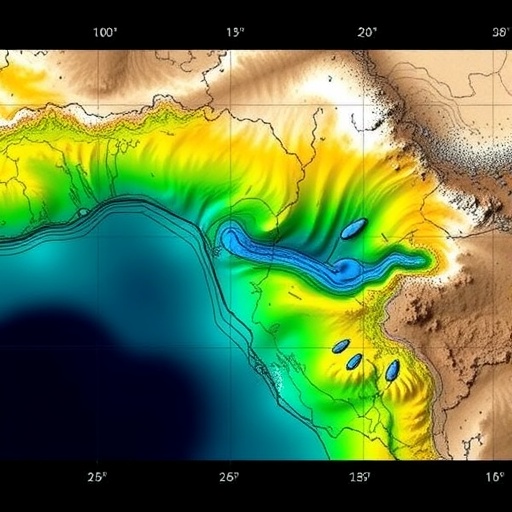
The Nile River, the lifeline of northeastern Africa, is governed by a climate system far more complex than its steady flow through Egypt might suggest. A new study in Climate Dynamics has traced the river’s fluctuations across multiple timescales, revealing that different parts of the basin respond to different climate drivers. The research shows that precipitation—not temperature—is the dominant force behind changes in Nile streamflow, while distant Pacific Ocean temperature patterns can influence rainfall thousands of kilometers away. The findings offer one of the clearest quantitative explanations yet of why Nile discharge rises and falls from year to year and from decade to decade, with implications for water security in Egypt, Sudan, Ethiopia, Uganda and the wider Nile Basin.
The study, led by Fang Huang of the Jiangsu Provincial Meteorological Service Center and co-authored by researchers in China, Spain and Egypt, examined approximately eight decades of naturalized annual streamflow at Aswan. Naturalized flow refers to an estimate of river discharge adjusted to represent natural conditions, minimizing the influence of dams and other human interventions. The researchers combined this record with precipitation and temperature datasets, river-gauge observations, sea-surface temperature records and atmospheric reanalysis products. These included the CRU TS and GPCC climate datasets, HadISST sea-surface temperatures, ERA5 atmospheric data and discharge information from the Global Runoff Data Centre. Together, the datasets allowed the team to link variations in water arriving at Aswan with conditions across the Nile’s major source regions and the global climate system.
The Aswan record displayed two major signatures. The first was pronounced interannual variability, meaning that the river’s flow could differ substantially from one year to the next. The second was a slower decadal pattern in which streamflow shifted through a positive–negative–positive sequence over the study period. These fluctuations matter because they operate on different planning horizons. Interannual changes can complicate agricultural decisions, reservoir management and flood preparedness, while decadal changes can reshape expectations about long-term water availability. Treating all Nile variability as a single phenomenon can therefore obscure the mechanisms responsible for it. The researchers addressed this problem through a three-tiered attribution framework designed to separate the influence of large-scale climate modes, regional precipitation and downstream river flow.
At the basin level, the analysis points overwhelmingly to precipitation as the main source of streamflow variability. Temperature changes had a comparatively minor role during the historical period examined. That result does not mean temperature is irrelevant to the Nile’s future. Rising temperatures can increase evaporation, alter soil moisture and intensify water demand, potentially worsening water scarcity even where rainfall does not decline. However, for explaining the observed ups and downs of annual discharge at Aswan, rainfall was the critical link. The location of that rainfall was equally important. The White Nile and Blue Nile basins contribute water through distinct climatic pathways, and their precipitation variability dominates different timescales of the river’s behavior.
The White Nile emerged as the principal driver of decadal-scale changes in lower Nile flow. According to the study, precipitation variability associated with the Pacific Decadal Oscillation, or PDO, explained 69 percent of the total variance in this slower component of streamflow, with a confidence interval of 62.0 to 77.1 percent. The PDO is a long-lived pattern of sea-surface temperature and atmospheric pressure variability centered in the North Pacific. Its phases can persist for years or decades, reorganizing atmospheric circulation and influencing climate far beyond the Pacific. In the study’s attribution chain, PDO-related climate variability affected rainfall over the White Nile Basin, and those precipitation changes were then reflected in the flow measured downstream at Aswan.
The Blue Nile, by contrast, was most strongly connected to year-to-year fluctuations through the El Niño–Southern Oscillation, or ENSO. ENSO is the recurring warming and cooling of the tropical Pacific Ocean, best known through its El Niño and La Niña phases. The researchers found that ENSO-related precipitation anomalies in the Blue Nile Basin accounted for 67 percent of interannual discharge fluctuations, with a confidence interval of 61.3 to 71.4 percent. This result helps explain why El Niño years have often been associated with altered rainfall over the Ethiopian highlands, where the Blue Nile rises. Because the Blue Nile supplies a major share of the Nile’s seasonal flood pulse, relatively modest changes in highland rainfall can produce substantial consequences for river levels downstream.
The proposed physical mechanism begins with sea-surface temperature anomalies in the eastern equatorial Pacific. When the ocean surface warms or cools, it changes the distribution of atmospheric convection—the vertical movement of warm, moist air that helps generate clouds and rainfall. These changes can reorganize wind divergence and moisture transport over the tropics. The study describes a seesaw pattern in which wind-field divergence and moisture flux vary between the tropical Pacific and the broader Asian–African region. Moisture flux is the movement of water vapor through the atmosphere, and changes in its direction or intensity can determine whether a basin receives abundant rainfall or experiences a deficit. Through this atmospheric bridge, remote Pacific conditions can alter the delivery of moisture to the Nile Basin, despite the enormous distance separating the source region and the river.
The findings also illustrate why the Nile cannot be managed using a single climate indicator. A climate mode that is influential on one timescale or in one sub-basin may be far less important elsewhere. The PDO’s relationship with White Nile precipitation helps explain slower shifts in lower-basin flow, whereas ENSO’s connection with Blue Nile rainfall helps account for rapid year-to-year changes. This distinction could improve seasonal forecasting and longer-range water planning. For example, monitoring tropical Pacific temperatures and atmospheric circulation may provide early clues about Blue Nile rainfall, while decadal climate diagnostics could help identify periods when the lower Nile is more likely to experience sustained high or low flow. Such information could support reservoir operations, irrigation scheduling, flood-risk assessments and negotiations over shared water resources.
The authors describe their framework as a stepwise approach that connects climate variability to hydrological consequences: a global climate mode influences regional precipitation, precipitation changes affect sub-basin runoff, and runoff ultimately appears as altered discharge at Aswan. By quantifying each stage, the study moves beyond simple correlations between ocean temperatures and river flow. It also provides uncertainty ranges for its main attribution estimates, an important feature when results are used in policy and infrastructure decisions. Nevertheless, the researchers’ conclusions concern historical variability and should not be interpreted as a complete forecast of the future Nile. Human water withdrawals, land-use change, reservoir construction and a warming climate may modify the relationships identified in the record. The study’s central message is that understanding those future risks requires first recognizing the river’s distinct climate rhythms.
For a basin already facing population growth, agricultural pressure and major changes in water infrastructure, the research offers both a scientific insight and a warning. Nile streamflow is not controlled by local weather alone; it is part of a planetary climate network in which ocean temperatures, atmospheric circulation and regional rainfall are tightly connected. The Blue Nile’s sensitivity to ENSO means that global climate variability can rapidly affect the water supply entering the river system, while the White Nile’s association with the PDO indicates that slower Pacific shifts may shape conditions over much longer periods. By identifying these pathways and measuring their relative importance, the study provides a more precise foundation for anticipating hydrological extremes. In an era when every major Nile fluctuation can carry geopolitical and humanitarian consequences, the river’s distant climate connections are becoming impossible to ignore.
Cite Scienmag News
Sloane Callahan. (August 26, 2026). How Climate Shapes Nile River Flow Across Timescales. Scienmag. https://scienmag.com/how-climate-shapes-nile-river-flow-across-timescales/
Sloane Callahan. "How Climate Shapes Nile River Flow Across Timescales." Scienmag, 26 August 2026, https://scienmag.com/how-climate-shapes-nile-river-flow-across-timescales/. Accessed 3 September 2026.
Sloane Callahan. "How Climate Shapes Nile River Flow Across Timescales." Scienmag. August 26, 2026. https://scienmag.com/how-climate-shapes-nile-river-flow-across-timescales/


