


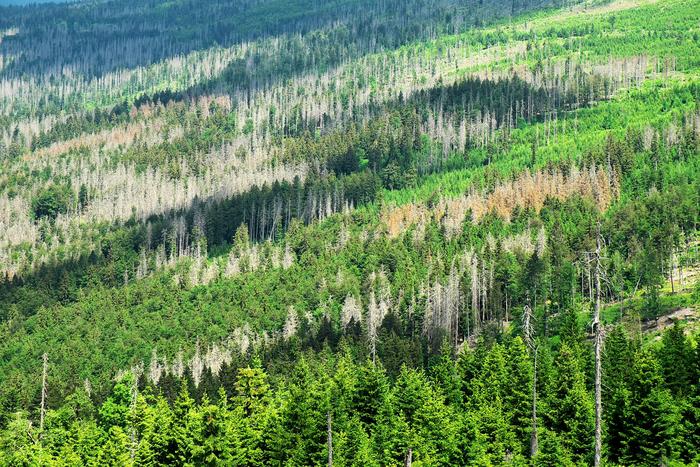
Europe’s forests have already been severely affected by climate change. Thousands of hectares of trees have already died due to drought and bark beetles. Scientists from the University of Vienna and the Technical University of Munich TUM have now investigated which trees can be used for reforestation. Their findings: only a few tree species are fit for the future, such as English oak in the UK. However, mixed forests are important for the survival of forests, otherwise the forest ecosystem as a whole could be weakened. The results of the study were recently published in the renowned journal Nature Ecology and Evolution.

Credit: Rupert Seidl
Europe’s forests have already been severely affected by climate change. Thousands of hectares of trees have already died due to drought and bark beetles. Scientists from the University of Vienna and the Technical University of Munich TUM have now investigated which trees can be used for reforestation. Their findings: only a few tree species are fit for the future, such as English oak in the UK. However, mixed forests are important for the survival of forests, otherwise the forest ecosystem as a whole could be weakened. The results of the study were recently published in the renowned journal Nature Ecology and Evolution.
Although European forests are naturally home to a mix of trees, the number of tree species is lower than in climatically comparable areas of North America or East Asia. In the future, even fewer species will be available to the forestry industry, as scientists led by Johannes Wessely and Stefan Dullinger from the University of Vienna have shown in their new study. Depending on the region, between a third and a half of the tree species found there today will no longer be able to cope with future conditions. “This is an enormous decline,” says lead author Johannes Wessely, “especially when you consider that only some of the species are of interest for forestry”.
The scientists examined the 69 more common of the just over 100 European tree species with regard to the 21st century in Europe. On average, only nine of these 69 species per location are fit for the future in Europe, compared to four in the UK. “Trees that are planted now for reforestation must survive under both current and future conditions. This is difficult because they have to withstand the cold and frost of the next few years as well as a much warmer climate at the end of the 21st century. There is only a very small overlap,” says Wessely. In the UK, these climate-fit species include, for example, the English oak. Which tree species will suit which region of Europe in the future varies greatly overall.
Forest ecosystem at risk due to restriction of species
However, even with the selected set of future-proof trees, a major problem remains: the average of nine species is not enough for a species-rich mixed forest. “Mixed forests consisting of many tree species are an important measure to make forests more robust against disturbances such as bark beetles. In some places in Europe, however, we could run out of tree species to establish such colorful mixed forests,” explains last author Rupert Seidl from the Technical University of Munich TUM.
Not all trees offer important properties
Trees store carbon, provide a habitat or food source for animals or can be processed into timber – these are all important properties of forests. But not all trees fulfill these functions equally; only an average of three of the nine climate-fit tree species can do this.
“Our work clearly shows how severely the vitality of forests is affected by climate change. We cannot rely solely on a new mix of tree species; rapid measures to mitigate climate change are essential for the sustainable protection of our forests,” says Wessely.
More information on current research at the University of Vienna can be found in the University of Vienna’s science magazine Rudolphina in the section Nature, Climate and the Cosmos.
Journal
Nature Ecology & Evolution
Article Title
A climate-induced tree species bottleneck for forest management in Europe.
Article Publication Date
29-Apr-2024
Cite Scienmag News
Sloane Callahan. (April 29, 2024). How can forests be reforested in a climate-friendly way? Scienmag. https://scienmag.com/how-can-forests-be-reforested-in-a-climate-friendly-way/
Sloane Callahan. "How can forests be reforested in a climate-friendly way?" Scienmag, 29 April 2024, https://scienmag.com/how-can-forests-be-reforested-in-a-climate-friendly-way/. Accessed 3 September 2026.
Sloane Callahan. "How can forests be reforested in a climate-friendly way?" Scienmag. April 29, 2024. https://scienmag.com/how-can-forests-be-reforested-in-a-climate-friendly-way/

