


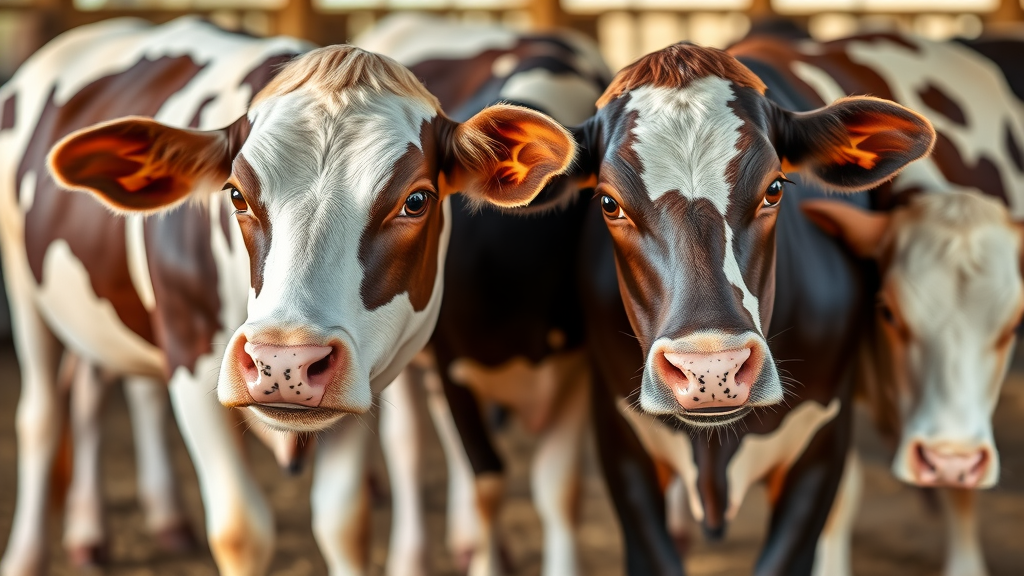
Across the tropical dairy belts of Brazil, one particular cow has quietly become the backbone of the national milk supply. Known as the F1 Holstein × Gyr, a first-generation cross between the high-yielding European Holstein and the heat-hardy Indian Gyr zebu, it belongs to the broader Girolando synthetic breed that now accounts for more than 70 percent of the milk produced in Brazil. Yet despite its economic dominance, the fundamental biology of this animal—how it partitions energy between milk, body tissue, heat, and methane over the course of a full lactation—has remained remarkably poorly documented. A new study published in Discover Agriculture now provides the most complete longitudinal picture to date, tracking twenty-nine primiparous F1 Holstein × Gyr cows through 294 days of milk production and mapping, day by day and stage by stage, where every megajoule of feed energy actually goes.
The research, led by Camila S. da Silva of Embrapa Mid-North together with colleagues at Embrapa Dairy Cattle in Minas Gerais, Michigan State University, and the Federal University of Minas Gerais, was conducted at the Multi-User Laboratory of Livestock Bioefficiency and Sustainability in Coronel Pacheco, a humid subtropical site in the heart of Brazilian dairy country. The heifers entered the trial at roughly two and a half years of age with an average body weight of 563 kilograms. None were inseminated during the study, a deliberate design choice that removed pregnancy as a confounding factor and allowed the researchers to isolate how lactation itself reshapes the animal’s energy economy. The cows were housed in a free-stall barn equipped with electronic feed bins and automated weighing platforms, so that every kilogram of feed consumed and every fluctuation in body weight was captured in real time.
The animals received a total mixed ration based on corn silage, chopped hay, soybean meal, ground corn, urea, and minerals, reformulated at each of three lactation stages so that the roughage-to-concentrate ratio shifted from 62:38 in early lactation to 81:19 by late lactation. The diet supplied on average 18.41 megajoules of gross energy per kilogram of dry matter. Measuring what happened to that energy required an unusually demanding experimental battery: six total-tract digestibility trials, in which feces were collected completely over five consecutive days and urine was sampled by spot collections; and respirometry sessions in open-circuit respiration chambers, where cows spent 22-hour periods under thermoneutral conditions while oxygen consumption, carbon dioxide production, and methane output were quantified. From these measurements the team calculated digestible energy intake, metabolizable energy intake, heat production, and ultimately the full energy balance of each cow.
The headline finding is that these animals are, metabolically speaking, unusually comfortable dairy cows. Milk yield averaged 16.1 kilograms per day, with fat-corrected yield at 18.4 kilograms, moderate figures by Holstein standards but achieved with striking stability. Dry matter intake held nearly flat across the lactation, drifting only from 15.7 kilograms per day in early lactation to 14.7 in late lactation. Digestible and metabolizable energy intakes likewise barely moved, hovering near 180 and 150 megajoules per day respectively. In contrast to the dramatic metabolic rollercoaster familiar from high-producing Holsteins, the F1 crossbreds simply never fell into a deep or prolonged energy deficit. Their energy balance dipped to only about −12.9 megajoules per day in the earliest stage and turned positive, reaching +8.8 megajoules per day, once cows reached mid-lactation.
That short negative phase is arguably the study’s most consequential result. In purebred Holsteins selected for extreme yields, the weeks after calving typically bring a punishing gap between the energy poured into milk and the energy the cow can physically consume, forcing the animal to mobilize body reserves and predisposing her to ketosis, impaired fertility, and other transition disorders. The F1 cows in this study resolved their negative balance within roughly two to three weeks postpartum. The authors attribute this resilience to the combination of moderate milk output, stable intake, and a genetic predisposition toward fat storage inherited partly from the zebu side. Bos indicus cattle and their crosses deposit proportionally more subcutaneous fat, whereas Holsteins accumulate visceral fat and channel nutrients preferentially into the mammary gland, leaving pure Holsteins metabolically far more vulnerable in early lactation.
Body condition data reinforced this picture. The cows averaged a body condition score of 3.7 on the five-point scale just two weeks after calving, climbed to 4.2 by fifteen weeks, and settled at 4.4 by week twenty-eight—a whole-lactation average of 4.1. Body weight rose steadily from around 592 kilograms in early lactation to 695 kilograms in late lactation, with the animals reaching about 726 kilograms at forty-two weeks in milk. Because the heifers had calved at roughly 78 percent of their hypothetical mature weight at thirty months, the researchers conclude that these animals grew faster than the average Brazilian Girolando herd, likely reflecting the standardized genetics and intensive rearing nutrition applied from calfhood onward. Still growing while lactating, they were effectively funding two demanding biological projects simultaneously without apparent metabolic strain.
The partitioning of dietary energy reveals where the calories went. Heat production was the single largest expenditure, consuming 34.1 percent of gross energy intake, with cows losing between 96.1 and 89.0 megajoules per day as heat across the three stages. Fecal energy losses came a close second at 33.2 percent, a figure that reflects the substantial roughage content of the rations, while urinary losses remained a minor and remarkably constant 3.4 megajoules per day. Energy retained in milk accounted for 20 percent of gross intake, declining from 61.2 megajoules per day in early lactation to 46.0 in late lactation as milk yield fell. Notably, and counter to what has been reported for Holsteins, both heat and methane losses declined rather than rose from early to late lactation in these crossbreds, most likely because energy intake itself tapered alongside the falling concentrate proportion of the diet.
The methane numbers carry implications well beyond cattle nutrition. Enteric methane represented 7.6 percent of gross energy intake—a methane conversion factor about one percentage point above the 6.5 percent default that the Intergovernmental Panel on Climate Change assigns to cattle and buffalo. In absolute terms, methane energy losses fell from 22.8 megajoules per day in early lactation to 18.6 in late lactation. The authors urge caution in generalizing the figure, since fiber fractions and feeding level strongly influence rumen passage rate and thus methanogenesis, and their diets contained only about half the concentrate of some comparison studies. Indeed, crossbred cows in comparable trials lost more energy as methane than Holsteins or Jerseys on high-concentrate rations. Still, with livestock methane under intensifying scrutiny as a greenhouse gas, the data identify a concrete research target: understanding and mitigating methane conversion in F1 and other Girolando compositions under tropical feeding systems.
Milk composition adds another dimension to the crossbred’s commercial case. The cows produced milk with an average fat content of 4.66 percent and protein of 3.57 percent, sitting at the upper end of published ranges for Girolando animals and above the breed averages of roughly 3.9 and 3.3 percent. Since pure Holsteins typically produce a larger but skimmer volume, the solids-rich F1 milk can counterbalance the yield gap, particularly attractive for producers diversifying into cheese and other dairy products. Feed efficiency told a similar intermediate story: cows converted each kilogram of dry matter into 1.16 kilograms of milk in early lactation, declining to 0.93 by late lactation, with an overall lactation figure near 1.05—better than Gyr, below elite Holstein, and potentially convergent with both when nutrient availability is not limiting.
Taken together, the study delivers a persuasive argument that F1 Holstein × Gyr cows are a viable and physiologically sustainable option for confined tropical milk production, combining heat tolerance and intake stability with acceptable yields and unusually gentle metabolic transitions. The authors are careful to note the caveats: the favorable energy balance reflects not only genotype but also excellent nutrition and a comparatively late age at first calving, and the pronounced tendency toward over-conditioning in mid-to-late lactation demands careful dietary energy control before subsequent calvings. They also emphasize that comparable measurements under grazing conditions—where most tropical F1 cows actually live—are essential next steps. But as a metabolic portrait of the cow that milks Brazil, the data finally fill in the energy ledger, showing precisely how a hybrid animal manages to give milk, gain weight, stay cool, and recover from calving faster than either of its parent breeds could alone.
Subject of Research: Energy metabolism and partitioning in primiparous F1 Holstein × Gyr dairy cows throughout lactation
Article Title: Unveiling the energy metabolism of primiparous F1 Holstein × Gyr cows throughout lactation
Article References: da Silva, C. S., Rodrigues, J. P. P., Sacramento, J. P., Coelho, S. G., & Campos, M. M. (2026). Unveiling the energy metabolism of primiparous F1 Holstein × Gyr cows throughout lactation. Discover Agriculture, 4(1), Article 296. https://doi.org/10.1007/s44279-026-00774-2
Image Credits: AI Generated
DOI: 10.1007/s44279-026-00774-2
Keywords: dairy cattle, Holstein, Gyr, Girolando, energy metabolism, lactation, tropical agriculture, methane emissions, body condition, feed efficiency, crossbreeding, respirometry
Cite Scienmag News
Alan Morgan. (September 25, 2026). How Brazil’s Heat-Proof Hybrid Dairy Cows Spend Their Energy Across a Full Lactation. Scienmag. https://scienmag.com/how-brazils-heat-proof-hybrid-dairy-cows-spend-their-energy-across-a-full-lactation/
Alan Morgan. "How Brazil’s Heat-Proof Hybrid Dairy Cows Spend Their Energy Across a Full Lactation." Scienmag, 25 September 2026, https://scienmag.com/how-brazils-heat-proof-hybrid-dairy-cows-spend-their-energy-across-a-full-lactation/. Accessed 4 October 2026.
Alan Morgan. "How Brazil’s Heat-Proof Hybrid Dairy Cows Spend Their Energy Across a Full Lactation." Scienmag. September 25, 2026. https://scienmag.com/how-brazils-heat-proof-hybrid-dairy-cows-spend-their-energy-across-a-full-lactation/


