


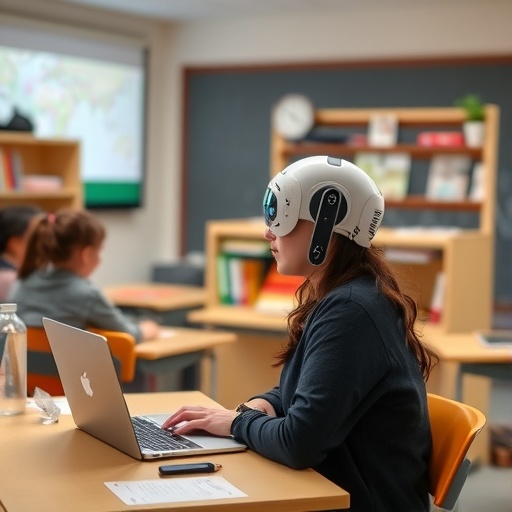
Artificial intelligence (AI) is rapidly transforming the educational landscape across the United States, ushering in a new era of digital innovation in classrooms. Major tech giants like Google and Microsoft have recently committed substantial investments to train educators in AI technologies, signaling a significant shift towards integrating AI tools into everyday teaching practices. These investments aim to equip teachers with the necessary skills to leverage AI in supporting student learning. However, this technological wave is eliciting mixed reactions among educators whose day-to-day work is being reshaped by these advances.
Katie Davis, a professor at the University of Washington’s Information School and co-director of the Center for Digital Youth, offers a nuanced perspective on how AI adoption is unfolding in educational contexts. Drawing on over two decades of teaching experience, Davis highlights the cyclical nature of technological promises in education—how each new innovation arrives with expectations that often remain unmet. From radios to computers and now AI, these tools have sparked hopes for revolutionary improvements, yet the reality frequently involves complexities that dampen the initial optimism.
Davis and her University of Washington research team undertook an in-depth qualitative study of teachers in the Aurora Public Schools district of Colorado, which is aggressively deploying AI platforms like Google’s Gemini and MagicSchool, an AI-enabled lesson planning assistant. Their findings reveal a broad sense of ambivalence among educators towards AI. Teachers appreciate AI’s capacity to reduce workload, especially for monotonous or administrative tasks, but many express concern about the potential degradation of the relational and social dynamics fundamental to effective teaching.
The research, presented at the ACM Conference on Human Factors in Computing Systems in Barcelona, illustrates how AI’s role in education is anything but straightforward. Teachers are embracing AI primarily as a tool to combat professional burnout, which has become a significant concern due to rising demands for educators to address both the academic and emotional needs of their students. AI functions as a collaborative partner, aiding in brainstorming creative lesson plans, generating assessments, and customizing instruction to diverse student needs, allowing educators to focus more on higher-level engagement.
A striking example of AI’s practical application in Aurora involves multilingual support, crucial given the district’s linguistic diversity with over 160 languages spoken by students. Teachers who speak only English rely on AI to translate instructional materials and communicate effectively with families, thus bridging critical gaps and fostering inclusivity. This capability underscores the transformative potential of AI in addressing unique classroom challenges that conventional approaches often cannot adequately meet.
Despite these advantages, Davis emphasizes the importance of systemic support for AI integration. Aurora’s proactive stance—through professional development and fostering collaborative teacher communities—has been pivotal in helping educators navigate AI adoption constructively. Such institutional backing contrasts sharply with under-resourced schools, where AI either remains blocked or used informally, potentially exacerbating existing educational disparities rather than alleviating them.
The paradoxical nature of AI as both a democratizing force and a driver of inequality is a critical theme in Davis’s findings. Echoing recent industry reports, higher-income groups tend to harness AI technology more effectively, widening socioeconomic divides. In educational settings, this translates to richer schools providing structured AI literacy and ethical training, while poorer schools may lack such guidance, leaving students to rely on AI without meaningful context or adult oversight. This discrepancy threatens to deepen existing inequalities in educational outcomes and technological fluency.
An additional layer of complexity concerns educators’ perceptions of using AI as part of their professional identity. Teachers express anxiety about being viewed as less authentic or even “cheating” if their use of AI tools becomes apparent to students and parents. This stigma reflects broader societal uncertainties surrounding AI—a tension between embracing AI’s benefits and fearing it may supplant foundational human skills and judgment. For teachers, this raises profound questions about the boundaries between augmentation and replacement in their professional practice.
Addressing these challenges requires a fundamental cultural shift in how schools approach AI. Davis advocates for open dialogue rather than concealment, encouraging schools to foster communities of practice where AI can be discussed candidly among educators and students. Such conversations are vital to demystify AI, combat stigma, and explore collaborative possibilities while grounding technological adoption in ethical and pedagogical considerations.
Sustainable professional development is also crucial. One-off seminars or presentations do little to translate AI tools into meaningful classroom impact. Instead, ongoing training that connects AI’s capabilities to the specific realities and needs faced by educators can empower them to harness technology effectively and responsibly. Leadership clarity on AI policy is equally important, providing concrete guidelines to teachers on appropriate AI use, thereby reducing uncertainty and resistance.
Central to Davis’s concerns is the inherently relational nature of teaching and learning. AI’s promise as a personal tutor or teaching assistant, as envisioned by tech leaders, risks overshadowing the indispensable human elements driving education. Learning thrives on dialogue, culture, and social interaction. If AI technologies inadvertently diminish these interactions, they could undermine the very essence of education—relationship-building and social participation that nurture critical thinking and holistic development.
While AI undoubtedly presents opportunities to reimagine and potentially improve educational practice, its integration demands careful, thoughtful stewardship. Research led by Davis and her collaborators—including doctoral students and scholars from multiple institutions—sheds light on the complex realities educators face as they incorporate AI. Supported by prestigious grants and interdisciplinary expertise, their work calls for policies and practices that balance innovation with equitable access, teacher agency, and the preservation of education’s social fabric.
As AI becomes an increasingly ubiquitous presence in classrooms, understanding how teachers negotiate this technology’s roles holds vital implications for shaping the future of education. By amplifying the positive impacts of AI and mitigating unintended consequences, schools can ensure that the digital classroom remains a space where technology supplements rather than supplants the irreplaceable human connection at the heart of learning.
News Publication Date: 13-Apr-2026
Web References: http://dx.doi.org/10.1145/3772318.3791904
References: Presented at the ACM Conference on Human Factors in Computing Systems, Barcelona, 2026
Cite Scienmag News
Courtney Benton. (May 5, 2026). How Are Educators Integrating AI into the Classroom? Scienmag. https://scienmag.com/how-are-educators-integrating-ai-into-the-classroom/
Courtney Benton. "How Are Educators Integrating AI into the Classroom?" Scienmag, 5 May 2026, https://scienmag.com/how-are-educators-integrating-ai-into-the-classroom/. Accessed 7 September 2026.
Courtney Benton. "How Are Educators Integrating AI into the Classroom?" Scienmag. May 5, 2026. https://scienmag.com/how-are-educators-integrating-ai-into-the-classroom/


