The pupil is one of the most honest structures in the human body. It dilates in darkness, constricts in brightness, and does so through an autonomic reflex arc that operates entirely outside conscious control. For decades, neuroscientists have exploited this involuntary behavior, known as the pupillary light reflex, or PLR, to probe the integrity of the retina, the optic nerve, the brainstem, and the broader arousal systems of the central nervous system. Now, a team of researchers in Peru and the United States has turned this humble physiological signal toward one of the most pressing problems in developmental medicine: the early detection of autism spectrum disorder. In a pilot proof-of-concept study published in the Journal of Autism and Developmental Disorders, the team reports that children with autism show a measurably different pupillary response to light than their typically developing peers, and that a simple statistical model built on those differences can separate the two groups with striking accuracy, at least within the sample studied.
The clinical backdrop explains why the work matters. Autism spectrum disorder affects a substantial and growing share of children worldwide, yet the gold-standard diagnostic pathway still depends on behavioral observation and caregiver interviews, most notably instruments such as the Modified Checklist for Autism in Toddlers, or M-CHAT, and the Autism Diagnostic Observation Schedule-2, known as ADOS-2. These tools are effective in trained hands, but they are slow, expensive, and heavily dependent on the child’s willingness and ability to cooperate, something that is notoriously difficult in toddlers, the very age group in which early intervention delivers its greatest benefit. In resource-limited settings, where specialist clinicians are scarce and waiting lists stretch for years, many children reach school age without ever receiving a formal diagnosis. The research team, led by Juan Flores and Andrea E. Montero of Universidad Peruana Cayetano Heredia in Lima, together with collaborators at Johns Hopkins Bloomberg School of Public Health, Yale Child Study Center, and other institutions, set out to test whether a biological measurement that requires almost nothing from the child could help close that gap.
Their approach rests on a well-established body of prior evidence. Earlier studies had already reported atypical PLR characteristics in individuals with autism, including abnormal transient pupillary responses documented as far back as 2009, and enhanced pupillary light reflex in infants who were later diagnosed with autism in toddlerhood, a finding reported in Nature Communications in 2018. A systematic review and meta-analysis published in 2021 concluded that pupillometry shows consistent group differences between autistic and non-autistic individuals, though with heterogeneous methods across studies. What remained missing was a practical, low-cost pipeline that could capture and quantify the reflex in very young children using nothing more exotic than a video camera and careful image processing, and then test whether the resulting numbers could discriminate diagnosed children from typically developing ones in a real clinical screening context.
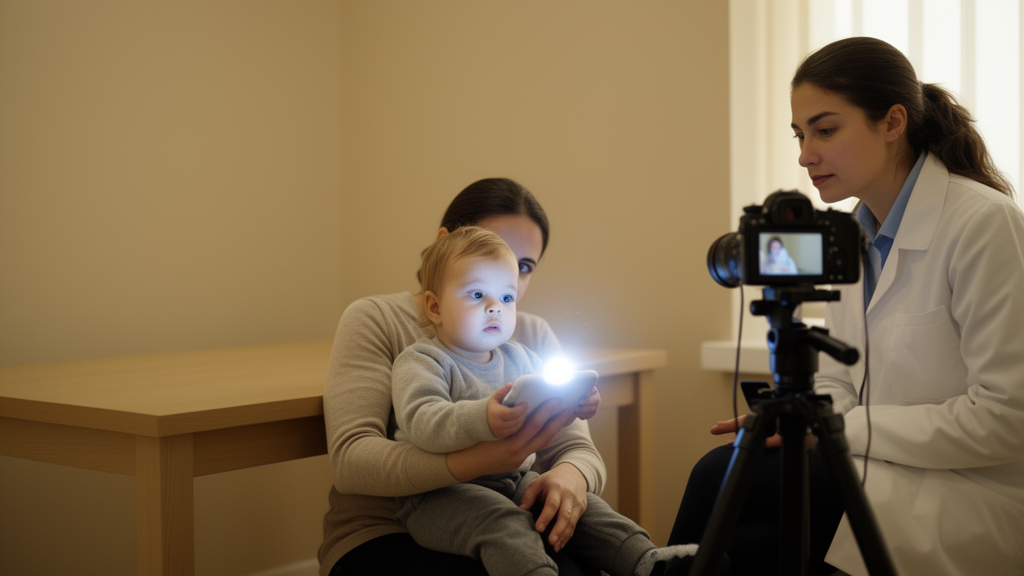
The study enrolled 30 children between the ages of two and five: 14 with a confirmed diagnosis of autism spectrum disorder, three of them girls, and 16 typically developing peers, ten of them girls. The diagnoses were not taken at face value. Each child in the autism group was evaluated with the M-CHAT screening questionnaire and the ADOS-2, the observational assessment widely regarded as a clinical reference standard, to confirm that the classification was sound. The pupillary testing itself was deliberately minimal. Researchers recorded five-second videos of each child’s eyes while delivering a controlled light stimulus, a protocol short enough that even a restless toddler could tolerate it. From those recordings, the team extracted three quantitative features of the reflex: the degree of pupillary constriction, meaning how much the pupil shrank in response to the light; the latency, meaning how long it took for constriction to begin; and the time to maximum contraction, meaning how quickly the pupil reached its tightest point.
The image-processing pipeline behind those measurements is where the engineering becomes interesting. Extracting a reliable pupil diameter from video frames of a moving child’s face is a nontrivial computer vision problem. The researchers drew on classical techniques that are foundational to the field, including the Canny edge detection algorithm for locating boundaries in each frame, direct least-squares ellipse fitting for modeling the pupil’s shape, the Viola-Jones cascade framework for detecting facial regions, and RANSAC-based robust model fitting to reject outlier measurements caused by blinks, head movements, or partial occlusion. Signal-processing steps, including Savitzky-Golay smoothing of the diameter time series, cleaned up the raw traces before the characteristic parameters of the reflex were computed. The result is a system that converts a short video clip into a compact set of numbers describing the dynamics of an involuntary neural reflex, without requiring any specialized pupillometer hardware beyond a camera and a light source.
The headline result concerns the degree of constriction. Children with autism showed a significantly greater degree of pupillary constriction in response to the light stimulus than their typically developing peers, a difference that reached statistical significance in the quantitative analysis. The other two features, latency and time to maximum contraction, were shorter in the autism group on average, but these differences rose only to the level of statistical trends rather than definitive effects. The direction of the finding is consistent with prior work suggesting enhanced or exaggerated pupillary light responses in autistic children, which some investigators have linked to atypical functioning of the locus coeruleus-norepinephrine system, the brain’s principal arousal circuitry. If the pupil of a child with autism clamps down harder and faster under the same light, that overshoot may reflect a nervous system tuned differently, and potentially measurable, long before behavioral symptoms can be reliably scored by a clinician.
To test whether those differences could translate into an actual screening decision, the team built an exploratory logistic regression model using the pupillary features as predictors of diagnostic status. The in-sample performance was remarkable: the model achieved a sensitivity of 93 percent, meaning it correctly identified nearly all of the children with autism, and a specificity of 86 percent, meaning it correctly cleared most of the typically developing children. The area under the receiver operating characteristic curve, a standard summary of discriminative power that ranges from 0.5, equivalent to a coin flip, to 1.0, perfect classification, came in at 0.93. Those are numbers that, if they held up in the real world, would place pupillometry among the more accurate screening tools available for early autism detection.
But the authors are careful, and rightly so, about what those numbers do and do not mean. The performance estimates were obtained without external validation or cross-validation, meaning the model was evaluated on the same 30 children from which it was built. In machine learning terms, the model may be overfitted to this particular sample, and its true performance on new, unseen children from different populations could be considerably lower. The sample was also small, with only 14 autistic children, and skewed toward girls in the typically developing group, which limits how broadly the findings can be generalized. These caveats do not undermine the proof of concept, but they mark the distance between a promising pilot and a deployable clinical tool. Larger, preregistered studies with independent validation cohorts, ideally across multiple sites and demographic groups, are the necessary next step before any claim of diagnostic utility can be made responsibly.
Even with those limitations, the practical appeal of the approach is hard to overstate. Pupillometry demands almost no cooperation from the child, unlike behavioral assessments that require sustained social engagement, which is precisely the capacity that autism affects. The equipment is inexpensive, the capture takes seconds, and the analysis can be automated, making the technique attractive for primary care clinics, community health posts, and low-resource settings where traditional diagnostic facilities are scarce. The researchers frame it as a complement to, not a replacement for, comprehensive clinical evaluation: a fast, objective first filter that could flag children who need full diagnostic workup, shortening the path from first concern to intervention during the developmental window when therapy has the greatest impact. For a condition in which every month of delayed diagnosis matters, a five-second video of a toddler’s eye responding to a flash of light is an unusually elegant place to start.
Subject of Research: Pupillary light reflex measurement as a potential biological screening tool for autism spectrum disorder in young children
Article Title: Analysis of the Pupillary Light Reflex Response Against Light Stimuli for Autism Screening in Children
Article References: Flores, J., Montero, A. E., Barrientos, F., Zavaleta, R., Dioses, A., Noazin, S., Powers, M., Gilman, R. H., Roman-Gonzalez, A., & Zimic, M. (2026). Analysis of the Pupillary Light Reflex Response Against Light Stimuli for Autism Screening in Children. Journal of Autism and Developmental Disorders. https://doi.org/10.1007/s10803-026-07501-2
Image Credits: AI Generated
DOI: 10.1007/s10803-026-07501-2
Keywords: autism spectrum disorder, pupillometry, pupillary light reflex, early screening, M-CHAT, ADOS-2, toddlers, logistic regression, biomarkers, computer vision, locus coeruleus, resource-limited settings
Cite Scienmag News
Ophelia Keating. (October 16, 2026). How a Five-Second Flash of Light Could Help Screen Toddlers for Autism. Scienmag. https://scienmag.com/how-a-five-second-flash-of-light-could-help-screen-toddlers-for-autism/
Ophelia Keating. "How a Five-Second Flash of Light Could Help Screen Toddlers for Autism." Scienmag, 16 October 2026, https://scienmag.com/how-a-five-second-flash-of-light-could-help-screen-toddlers-for-autism/. Accessed 16 October 2026.
Ophelia Keating. "How a Five-Second Flash of Light Could Help Screen Toddlers for Autism." Scienmag. October 16, 2026. https://scienmag.com/how-a-five-second-flash-of-light-could-help-screen-toddlers-for-autism/