


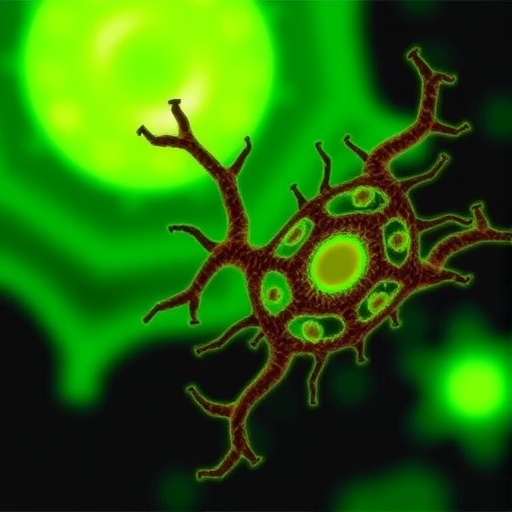
In a groundbreaking exploration into the evolutionary origins of plant cells, researchers have uncovered new evidence revealing how certain unicellular predators maintain chloroplasts stolen from their algal prey. This discovery provides unprecedented insight into the intricate relationship between host organisms and incorporated foreign organelles, deepening our comprehension of a process that began billions of years ago and fundamentally shaped life on Earth.
Chloroplasts, the essential organelles responsible for photosynthesis in plants and algae, were once free-living bacteria. Their transition from independent organisms to integrated parts of complex eukaryotic cells marked a pivotal evolutionary event. Unraveling how this symbiosis initially formed remains a central question for biologists studying cellular evolution. The tiny predator Rapaza viridis, a single-celled protist, sheds light on this evolutionary mystery by demonstrating a remarkable form of biological integration known as kleptoplasty, where chloroplasts are retained after consuming green algal cells.
Unlike typical kleptoplastidy, where the engulfed chloroplast functions temporarily but independently, Rapaza viridis exhibits an advanced level of molecular chimerism. This means that beyond merely hijacking organelles, the host cell actively produces proteins from its own genome, transports these proteins into the stolen chloroplast, and sustains key chloroplast machinery. Such integration blurs the boundary between prey and host, providing a fascinating model that mirrors the early steps of endosymbiotic evolution.
The study’s research team, led by Masami Nakazawa at Osaka Metropolitan University and Yuichiro Kashiyama at Fukui University of Technology, utilized a combination of genetic engineering tools and biochemical assays to probe this host-organelle relationship. Through meticulous experimentation, they identified numerous host-encoded proteins localized within the kleptoplast, crucially involved in maintaining photosynthetic functionality. Disruption of genes encoding these proteins resulted in diminished chloroplast performance, underscoring their vital role.
This discovery challenges the previously held notion that kleptoplasty is solely a form of temporary organelle acquisition with limited integration. Instead, Rapaza viridis demonstrates that molecular crosstalk and protein import from the host’s nucleus can occur, representing a sophisticated evolutionary strategy to enhance organelle function and longevity. These findings open new avenues for understanding the evolution of permanent endosymbiotic organelles like chloroplasts.
Structurally, Rapaza viridis exhibits a temporary coexistence of prey-derived chloroplasts alongside its own cellular components, a condition described as structural-level chimerism. However, the molecular data reveal a deeper, functional fusion at the biochemical level, a transient molecular chimera. This condition signifies a critical evolutionary intermediate that captures how ancient eukaryotes might have transitioned from loose organelle retention to stable endosymbiosis.
Professor Kashiyama emphasizes the uniqueness of this organism as the first known to biochemically demonstrate host-produced proteins functioning within stolen organelles from a foreign species. Such a mechanism illustrates how evolutionary pressures fostered increasing complexity in cellular partnerships. The implication is profound, as it suggests that even transient organelle retention can involve extensive molecular integration, challenging simplistic views of organelle acquisition.
Dr. Nakazawa highlights that these insights into Rapaza viridis offer a compelling experimental system that models early plant cell evolution. By probing the interactions between host and kleptoplast at a molecular level, scientists can glean clues about how ancestral eukaryotes began harnessing foreign organelles to their advantage, a process that ultimately gave rise to modern photosynthetic life forms.
Beyond evolutionary implications, this research also holds potential for synthetic biology and biotechnology. Understanding how host cells manage imported organelles and maintain their functions could inspire novel approaches to cellular engineering, enabling the design of cells with customized metabolic capabilities or improved photosynthetic efficiency.
The research was meticulously detailed in the journal Nature Communications, outlining comprehensive genetic analyses and experimental validations that underpin the reported phenomena. This work signifies a leap in our grasp of cellular symbioses and sets the stage for future investigations into organelle acquisition and maintenance.
The trajectory of this research aligns with a growing interest in studying non-model organisms that defy conventional frameworks. Rapaza viridis represents a living window into evolutionary processes often hidden from view in more derived lineages, emphasizing the value of exploring biological diversity to understand life’s origins.
As the scientific community continues to investigate the mechanisms underpinning endosymbiotic events, studies like this underscore the importance of interdisciplinary approaches combining genetics, cell biology, and evolutionary theory. The ability of cells to exploit foreign organelles through transient molecular chimerism may reveal principles applicable across a wide range of biological contexts.
In essence, this research not only revisits a fundamental chapter in life’s history but also challenges us to rethink how cellular identity and cooperation evolve. The fusion of genetic and biochemical integration in Rapaza viridis exemplifies nature’s ingenuity and provides a captivating glimpse into the evolutionary dance that forged the plant kingdom.
Cite Scienmag News
Gavin Prescott. (March 25, 2026). Host-Produced Proteins Sustain Stolen Chloroplasts, Shedding Light on the Origins of Plant Cells. Scienmag. https://scienmag.com/host-produced-proteins-sustain-stolen-chloroplasts-shedding-light-on-the-origins-of-plant-cells/
Gavin Prescott. "Host-Produced Proteins Sustain Stolen Chloroplasts, Shedding Light on the Origins of Plant Cells." Scienmag, 25 March 2026, https://scienmag.com/host-produced-proteins-sustain-stolen-chloroplasts-shedding-light-on-the-origins-of-plant-cells/. Accessed 3 September 2026.
Gavin Prescott. "Host-Produced Proteins Sustain Stolen Chloroplasts, Shedding Light on the Origins of Plant Cells." Scienmag. March 25, 2026. https://scienmag.com/host-produced-proteins-sustain-stolen-chloroplasts-shedding-light-on-the-origins-of-plant-cells/


