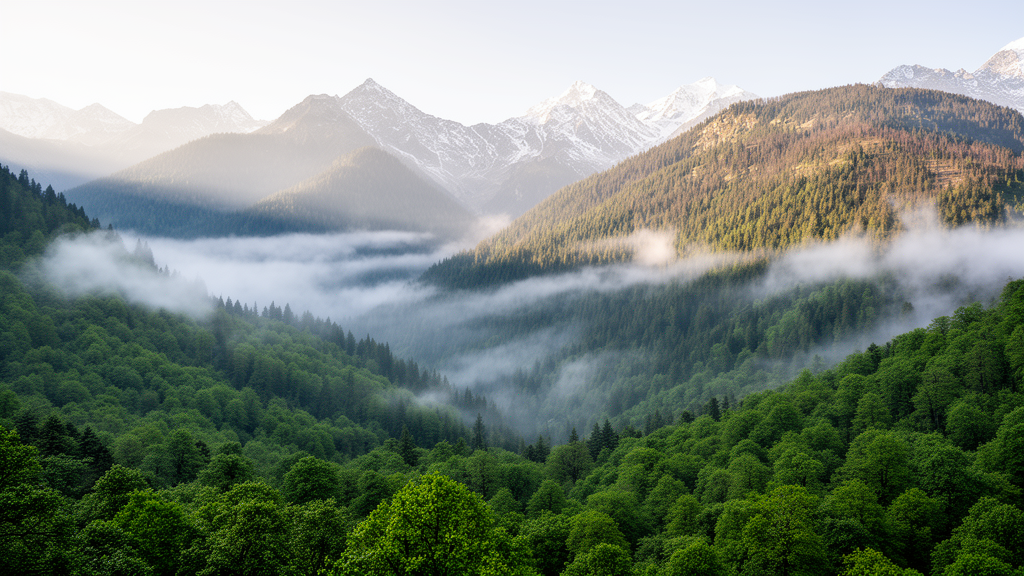
Forests along an altitude gradient in India’s Garhwal Himalaya divide the work of carbon storage in a strikingly predictable way: high-elevation conifer stands dominated by deodar accumulate the most carbon in tree biomass, while species-rich mixed broadleaf forests at lower elevations lock the most carbon into the soil. That is the central finding of a new field study published in the journal Carbon Research, which quantified both vegetation and soil carbon pools across nine forest sites in Tehri Garhwal district, Uttarakhand, spanning elevations from 500 to 2300 metres above sea level.
The research team, led by Arvind Singh and Vinod Prasad Khanduri with senior author R. K. Chaturvedi, sampled three contrasting forest types, each at three elevation sub-sites. Deodar forests, dominated by Cedrus deodara, occupied sites between 1900 and 2300 metres. Pine forests, composed almost entirely of Pinus roxburghii, ranged from 1550 to 1950 metres. Mixed broadleaf forests sat lowest on the gradient, between 500 and 1000 metres. At every site the researchers laid out ten quadrats of 10 by 10 metres, producing 90 quadrats in total, and collected soil samples from two depths, 0 to 15 centimetres and 15 to 30 centimetres, yielding 180 soil samples for laboratory analysis.
The headline numbers are substantial. Deodar forests recorded the highest total carbon density in vegetation, ranging from 230.85 to 274.85 megagrams of carbon per hectare, with the peak value of 274.85 measured at the Thangdhar site between 2100 and 2200 metres. There, aboveground biomass density reached 448.04 megagrams per hectare and belowground biomass 101.66 megagrams per hectare. Pine forests, by comparison, stored markedly less in trees, with total carbon densities between 106.81 and 123.85 megagrams per hectare, peaking at Chamba. Mixed forests held the least biomass carbon, with the best performer, a Shorea robusta stand at Narendra Nagar, reaching a total carbon density of 57.52 megagrams per hectare.
The soil picture reversed that ranking. Mixed forests, which contained 28 tree species across their sites, showed the highest total soil organic carbon concentrations, at 13.18 plus or minus 0.30 milligrams per gram in the surface layer and 9.77 plus or minus 0.35 milligrams per gram at 15 to 30 centimetres. Pine forests recorded the lowest surface value at 9.75 plus or minus 0.67 milligrams per gram, and deodar forests the lowest at depth, 8.42 plus or minus 0.82 milligrams per gram. Mixed forests also led in the very labile carbon fraction, at 7.43 milligrams per gram in the topsoil, representing 56.37 percent of surface soil organic carbon, and in the non-labile fraction, at 2.06 milligrams per gram.
Those fractions matter because they behave differently over time. Using a modified Walkley-Black wet oxidation method with acid solutions of increasing strength, the team separated soil organic carbon into four pools of decreasing decomposability: very labile, labile, less labile, and non-labile. The labile pools turn over quickly and respond rapidly to land-use change, while the non-labile pool decomposes slowly because of its recalcitrant chemistry. Summing the first two pools gives the active carbon pool; summing the last two gives the passive pool, the reservoir of carbon that persists in soil for the long term. Mixed forests posted the largest values on both counts, with an active pool of 13.48 tonnes of carbon per hectare and a passive pool of 6.41 tonnes per hectare in the surface layer.
Statistically, the contrasts were robust. Differences in carbon storage among forest types were significant at p below 0.05 for biomass variables, tested with one-way analysis of variance, and for soil variables, tested with two-way analysis of variance using forest type and soil depth as fixed factors. Post-hoc comparisons used Duncan’s Multiple Range Test. Nearly every soil carbon measure declined significantly with depth, and the passive pool showed the clearest forest-type signal in the surface layer, with deeper layers showing no significant differences among forest types. The authors report that the passive carbon pool in mixed forests was about 35 percent greater than in deodar forests.
The mechanisms the authors propose rest on functional differences between the forest types. Deodar is a long-lived conifer with high wood density and slow turnover, traits that favour the steady accumulation of carbon in standing timber, particularly under the cooler high-elevation conditions that also slow decomposition. Mixed broadleaf forests, by contrast, produce nutrient-rich litter and fine roots that feed soil microbes and promote the conversion of labile organic inputs into mineral-associated, stable soil carbon. Their structurally complex rooting systems increase belowground inputs and strengthen organo-mineral associations. Pine forests, shaped by a fire-adapted ecology and repeated human disturbance, showed simpler stand structure and the weakest performance on both storage pathways, though the authors note their wide spatial extent still makes them regionally important.
The study’s land-cover analysis, based on a supervised maximum likelihood classification of cloud-free Landsat-8 imagery from 2022, mapped the watershed’s five cover classes and found forest vegetation covering 3015.58 square kilometres. Deodar forest occupied 33.98 percent of the study area, pine forest 30.35 percent, mixed forest 13.85 percent, and agricultural land 20.95 percent. The authors link the greater agricultural footprint and fragmentation at lower elevations to the lower biomass and soil carbon they measured there, and they argue that limiting further land-use conversion in high-carbon forest zones should be a management priority.
The authors are careful about the limits of their design. Because each forest type occupies its own natural elevation band, forest type and altitude are confounded, and differences in temperature, soil moisture, nutrient status, and decomposition rates along the gradient may have contributed to the observed patterns alongside species composition. The study cannot disentangle these effects, and the authors suggest that future work treat elevation as a covariate or use stratified sampling to separate the two influences. They also recommend longer-term monitoring to capture seasonal and interannual variation, microbial community analyses to clarify decomposition pathways, and species-specific allometric equations to sharpen biomass estimates, since the current calculations relied on generic volume equations and biomass expansion factors with a uniform 50 percent carbon fraction drawn from IPCC guidelines.
The practical message the authors draw is that the two forest types are complementary rather than competing carbon assets. Mature deodar stands function as long-term biomass reservoirs and deserve protection, particularly old-growth stands, while mixed broadleaf forests deliver the more durable soil carbon storage and should anchor restoration and afforestation programmes using native broadleaf species. They also suggest monoculture pine stands could benefit from diversification. The findings feed directly into India’s National Mission for Sustaining Himalayan Ecosystem and the country’s broader carbon sink commitments, and the authors frame the work as a template for carbon quantification in other mountain ecosystems facing warming that, in the Himalayan region, is proceeding at roughly 0.3 degrees Celsius per decade, faster than the global average.
Subject of Research: Carbon storage in biomass and soil across three Himalayan forest types along an altitude gradient
Article Title: Himalayan altitude gradient drives divergent carbon storage: conifer biomass peaks, broadleaf soils stabilize
Article References: Singh, A., Khanduri, V. P., Rawat, D., Singh, B., Riyal, M. K., Thakur, T. K., Mishra, G., Kumar, M., & Chaturvedi, R. K. (2026). Himalayan altitude gradient drives divergent carbon storage: conifer biomass peaks, broadleaf soils stabilize. Carbon Research, 5(1), Article 48. https://doi.org/10.1007/s44246-026-00287-z
Image Credits: AI Generated
DOI: 10.1007/s44246-026-00287-z
Keywords: Himalaya, carbon storage, soil organic carbon, forest biomass, Cedrus deodara, altitude gradient, Garhwal, carbon sequestration, mixed forests, Pinus roxburghii, Himalayan, altitude
Cite Scienmag News
Gavin Prescott. (October 29, 2026). Himalayan Forests Split Carbon Duties by Altitude, Study Finds. Scienmag. https://scienmag.com/himalayan-forests-split-carbon-duties-by-altitude-study-finds/
Gavin Prescott. "Himalayan Forests Split Carbon Duties by Altitude, Study Finds." Scienmag, 29 October 2026, https://scienmag.com/himalayan-forests-split-carbon-duties-by-altitude-study-finds/. Accessed 3 November 2026.
Gavin Prescott. "Himalayan Forests Split Carbon Duties by Altitude, Study Finds." Scienmag. October 29, 2026. https://scienmag.com/himalayan-forests-split-carbon-duties-by-altitude-study-finds/