


Exogenous reactive nitrogen input has a profound effect on the carbon cycle of terrestrial ecosystems. Most current research on soil organic carbon (SOC) dynamics in relation to nitrogen input has focused predominantly on the surface soil layers. However, studies limited to the surface layer cannot fully reveal the complete response of SOC to nitrogen input because approximately half of the SOC is stored in deeper soil layers. Given the unique environmental conditions of deep soils, microbial decomposition and stabilization of deep SOC may respond differently compared to surface soils. Moreover, surface-only studies have not addressed whether nitrogen input affects the vertical migration of SOC, thereby influencing the distribution of newly absorbed carbon throughout the entire soil profile. Consequently, conducting whole-profile soil studies is essential for accurately predicting SOC exchange with the atmosphere in response to nitrogen input.

Credit: Hualing HU, Liang ZHAO, Wenbing TAN , Guoan WANG, Beidou XI
Exogenous reactive nitrogen input has a profound effect on the carbon cycle of terrestrial ecosystems. Most current research on soil organic carbon (SOC) dynamics in relation to nitrogen input has focused predominantly on the surface soil layers. However, studies limited to the surface layer cannot fully reveal the complete response of SOC to nitrogen input because approximately half of the SOC is stored in deeper soil layers. Given the unique environmental conditions of deep soils, microbial decomposition and stabilization of deep SOC may respond differently compared to surface soils. Moreover, surface-only studies have not addressed whether nitrogen input affects the vertical migration of SOC, thereby influencing the distribution of newly absorbed carbon throughout the entire soil profile. Consequently, conducting whole-profile soil studies is essential for accurately predicting SOC exchange with the atmosphere in response to nitrogen input.
A research team led by Dr. Wenbing Tan from the Chinese Research Academy of Environmental Sciences conducted a long-term field experiment at an agricultural site, collecting soil samples from plots with varying nitrogen fertilizer treatments. By analyzing stable carbon isotopes, the team investigated the contributions of new versus old carbon to SOC and aimed to elucidate the role of soil depth in this context. Additionally, the team integrated physical and chemical soil properties with the vertical distribution of organic carbon and nitrogen to explore the mechanisms of SOC dynamics in response to different rates of nitrogen fertilizer application in deep soils.
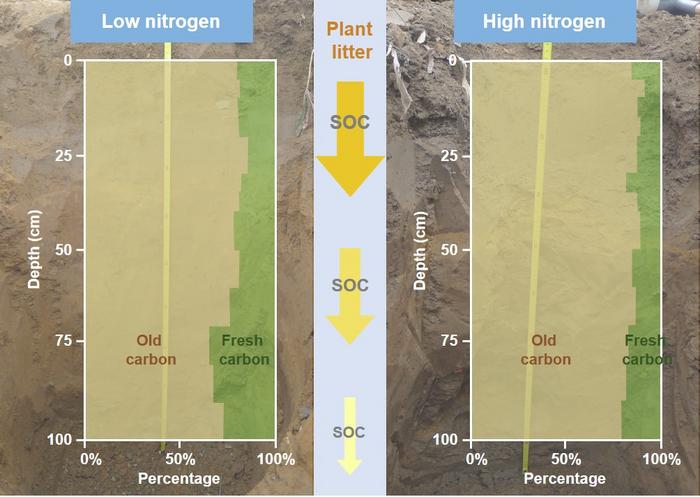
The study revealed that SOC increased significantly with nitrogen fertilizer application, with the extent of this increase depending on the amount of nitrogen applied. Compared to low nitrogen fertilizer addition, high nitrogen fertilizer application significantly enhanced SOC sequestration primarily through reduced tillage and the return of crop residues to the field. The study observed notable differences in SOC turnover rates under different nitrogen levels. Under low nitrogen conditions, the SOC turnover time in the 0–20 cm soil layer was approximately 20–40 years, whereas under high nitrogen conditions, the SOC turnover time in the 10–20 cm soil layer extended up to 100 years. High nitrogen fertilizer application mainly increased SOC sequestration by transferring organic matter from the surface to more stable deep soil layers. Due to the high turnover rate of new organic carbon in deep soils under low nitrogen conditions, the carbon sequestration capacity of SOC in deep soils was less compared to that under high nitrogen conditions.
The results support the notion that reduced microbial decomposition rates of SOC under high nitrogen input conditions are a key mechanism for enhancing soil carbon sink functions. More importantly, the research team confirmed that the increased soil carbon sink strength under high nitrogen enrichment conditions is primarily due to enhanced vertical transport of soil organic matter, leading to a greater distribution of new organic carbon in deeper soil layers. This new mechanism offers a significant explanation for the enhancement of soil carbon storage. Future research should further define the exact impact range of this new mechanism under different nitrogen application levels and explore the applicability of these findings across various terrestrial ecosystems.
This study has been published on the Journal of Frontiers of Agricultural Science and Engineering on 2024, Vol. 11, No. 2. DOI: 10.15302/J-FASE-2024565.
Journal
Frontiers of Agricultural Science and Engineering
Method of Research
Experimental study
Subject of Research
Not applicable
Article Title
Discrepant responses of soil organic carbon dynamics to nitrogen addition in different layers: a case study in an agroecosystem
Article Publication Date
17-May-2024
Cite Scienmag News
Alan Morgan. (August 8, 2024). High nitrogen input promotes the redistribution of new organic carbon to deeper soil layers. Scienmag. https://scienmag.com/high-nitrogen-input-promotes-the-redistribution-of-new-organic-carbon-to-deeper-soil-layers/
Alan Morgan. "High nitrogen input promotes the redistribution of new organic carbon to deeper soil layers." Scienmag, 8 August 2024, https://scienmag.com/high-nitrogen-input-promotes-the-redistribution-of-new-organic-carbon-to-deeper-soil-layers/. Accessed 5 September 2026.
Alan Morgan. "High nitrogen input promotes the redistribution of new organic carbon to deeper soil layers." Scienmag. August 8, 2024. https://scienmag.com/high-nitrogen-input-promotes-the-redistribution-of-new-organic-carbon-to-deeper-soil-layers/

