


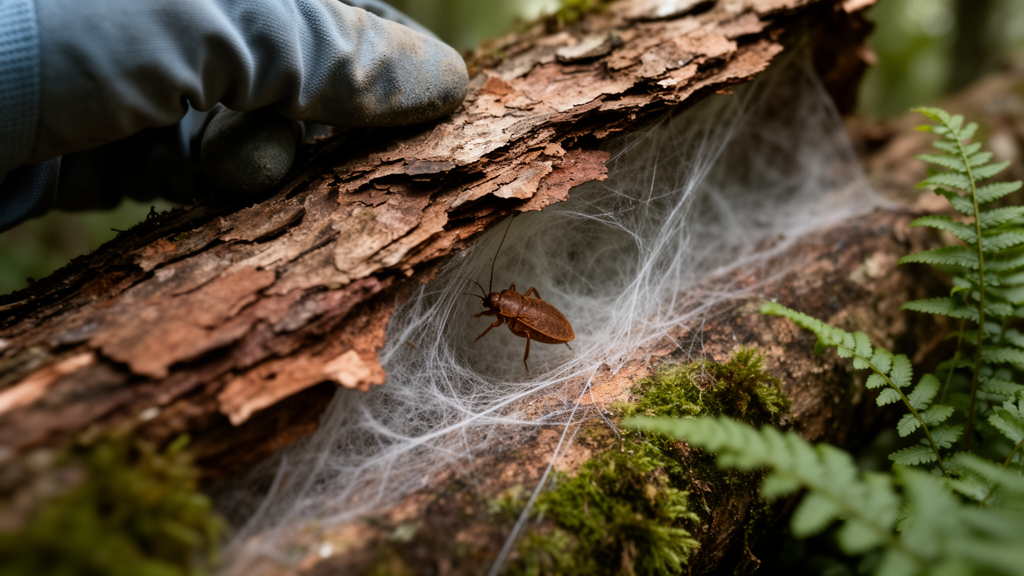
Beneath the bark, inside the cracks of tree trunks, and within the silken galleries they spin from glands on their front legs, webspinners have quietly colonized much of Mexico. A new study published in the Journal of Orthoptera Research has dramatically expanded the known range of three introduced Old-World species in the family Oligotomidae, revealing that these secretive insects are far more widespread across the country than decades of sparse records had suggested. The work, based on a review of 431 specimens held in two major Mexican insect collections, adds new state-level records for all three species of the genus Oligotoma found in the country and provides the first comprehensive identification key to the introduced webspinners of Mexico.
Webspinners, the order Embioptera, are among the most overlooked insects on Earth. Roughly 400 species have been described so far, but global estimates suggest that as many as 2,000 species may inhabit tropical and subtropical regions worldwide. These elongate, small insects, averaging about 10 millimeters in length, are instantly recognizable by one defining trait: their enlarged foretarsi, the first segment of which houses silk-producing glands whose structure and composition have remained conserved for more than 100 million years. This remarkable evolutionary stability makes webspinners a monophyletic group, one that phylogenetic and morphological studies place as the sister clade to stick insects within the broader lineage Eukinolabia.
Life as a webspinner is lived largely out of sight. Both nymphs and adults spin silken galleries in which they live, feed, and reproduce, exhibiting gregarious and subsocial behavior. Females and nymphs are wingless, while males are usually winged, though exceptions exist. Because of their small size and cryptic habits, webspinners are notoriously difficult to collect, which explains their poor representation in entomological collections and the persistent gaps in our understanding of their true distributions. Wing venation patterns and the external male genitalia remain the most reliable features for identifying families, genera, and species within the order.
In their native ranges, webspinners contribute meaningfully to soil function. They participate in organic matter decomposition and nutrient redistribution, aerate the soil through their burrowing and gallery construction, improve soil structure by enhancing aeration and water infiltration, and create microhabitats that shelter microorganisms and small invertebrates, thereby promoting biodiversity. The ecological impact of introduced species, however, remains poorly studied. Researchers suggest that non-native webspinners may compete with native detritivores for food, alter soil structure through their silk galleries, and influence food webs by serving as prey for insectivorous animals. Some species, notably Oligotoma saundersii, have established populations across the globe, demonstrating a striking adaptability and potential for further expansion.
Mexico hosts five families of webspinners: Anisembiidae, Archembiidae, Clothodidae, Teratembiidae, and Oligotomidae. The last of these is represented entirely by introduced Old-World species, including Haploembia solieri in Baja California and three species of the genus Oligotoma. Oligotoma humbertiana had been recorded in central and southwestern Mexico, Oligotoma nigra in the northwest, and Oligotoma saundersii sporadically in both northern and southern parts of the country. A phylogenetic analysis of the family supports an Asian origin for both Oligotoma and Haploembia, confirming that all Mexican oligotomids are arrivals rather than natives. The study of webspinners in Mexico has been limited by a lack of interest among entomologists, as the group holds little medical or commercial importance, and by the assumption that their apparent scarcity implies limited ecological impact.
To address these gaps, the researchers examined 431 webspinner specimens preserved in ethanol, held in the Colección Nacional de Insectos of the Instituto de Biología at the Universidad Nacional Autónoma de México and the Entomology Laboratory of the Facultad de Ciencias Forestales at the Universidad Autónoma de Nuevo León. All specimens were initially sexed based on the presence or absence of wings, then re-examined to identify potential wingless males among the wingless individuals. Adults were identified to family level, and the 166 individuals belonging to Oligotomidae were subsequently identified to species using specialized literature. Genitalia were observed with dissection tools under a stereoscope, and detailed morphological images of the head, thorax, abdomen, and genitalia were captured using multifocal photography with a ZEISS stereomicroscope and stacked digitally.
The results were striking. Oligotoma humbertiana, previously known only from Guerrero, Jalisco, and Puebla, is now newly recorded for eleven additional states: Baja California Sur, Ciudad de México, Colima, Michoacán, Morelos, Nayarit, Oaxaca, Sinaloa, Sonora, Veracruz, and Yucatán. Oligotoma nigra, previously confined to Baja California in the extreme northwest, is newly recorded for Baja California Sur, Chihuahua, and Colima. Oligotoma saundersii, previously reported only from Campeche and Puebla, is newly recorded for eight states: Coahuila, Colima, Nayarit, Nuevo León, Oaxaca, Sonora, Veracruz, and Yucatán. Taken together, these records indicate that all three introduced species now occupy broad swaths of Mexican territory, spanning both the Pacific and Gulf coasts and reaching from the northern deserts to the Yucatán Peninsula.
Distinguishing these species requires close attention to minute anatomical details. Males of Oligotoma humbertiana bear subapical spines on the exterior side of the process of the right hemitergite, a feature absent in the other two species, and the basipodite of the left cercus carries a prominent internal lobe. Oligotoma nigra males instead display a hook-shaped process on the left cercus basipodite and a hypandrium that extends into an elongated, distally truncated projection. Oligotoma saundersii males are perhaps the most distinctive, with a conspicuous sickle-shaped widened spine on the left epiproct and a spatulated right tergal process with curved sides. Females can be separated by the shape of the head, which is squared in O. nigra but longer than broad in the other two species, and by diagnostic patterns on the ventral abdominal sternites VIII and IX, which differ subtly but consistently among the three species.
The new illustrated identification key proposed in the study also includes Haploembia solieri, the only species of that genus recorded in the Western Hemisphere, whose wingless males and two-toothed mandibles immediately separate it from the winged males of Oligotoma. The key relies on characters of the mandibles, the number of ventral papillae on the hind basitarsi, and the detailed morphology of male terminalia and female sternites, providing researchers and collectors with a practical tool for identifying introduced webspinners throughout Mexico and potentially beyond.
One of the most intriguing questions raised by the study is whether these new records reflect recent colonization over the last four decades or whether the species were already widespread by the 1980s, with the limited earlier records simply reflecting the difficulty of collecting and identifying these insects, compounded by the lack of attention from entomologists. The authors argue that exploring the national records of Embioptera across other Mexican insect collections is essential to clarifying the distribution of the group in the country and around the world, and to understanding the potential impact of these introduced species on native webspinner communities. As the ignored inhabitants of the soil step into the light, Mexico’s webspinner fauna may prove far richer, and far more transformed by human-mediated introductions, than anyone had imagined.
Subject of Research: Distribution and identification of introduced Old-World webspinners (Oligotomidae) in Mexico
Article Title: The ignored of the soil: Current distribution and key to species of the introduced Old-World webspinners of the family Oligotomidae ( Insecta , Embioptera ) in Mexico
Article References: Moreno Castillo, E., Dueñas-Cedillo, A. R., De Luna, M., Pando-Moreno, M., Garibay-Orijel, R., Armendáriz-Toledano, F., & Cancino-López, R. J. (2026). The ignored of the soil: Current distribution and key to species of the introduced Old-World webspinners of the family Oligotomidae (Insecta, Embioptera) in Mexico. Journal of Orthoptera Research, 35(1), 157-166. https://doi.org/10.3897/jor.35.154165
Image Credits: AI Generated
Keywords: webspinners, Embioptera, Oligotomidae, Oligotoma, invasive species, Mexico, insect distribution, soil ecology, taxonomy, entomology, silk galleries, biodiversity
Cite Scienmag News
Gavin Prescott. (October 17, 2026). Hidden webspinners reveal a far wider secret spread across Mexico. Scienmag. https://scienmag.com/hidden-webspinners-reveal-a-far-wider-secret-spread-across-mexico/
Gavin Prescott. "Hidden webspinners reveal a far wider secret spread across Mexico." Scienmag, 17 October 2026, https://scienmag.com/hidden-webspinners-reveal-a-far-wider-secret-spread-across-mexico/. Accessed 17 October 2026.
Gavin Prescott. "Hidden webspinners reveal a far wider secret spread across Mexico." Scienmag. October 17, 2026. https://scienmag.com/hidden-webspinners-reveal-a-far-wider-secret-spread-across-mexico/


