


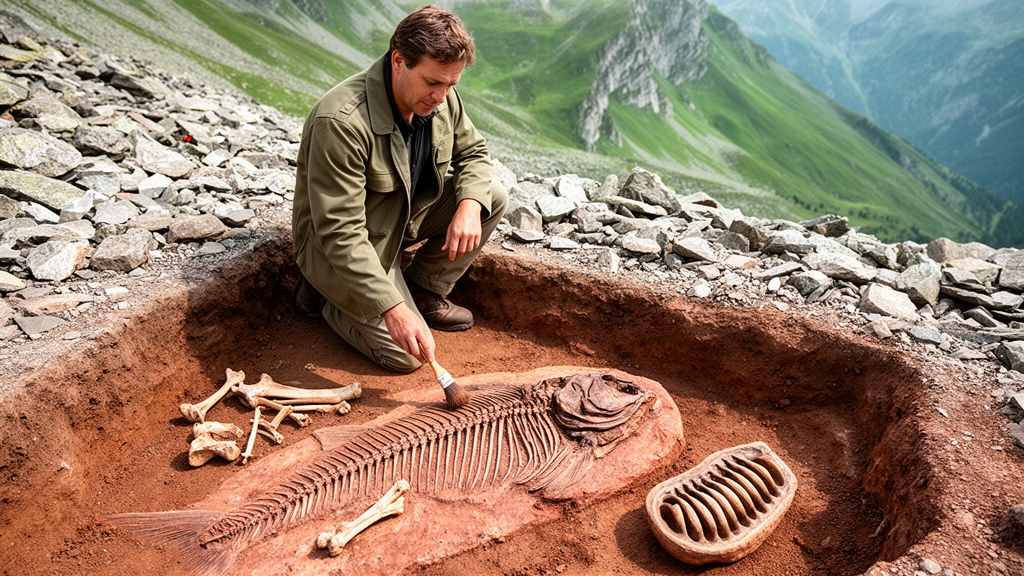
At the famous Gruhalde clay pit in Frick, northern Switzerland, palaeontologists have spent decades pulling exquisitely preserved dinosaurs, turtles, sphenodonts and synapsids from Late Triassic clays. Now the site has surrendered something far more modest in size but outsized in scientific consequence: the first identifiable lungfish remains ever recovered from the Late Triassic of Switzerland. The fossils, described in the Swiss Journal of Palaeontology, consist of isolated dental plates assigned to the genus Ptychoceratodus, and they plug a conspicuous blank spot on the map of lungfish distribution in the supercontinent Pangea roughly 220 million years ago.
Lungfishes are specialised lobe-finned bony fish whose living relatives inhabit freshwater environments in tropical and subtropical climate zones. One of their most distinctive traits is a modified dentition built from three pairs of dental plates that grow successively throughout the animal’s life. The group reached its peak diversification during the Triassic, and the deposits of north-western Pangea, corresponding to modern North America, Europe and North Africa, hold the richest fossil record of Late Triassic lungfishes anywhere on Earth. Yet these fish are usually represented only by isolated dental plates, scattered across outcrops in France, Germany, Great Britain, Greenland, Morocco, Poland, Turkey and the United States, and they remain understudied relative to their sheer abundance in continental assemblages of that time.
The new specimens were collected during two campaigns, in 2007 and 2019, from a stratigraphic horizon known as the unterste Schicht, tief within the Gruhalde Member of the Klettgau Formation. All of them come from sand lenses roughly one to three metres above a well-defined marking layer called the Referenzschicht, in direct association with dinosaur remains. The most complete dental plate, specimen SMF19-3-25, measures just 13.7 millimetres long and is heavily eroded on all sides, likely due to mechanical damage after the animal’s death. Despite this imperfect preservation, several taxonomically diagnostic features survive, including the number and arrangement of the ridges that characterise lungfish toothplates.
Those features proved decisive for identification. The plate bears five ridges originating anteriorly from the mediolingual joint, a configuration typical for the upper dental plates of Late Triassic Ptychoceratodus. The specimen differs from Arganodus, which normally carries six or more ridges, and from Ceratodus, whose ridges arise from a medial rather than anterior origin at the mediolingual junction. The inner angle of the plate, close to 90 degrees, also distinguishes it from cf. Metaceratodus material known from the Late Triassic of Poland. The occlusal surface shows a narrow, mesiodistally elongated plateau along the lingual margin, studded with numerous occlusal pits that record physiological wear during the animal’s life. A rough surface on the mesial side probably reflects the symphysial joint where the paired upper plates met.
Fragmentary specimens recovered from the same layer are too incomplete to reveal their general morphology, but their size hints at something remarkable: some elements represent parts of dental plates belonging to individuals several times larger than the animal that bore the complete specimen. Unfortunately, the widespread damage to the best-preserved plate hampers identification at species level, though its proportions are tentatively similar to species such as Ptychoceratodus concinnus, P. rectangulus and P. roemeri, which share a contiguous position of the upper dental plates. The description is the first of lungfish dental plates from the Klettgau Formation, despite brief earlier reports of their presence in the Frick region.
But the Swiss find is only half the story. The researchers compiled every known occurrence of lungfishes in Late Triassic north-western Pangea into the first georeferenced, open-source dataset of fossil lungfish localities, built in QGIS software. Each record includes the locality name, lithostratigraphic and chronostratigraphic position, a list of lungfish taxa, the depositional environment, and references, with flags marking approximated coordinates and taxonomic or stratigraphic uncertainties. The current coordinates were then transformed into palaeo-coordinates using GPlates software and a tectonic model set to a 220-million-year timeslice, allowing the distribution of the three dominant genera, Arganodus, Ceratodus and Ptychoceratodus, to be mapped onto the geography of the Late Triassic world.
The analysis confirmed a striking latitudinal pattern first proposed for two of the genera in an earlier study. Arganodus, readily distinguishable by its unusually high number of ridges resembling some Palaeozoic taxa, is restricted to lower latitudes, occurring in the Argana Basin of Morocco, the Zarzaitine Formation of Algeria, the Chinle and Dockum Groups of western North America, the Cleveland Basin of eastern North America, and the Lycian Taurus of Turkey, the only known Late Triassic locality where Arganodus and Ptychoceratodus co-occur. Ptychoceratodus dominates higher latitudes, particularly the continental facies of the Central European Basin and adjacent subbasins, with additional finds from Turkey and two localities in the Fleming Fjord Basin of Greenland. The new Swiss occurrence fits neatly into this European cluster. The researchers also argue, by parsimony, that recently reported North American specimens cautiously identified as cf. Ptychoceratodus can be safely reassigned to Arganodus, since high ridge counts are otherwise found only in large Middle Triassic species of Ptychoceratodus.
Two main explanations could account for this latitudinal separation. The first involves climatic controls on lungfish life history, most intuitively the seasonality of water reservoirs driven by precipitation and evaporation dynamics. Living lungfishes are famous for surviving dry seasons by aestivation, and even extant aestivating Protopterus species display interspecific differences in habitat preference, with some inhabiting seasonal reservoirs and others occupying permanent water bodies. The generic-level split between Ptychoceratodus and Arganodus may reflect similar phenomena along climatic gradients between tropical and more boreal zones of Pangea, with additional factors such as water temperature or oxidation affecting eggs and offspring. The second explanation, separation by a topographic barrier limiting dispersal between northern and southern populations, is considered less likely, because no such barrier has been identified in palaeogeographic reconstructions and Ptychoceratodus is also known from the Late Triassic southern hemisphere. The hypotheses could be tested with palaeoclimatic models and ecological niche modelling, comparing fossil distributions with hypothetical distributions of climatic variables.
Ceratodus tells a different tale. Long obscured by its historical use as a wastebasket taxon applied to nearly all Mesozoic lungfish material, the genus only received a formal diagnosis in 1993, based on the medial origin of its dental plate ridges and a singular prearticular sulcus, later strengthened by skull roof features. Its Late Triassic record comprises three valid species, and its occurrences, though far fewer than those of Ptychoceratodus, show a directly opposite palaeoenvironmental pattern. Five out of six unambiguous Ceratodus localities display marine depositional settings, including the Rhaetian bonebeds of Aust Cliff and Barnhill Quarry in Great Britain, Provenchères-sur-Meuse and Saint-Nicolas-de-Port in France, and the famous Carnian marine accumulation at Polzberg in Austria. A Fisher’s exact test, restricted to taxonomically and palaeoenvironmentally unambiguous occurrences, confirmed that this difference from Ptychoceratodus is statistically significant, with a p-value of 0.0039.
Does this mean Ceratodus tolerated marine salinity? The authors urge caution. Post-Carboniferous lungfishes are generally regarded as freshwater based on the ecology of living species and the predominance of fossil occurrences in continental deposits, and lungfish remains in marine deposits are usually explained by transport or reworking from freshwater or brackish environments. The rarity of Ceratodus in marine assemblages at a global scale makes its occurrence in marine deposits insufficient evidence of full salinity tolerance; stable isotope analyses or comparative taphonomy would be needed to test that hypothesis directly. A more likely explanation, for now, is that Ceratodus preferred nearshore continental habitats such as coastal riverine systems or river mouths, environments that favoured transport of its remains into marine settings. Similar associations appear in the Cretaceous, and a modern analogue is provided by the strictly freshwater Neoceratodus forsteri, whose remains nonetheless occur in coastal marine environments. The new Swiss lungfish, small as it is, thus anchors a broader re-evaluation of how climate belts and coastal proximity shaped the distribution of these ancient air-breathing fish, and the open-source dataset behind the study stands ready as a foundation for future, fully reproducible palaeobiogeographic analyses.
Subject of Research: Late Triassic lungfish palaeobiogeography and new Ptychoceratodus remains from the Klettgau Formation of Frick, Switzerland
Article Title: First dipnoan remains from the Late Triassic of Frick (Switzerland) and the re-evaluation of lungfish palaeobiogeography controls in the Late Triassic
Article References: Pawlak, W., Rytel, A., Carrillo-Briceño, J. D., Bachmann, U., & Pabst, B. (2026). First dipnoan remains from the Late Triassic of Frick (Switzerland) and the re-evaluation of lungfish palaeobiogeography controls in the Late Triassic. Swiss Journal of Palaeontology, 145, 655-663. https://doi.org/10.3897/sjp.145.186528
Image Credits: AI Generated
Keywords: lungfish, Ptychoceratodus, Arganodus, Ceratodus, Late Triassic, Norian, Klettgau Formation, Frick, Switzerland, palaeobiogeography, dental plates, north-western Pangea
Cite Scienmag News
Gavin Prescott. (October 17, 2026). Swiss Dinosaur Graveyard Yields First Triassic Lungfish and Rewrites Their Ancient Map. Scienmag. https://scienmag.com/swiss-dinosaur-graveyard-yields-first-triassic-lungfish-and-rewrites-their-ancient-map/
Gavin Prescott. "Swiss Dinosaur Graveyard Yields First Triassic Lungfish and Rewrites Their Ancient Map." Scienmag, 17 October 2026, https://scienmag.com/swiss-dinosaur-graveyard-yields-first-triassic-lungfish-and-rewrites-their-ancient-map/. Accessed 17 October 2026.
Gavin Prescott. "Swiss Dinosaur Graveyard Yields First Triassic Lungfish and Rewrites Their Ancient Map." Scienmag. October 17, 2026. https://scienmag.com/swiss-dinosaur-graveyard-yields-first-triassic-lungfish-and-rewrites-their-ancient-map/


