


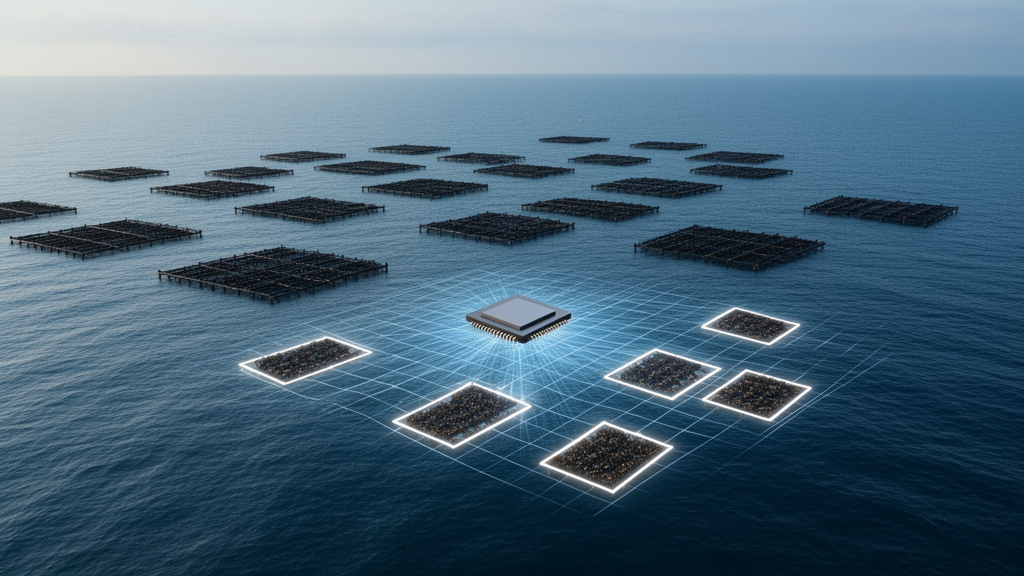
Off the coast of Galicia in northwestern Spain, thousands of floating wooden rafts dot the surface of the Ría de Arousa, each one growing ropes of mussels that feed one of Europe’s most valuable aquaculture industries. Spain ranks third worldwide in mussel production, contributing roughly 44.6 percent of European output and about 10 percent of the global total, with Galicia alone accounting for nearly 90 percent of national production. Within Galicia, the Ría de Arousa is the principal hub, hosting the highest concentration of mussel rafts in the region and representing nearly 70 percent of the platforms distributed across the Rías Baixas. Keeping accurate track of these structures has long required costly boat surveys and labor-intensive field inspections, but a new study suggests that a carefully chosen artificial intelligence model, running on very high-resolution satellite imagery, can do the job automatically at regional scale.
The research, published in Frontiers in Remote Sensing, was conducted by a team from K. N. Toosi University of Technology in Tehran and the Ludwig-Franzius-Institute for Hydraulic, Estuarine and Coastal Engineering at Leibniz University Hannover. The researchers set out to answer a deceptively simple question: which version of a modern deep learning detector is best suited to finding elongated, obliquely oriented mussel rafts, known locally as bateas, in satellite images where individual structures are only a few pixels wide? Their answer carries practical weight for coastal managers who need precise spatial information for concession licensing, environmental monitoring, hydrodynamic modeling, and maritime safety.
The technical challenge at the heart of the study lies in how detection algorithms describe the objects they find. Standard versions of the YOLO, or You Only Look Once, family of detectors generate axis-aligned bounding boxes, rectangular frames locked to the horizontal and vertical axes of the image. When the target is an elongated raft rotated at an arbitrary angle, such a rectangle inevitably includes large amounts of surrounding water, inflating the apparent size of the object and shifting its estimated center. These errors may seem minor, but they can negatively affect concession compliance checks, environmental assessments, and maritime navigation. Oriented bounding box, or OBB, extensions of YOLO address this limitation by predicting rotated boxes parameterized by center coordinates, width, height, and an orientation angle, allowing the frame to align closely with the geometry of the raft itself.
To compare the two approaches fairly, the team compiled a dedicated dataset from very high-resolution imagery acquired through the SASPlanet environment using publicly available Bing Maps imagery, collected at zoom levels corresponding to a ground sampling distance of roughly 0.15 to 0.50 meters. The imagery was divided into non-overlapping 640 by 640 pixel patches, and the researchers manually annotated 403 patches containing both raft and non-raft regions. The non-raft samples deliberately included confusing coastal background features such as shoreline structures, vessels, sea clutter, and rocky coastal textures. The dataset was partitioned into 174 training patches, 49 validation patches, and 180 independent test patches, with data augmentation applied only to the training subset through horizontal flipping, vertical flipping, and rotational transformations, expanding the training pool from 174 to 522 patches. No augmentation touched the validation or test sets, keeping the final evaluation independent from the training data.
With the dataset in place, the team trained two model families, YOLOv8-OBB and YOLO11-OBB, across five architectural scales each, from nano to extra-large, using the Ultralytics framework. Both architectures share a backbone-neck-head paradigm: a backbone of convolutional layers extracts features, a neck fuses them across scales using a feature pyramid network-like structure, and a detection head predicts class probabilities together with oriented bounding box parameters. YOLOv8 relies on Cross Stage Partial-inspired C2f modules for efficient feature reuse, while YOLO11 introduces C3K2 modules that extend the CSP design to improve feature interaction without significant computational overhead. Crucially, YOLO11 adds a C2PSA module after the spatial pyramid pooling stage that performs attention-based feature recalibration, enhancing informative spatial and channel-wise features and improving the modeling of long-range dependencies, a capability particularly beneficial for detecting elongated and arbitrarily oriented objects in remote sensing imagery.
Training was conducted in Google Colab on an NVIDIA T4 GPU with 14 GB of memory, running for 50 epochs with the AdamW optimizer configured with a base learning rate of 0.002 and a momentum factor of 0.9. The models were trained by minimizing a composite loss function combining rotated bounding box regression, binary cross-entropy classification, and distribution focal terms, with the regression component measuring geometric discrepancy through rotated Intersection over Union. Evaluation followed rigorous protocols: a fixed confidence threshold of 0.3 was calibrated exclusively on the validation set to prevent information leakage, and an IoU threshold of 0.7 was selected after sensitivity analysis showed that stricter thresholds unfairly penalized visually accurate detections. The team also applied bootstrap resampling, generating 1,000 samples at the image-patch level to derive 95 percent confidence intervals, and used the Wilcoxon signed-rank test with the Holm-Bonferroni correction to assess statistical significance between competing methods.
The results delivered a clear verdict. The YOLO11 family generally outperformed YOLOv8 in detection accuracy, localization quality, and performance under challenging maritime conditions. Among all evaluated models, YOLO11s achieved the highest F1-score of 0.866 and the highest mAP50-90 of 85.21 percent, representing improvements of approximately 11.6 percent and 7.5 percent respectively compared with the best-performing YOLOv8 model, YOLOv8m. Meanwhile, YOLO11n recorded the highest Mean IoU of 0.872 and the highest mAP50 of 96.87 percent. The pairwise statistical tests confirmed that YOLO11n and YOLO11s exhibited significant improvements relative to all YOLOv8 variants in patch-level F1-score distributions, although several comparisons of Mean IoU between top-performing models were statistically equivalent, indicating that the superiority of YOLO11 is more evident in detection performance than in localization accuracy.
Perhaps the most striking finding is what the results say about model size. Larger architectures, despite carrying far more parameters and computational complexity, did not consistently outperform the compact variants. Within the YOLO11 family, the nano and small models matched or outperformed several larger configurations, and the extra-large YOLO11x saw its mAP50-90 drop substantially to 46.26 percent, suggesting reduced localization consistency under stricter overlap requirements. Qualitative analysis showed that larger models occasionally exhibited over-segmentation in dense raft environments, producing redundant bounding boxes or orientation inconsistencies. The researchers attribute this to the repetitive, well-defined geometry of mussel rafts: once a model captures the necessary discriminative information, additional capacity introduces unnecessary complexity without proportional performance gains. This aligns with broader object detection research suggesting that beyond a certain point, increasing model capacity offers limited advantage when target objects have regular geometric patterns.
The study also probed model behavior under the messy conditions of real coastal environments. Detection errors predominantly occurred in shoreline areas, wave-affected textures, and vessel-related structures, which share elongated shapes, repetitive patterns, or radiometric similarities with mussel rafts. In negative test patches containing no rafts at all, most variants avoided false detections, indicating that rocky coastlines, shallow-water textures, and complex nearshore backgrounds were generally not confused with raft structures. However, several YOLOv8 variants produced false detections along coastal land-water boundary features, while the YOLO11 family showed fewer shoreline-related errors. In scenes with densely distributed rafts, accurate orientation estimation proved essential for separating adjacent objects, and the YOLO11 variants, particularly YOLO11n and YOLO11s, produced more consistent oriented bounding boxes with better alignment to the dominant axis of the raft structures.
To demonstrate operational scalability, the team developed an open-source Python-based graphical user interface that allows users to load satellite imagery, perform inference with trained YOLO-OBB models, and visualize predicted oriented bounding boxes, reducing technical barriers for aquaculture managers, researchers, and policymakers. The framework was applied to a very high-resolution image of the Ría de Arousa covering approximately 60,309 by 61,569 pixels at 50 centimeter resolution, successfully deployed through a patch-based processing strategy that demonstrated the feasibility of large-scale mussel raft mapping. YOLO11l-OBB produced fewer false detections than YOLOv8x-OBB in this large-scale scene. A subsequent qualitative evaluation using YOLO11s-OBB on a Southeast Asian aquaculture area showed that the model detected several raft structures with geometries similar to those observed in Galicia but missed structures with substantially different shapes and arrangements, suggesting that geographically diverse training samples may improve adaptability. The researchers released their fine-tuned weights and curated dataset of over 403 annotated patches publicly on Kaggle for reuse and benchmarking, and they recommend YOLO11n for large-scale monitoring in resource-constrained environments due to its computational efficiency, while YOLO11s provides a slight advantage in detection accuracy and localization quality. Future work, they note, should focus on expanding the training dataset with samples from different geographic regions and aquaculture systems, investigating cross-region transferability, and evaluating the framework under a broader range of environmental and acquisition conditions.
Subject of Research: Comparative evaluation of YOLO-OBB deep learning models for detecting mussel raft aquaculture structures in very high-resolution satellite imagery of the Ría de Arousa, Spain.
Article Title: Comparative assessment of YOLO-OBB models for AI-enabled mussel raft detection in VHR remote sensing imagery: insights from the Ría de Arousa, Spain
Article References: Dabestani, F., Moghimi, A., Azhir, A., Welzel, M., Ebadi, H., & Sahebi, M. R. (2026). Comparative assessment of YOLO-OBB models for AI-enabled mussel raft detection in VHR remote sensing imagery: insights from the Ría de Arousa, Spain. Frontiers in Remote Sensing, 7, Article 1838735. https://doi.org/10.3389/frsen.2026.1838735
Image Credits: AI Generated
DOI: 10.3389/frsen.2026.1838735
Keywords: YOLO, oriented bounding box, mussel raft detection, remote sensing, very high-resolution imagery, deep learning, aquaculture monitoring, Ría de Arousa, object detection, satellite imagery, coastal management, computer vision
Cite Scienmag News
Blake Davidson. (October 17, 2026). Smarter, smaller AI models outperform bigger rivals at spotting mussel rafts from space. Scienmag. https://scienmag.com/smarter-smaller-ai-models-outperform-bigger-rivals-at-spotting-mussel-rafts-from-space/
Blake Davidson. "Smarter, smaller AI models outperform bigger rivals at spotting mussel rafts from space." Scienmag, 17 October 2026, https://scienmag.com/smarter-smaller-ai-models-outperform-bigger-rivals-at-spotting-mussel-rafts-from-space/. Accessed 17 October 2026.
Blake Davidson. "Smarter, smaller AI models outperform bigger rivals at spotting mussel rafts from space." Scienmag. October 17, 2026. https://scienmag.com/smarter-smaller-ai-models-outperform-bigger-rivals-at-spotting-mussel-rafts-from-space/


