


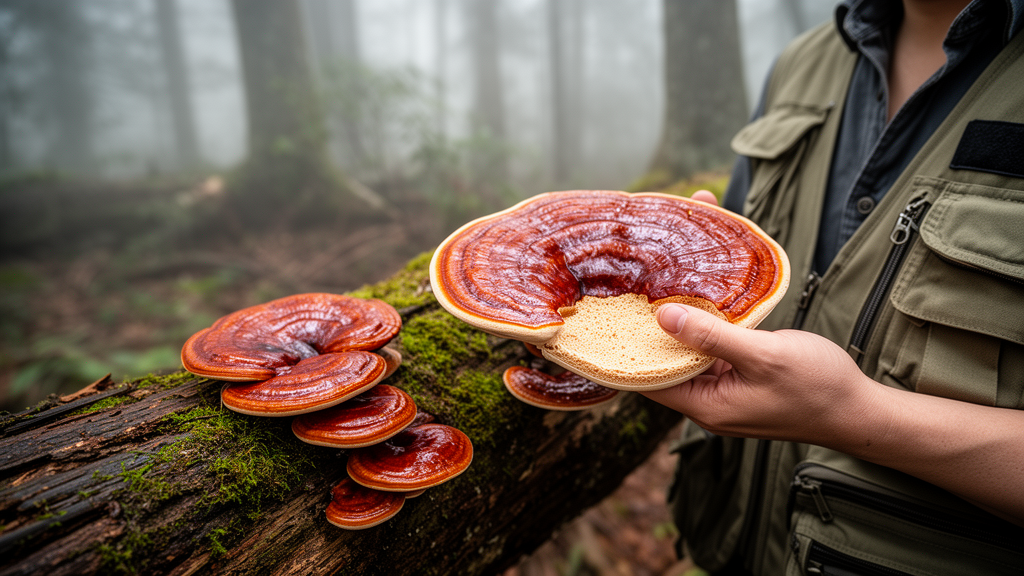
Few fungi carry as much cultural and commercial weight as Ganoderma, the genus of wood-rotting bracket fungi known across Asia as lingzhi or reishi. For centuries these glossy, lacquered mushrooms have been brewed into teas and ground into medicines, and today they anchor a global dietary supplement industry worth billions. Yet behind that familiar name lies a taxonomic tangle that has confounded mycologists for more than a hundred years. A new integrative study published in MycoKeys now untangles a significant part of that knot, describing two species new to science, adding two species newly recorded for China, and formally retiring two doubtful names through careful synonymization.
The research team, led by taxonomists working across Yunnan, Xizang, and Anhui provinces, combined a four-locus molecular dataset with exhaustive morphological and ecological analysis. They amplified and sequenced four nuclear regions: the internal transcribed spacer (ITS), the nuclear large ribosomal subunit (nrLSU), the translation elongation factor 1-alpha gene (TEF1-α), and the second largest subunit of RNA polymerase II (RPB2). In total, 46 new sequences were generated from 18 specimens, and the concatenated alignment spanned 4,258 aligned sites. Maximum likelihood and Bayesian phylogenetic analyses produced largely congruent trees, resolving the newly sampled collections into six well-supported terminal clades within the genus.
The most consequential finding concerns the type species of the genus itself, Ganoderma lucidum. Originally described from Europe, this name has been applied indiscriminately to glossy, laccate bracket fungi across Asia for over a century, obscuring what were in fact many distinct species. The new study confirms that true G. lucidum does occur in temperate East Asia, with verified collections from Inner Mongolia and Jilin in northern China growing on larch and Mongolian oak. But the tropical and subtropical Asian specimens long labeled as G. lucidum belong to something else entirely: a newly described species named Ganoderma sinolucidum, known locally in central Yunnan as Xue Lingzhi and cultivated on a small scale for its medicinal properties.
Ganoderma sinolucidum is distinguished by relatively small, thin basidiomata with a slender, elongated stipe, a persistently milky-white pore surface and context, subcircular pores with well-developed dissepiments, and basidiospores measuring 7.5 to 13.5 by 6 to 9 micrometers that are only slightly or not at all truncated at the apex. It grows exclusively on broad-leaved trees, particularly species in the Fagaceae family, and occupies tropical to subtropical forests at elevations between roughly 1,800 and 2,300 meters in Yunnan Province. Its sister relationship to the European G. lucidum is strongly supported in the phylogeny, yet the two species differ clearly in pileus margin color, host association, and biogeography.
The second new species, Ganoderma roseogelatum, is perhaps the more visually striking discovery. Known locally as Gasa Lingzhi and sold in the medicinal materials market of Gasa Town in Xinping County, Yunnan, this fungus produces compound, often fused pilei with a lacquer-like sheen and a short, lateral stipe. What sets it apart from every other known Ganoderma species is a remarkable trait: when injured, the fresh pore surface slowly exudes a pale pink, gelatinous substance. The species epithet roseogelatum directly references this rose-colored exudation. Local Bai and Yi traditional healers regard it as a medicinal mushroom, using it to treat insomnia, hangovers, and various cancers, though its confirmed distribution currently remains restricted to Yunnan Province pending further field verification.
The study also delivers two significant new country records for China. Ganoderma eickeri, originally described from South Africa, was collected in Shitai County, Anhui Province, growing on dead wood of Pinus massoniana at 370 meters elevation. Molecular analysis placed the Chinese specimen firmly within the African holotype’s clade with 100 percent bootstrap support, and the two sequences differ by only two bases in the ITS region. This represents the first documentation of G. eickeri outside Africa and establishes a novel Afro-Asian disjunct distribution, only the second such pattern in the genus supported by molecular evidence.
Even more remarkable is the case of Ganoderma oregonense. Originally described from North America, this species was confirmed in Asia through the sequencing of a holotype that had baffled taxonomists for decades. Ganoderma tibetanum, described from Xizang in 1983, had long been considered taxonomically doubtful because its holotype is malformed, with an irregular pileus, underdeveloped cuticle, and degraded DNA that repeatedly defeated conventional Sanger sequencing. The research team turned to next-generation sequencing and successfully recovered a clean ITS sequence from the type specimen. Phylogenetic analysis placed it within the G. oregonense clade with moderate but meaningful support, and the basidiospore measurements from the holotype fell entirely within the range reported for the North American species. The conclusion is clear: G. tibetanum is a synonym of G. oregonense, and this North American species occurs in China.
This finding elevates G. oregonense to the third Ganoderma species with a verified Asia-North America disjunct distribution, joining G. applanatum and G. tsugae. Such transcontinental disjunctions in fungi remain poorly documented, and each confirmed case offers a window into historical biogeographic connections between the two continents. The study’s authors caution, however, that many historical reports of supposedly cosmopolitan Ganoderma species likely rest on misidentifications, and that the true global distributions of most species in the genus remain to be fully elucidated through integrative taxonomy.
The synonymization of Ganoderma weixiense under G. leucocontextum illustrates a different but equally important dimension of the work. Both species had been described from high-altitude regions of southwestern China based solely on ITS sequences, and both were morphologically nearly identical, differing mainly in reported basidiospore size. When the researchers re-measured the G. weixiense holotype, they obtained spore dimensions of 8.5 to 12.5 by 6.5 to 9 micrometers, falling squarely within the range of G. leucocontextum and contradicting the original published description of 6 to 8 by 3 to 4 micrometers. The discrepancy likely arose because the original authors measured immature spores. Phylogenetic analysis confirmed that the G. weixiense sequence nests within the G. leucocontextum clade, and multi-locus comparisons of newly collected specimens revealed minimal nucleotide variation, supporting their conspecificity.
Beyond the specific taxonomic resolutions, the study highlights diagnostic characters that have been underutilized in Ganoderma taxonomy. The color of the growing margin in young basidiomata, for instance, proves reliably informative: G. roseogelatum, G. leucocontextum, and G. sinolucidum all exhibit a white growing margin, whereas G. lucidum displays a yellowish-brown one. Pore morphology, including surface color, shape, and dissepiment development, also varies markedly among the studied species and offers a practical identification framework. The authors recommend that field collectors document these ephemeral ontogenetic features, which are often lost by the time specimens reach the herbarium.
With 52 taxa now recorded in China, the revised framework provides a more reliable foundation for the pharmacological research, cultivation standardization, and conservation planning that depend on knowing exactly which species is being studied or grown. Different Ganoderma species can exhibit distinct bioactive profiles, and misidentified products undermine the reproducibility of medicinal research. By resolving long-standing misapplications of the European name G. lucidum to Asian taxa and by demonstrating the power of sequencing type specimens, even degraded ones, this study sets a methodological benchmark for future work on one of the world’s most economically and culturally significant fungal genera.
Subject of Research: Integrative taxonomic revision of the Ganoderma fungal genus in China using multi-locus phylogenetics and morphology
Article Title: Update and taxonomic revision of Ganoderma ( Basidiomycota , Ganodermataceae ) from China
Article References: Lei, H.-C., Li, J., Yu, T.-J., Gao, Y.-X., Wu, Z.-H., Dai, Y.-C., Liu, T.-Z., Mao, R.-K., Guan, W.-J., Tang, Y., Li, T., Lu, Y.-T., Zang, Q.-W., & Tang, L.-P. (2026). Update and taxonomic revision of Ganoderma (Basidiomycota, Ganodermataceae) from China. MycoKeys, 140, 261-297. https://doi.org/10.3897/mycokeys.140.204190
Image Credits: AI Generated
DOI: 10.3897/mycokeys.140.204190
Keywords: Ganoderma, lingzhi, taxonomy, phylogenetics, new species, China, mycology, Ganoderma lucidum, Ganoderma sinolucidum, Ganoderma roseogelatum, biogeography, type specimens
Cite Scienmag News
Roger Howard. (October 17, 2026). China’s Lingzhi Fungi Rewritten: Two New Ganoderma Species and a Century of Mistaken Identity Resolved. Scienmag. https://scienmag.com/chinas-lingzhi-fungi-rewritten-two-new-ganoderma-species-and-a-century-of-mistaken-identity-resolved/
Roger Howard. "China’s Lingzhi Fungi Rewritten: Two New Ganoderma Species and a Century of Mistaken Identity Resolved." Scienmag, 17 October 2026, https://scienmag.com/chinas-lingzhi-fungi-rewritten-two-new-ganoderma-species-and-a-century-of-mistaken-identity-resolved/. Accessed 17 October 2026.
Roger Howard. "China’s Lingzhi Fungi Rewritten: Two New Ganoderma Species and a Century of Mistaken Identity Resolved." Scienmag. October 17, 2026. https://scienmag.com/chinas-lingzhi-fungi-rewritten-two-new-ganoderma-species-and-a-century-of-mistaken-identity-resolved/


