


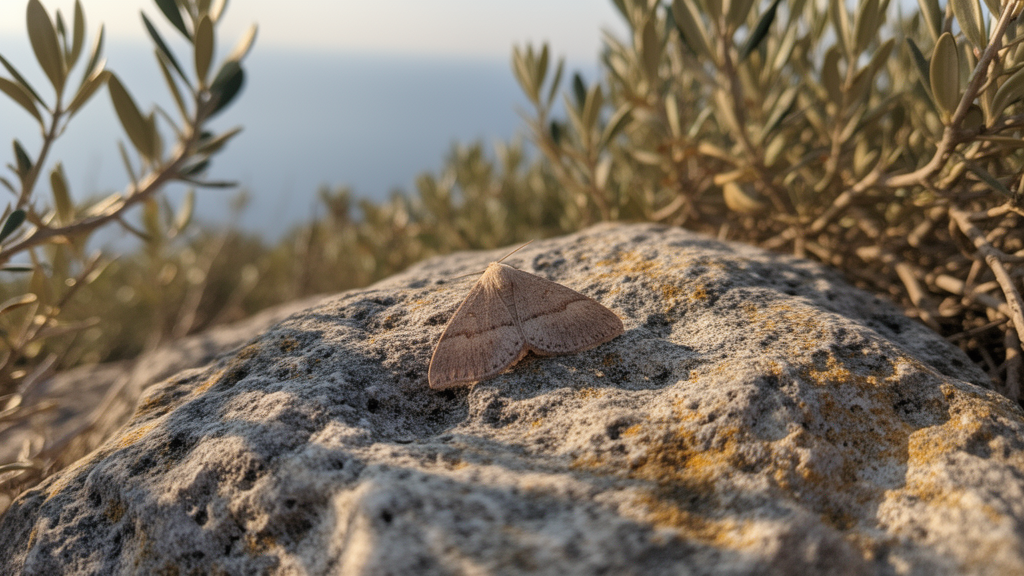
For more than two centuries, one of Europe’s most familiar micromoths has been hiding a secret. Carcina quercana, a strikingly patterned moth so distinctive that it graces the cover of a popular identification guide, has always been considered unmistakable. Now, a study published in Alpine Entomology has revealed that this assumption was wrong: a second, genetically and anatomically distinct species has been living under the same name across the eastern Mediterranean and the Near East all along. The new species, named Carcina ingridmariae, was described from Greece, Croatia, Cyprus and Türkiye, and barcode data suggest it also occurs in Lebanon.
The story begins with the long history of C. quercana itself. Described by Fabricius in 1775 from the oak forests of Saxony, the moth was so conspicuous that only a handful of authors ever gave it different names, the last valid synonym dating back roughly 150 years to Millière in 1874. Even a purple-winged variant from the French Alpes Maritimes, described as var. purpurana, turned out on examination to differ neither in genitalia morphology nor in DNA barcodes from typical specimens. For generations of entomologists, the species was a textbook example of a moth that could be identified at a glance.
That confidence started to crack when comprehensive genetic surveys of the Greek lepidopteran fauna uncovered a striking range of variation in DNA barcode sequences that was initially interpreted as intraspecific. It was only during work on the Lepidoptera of Crete that researchers paid closer attention to the anomaly. A genital morphological analysis then revealed a clearly separated species, formally described in the present work. The lesson, the authors argue, is that species regarded as unmistakable can be inadequately considered precisely because nobody thinks to question them.
The technical evidence for the split is compelling. The study was based on around 100 specimens of Carcina, with dried legs from 13 specimens processed for DNA barcoding at the Canadian Centre for DNA Barcoding in Guelph, using the standard 658-base-pair segment of the COI gene. Seven public sequences from the Barcode of Life Database were added as references, and a neighbor-joining tree was constructed under the Kimura 2-parameter model. The result was unambiguous: C. ingridmariae clusters in its own unique Barcode Index Number, BOLD:ADY8382, while C. quercana clusters in BOLD:AAB0177.
The genetic distances are dramatic for closely related moths. Within the new species’ BIN, the average intraspecific p-distance of the barcode region is just 0.23 percent, with a maximum of 0.64 percent. Within C. quercana, the average is 0.29 percent with a maximum of 2.13 percent across 178 records. The minimum distance between the two species, however, is 6.55 percent in both directions, a gap far exceeding the thresholds typically used to delimit animal species from barcode data. A single short sequence from Crete, only 234 base pairs long, was excluded from the tree analysis but corresponds fully with the new species.
Externally, the two species are frustratingly similar, which explains how the new moth escaped notice for so long. There is a tendency in C. ingridmariae towards reduced forewing markings, especially in males, and the ground color is often a paler orange-brown rather than red- to pink-brown. The yellow costal blotch on the forewing is usually more slender, and the yellow and dark markings in the basal half of the wing are reduced. But these are tendencies, not certainties, and the authors state plainly that the new species cannot be distinguished phenotypically from C. quercana with confidence.
The genitalia tell a different story. Male C. ingridmariae possess a slender gnathos only about half as wide as that of C. quercana, together with a very broad and long detached cucullus, more slender juxta lobes and, judging from the specimens available so far, an absence of cornuti on the phallus. In females, the most conspicuous difference is a broadly tubular, strongly sclerotized antrum. The other congeneric taxa, including the Far Eastern C. luridella and the Congolese C. haemographa, cannot be confused externally, and C. luridella differs in the male genitalia particularly by a much broader gnathos.
The description rests on a holotype male collected at Lakki in Crete in September 2022, along with a long series of paratypes from Crete, the Peloponnese, Chalkidiki, Kos, the Croatian island of Krk, both southern and northern Cyprus, and Gönen in Türkiye. Forewing length ranges from 8.0 to 9.3 millimeters in males and 7.6 to 10.5 millimeters in females. The species has been recorded from the coastline to about 1500 meters in wooded or shrub-rich habitats, attracted to artificial light, with a flight period suggesting possible bivoltinism: early May to late June, and mid-August to the first half of October.
Little is known about the biology of the new moth, but extensive data on larval phenology and food plants of alleged C. quercana from Mount Cholomontas in Chalkidiki almost certainly refer to C. ingridmariae, since part of the type material was collected there. The species would thus live on a remarkable spectrum of oaks, including Quercus trojana, Q. pedunculiflora, Q. macrolepis, Q. coccifera, Q. ilex, Q. pubescens, Q. dalechampii and Q. frainetto. Like its relative, it probably feeds on a wider range of woody plants, as indicated by its presence in northern Cyprus, where Quercus species are absent. The caterpillars are assumed, like those of C. quercana, to live in flat, silvery white silk webs on the underside of leaves, pupating between two spun leaves.
The discovery carries a broader message for biodiversity science. DNA barcoding has produced numerous new species discoveries in the European moth fauna in recent years, but most have been inconspicuous, morphologically cryptic species. Only a few exceptional cases, such as the meal moth relative Pyralis cardinalis, involved widespread but externally distinctive species wrongly attributed to an apparently unmistakable relative. The oldest known published specimen of C. ingridmariae dates back to 1916, and type material sampled as early as 1978 sat in collections without detailed morphological investigation. The authors argue that a reasonably complete survey of European species diversity will only be possible through consistent genetic inventories of all taxonomic groups with the broadest possible geographical coverage across the continent, work that currently exists only in isolated cases for larger groups. Genetically divergent clusters recently discovered in Crete and Cyprus, they note, may well contain further hidden diversity waiting for someone to stop assuming and start looking.
Subject of Research: A new micromoth species, Carcina ingridmariae, was discovered in the eastern Mediterranean through DNA barcoding and genital morphology after being long confused with the familiar Carcina quercana.
Article Title: The supposedly unmistakable mistaken: Carcina ingridmariae sp. nov., a surprising example of overlooked diversity from Europe and the Near East ( Lepidoptera , Peleopodidae )
Article References: Huemer, P. (2025). The supposedly unmistakable mistaken: Carcina ingridmariae sp. nov., a surprising example of overlooked diversity from Europe and the Near East (Lepidoptera, Peleopodidae). Alpine Entomology, 9, 51-63. https://doi.org/10.3897/alpento.9.158239
Image Credits: AI Generated
Keywords: entomology, DNA barcoding, new species, Lepidoptera, biodiversity, Peleopodidae, Mediterranean, taxonomy, supposedly, unmistakable, mistaken, Carcina
Cite Scienmag News
Drew Townsend. (October 17, 2026). Hidden Moth Species Discovered Hiding in Plain Sight Across the Mediterranean. Scienmag. https://scienmag.com/hidden-moth-species-discovered-hiding-in-plain-sight-across-the-mediterranean/
Drew Townsend. "Hidden Moth Species Discovered Hiding in Plain Sight Across the Mediterranean." Scienmag, 17 October 2026, https://scienmag.com/hidden-moth-species-discovered-hiding-in-plain-sight-across-the-mediterranean/. Accessed 17 October 2026.
Drew Townsend. "Hidden Moth Species Discovered Hiding in Plain Sight Across the Mediterranean." Scienmag. October 17, 2026. https://scienmag.com/hidden-moth-species-discovered-hiding-in-plain-sight-across-the-mediterranean/


