


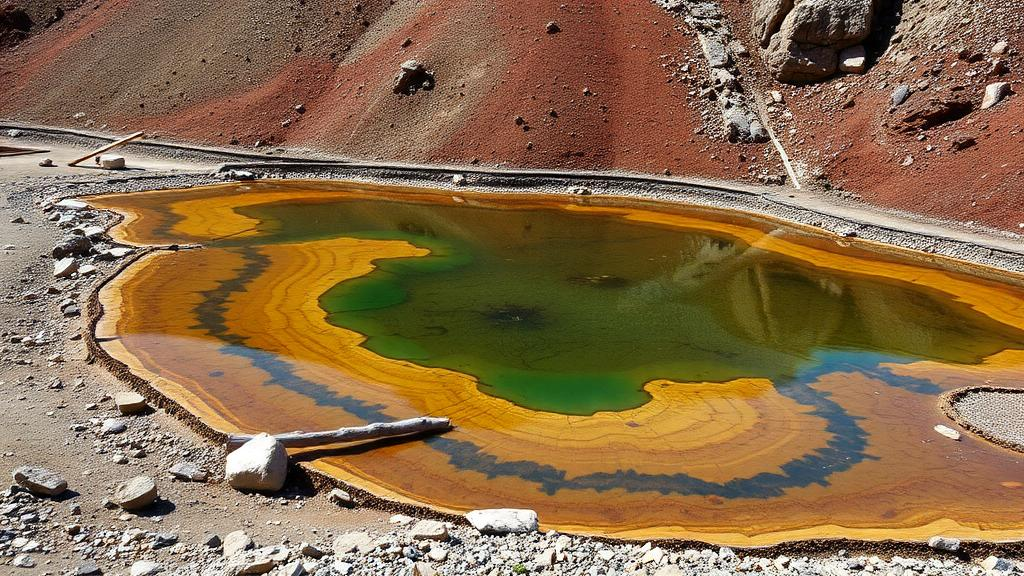
On the roof of the world, thousands of lakes are being born. As permafrost thaws across the Tibetan Plateau, the ground collapses into depressions that fill with meltwater, creating thermokarst lakes whose sediments brew a distinctive chemistry: alkaline waters ranging from mildly basic pH 7.5 all the way to pH 10.2. These young, rapidly evolving ecosystems are natural laboratories for studying how microbial communities adapt to chemical stress, and a new study published in Nature Communications reveals that one of the most surprising winners in this harsh environment is a group of bacteria that were only discovered to exist less than a decade ago.
The microbes in question are comammox Nitrospira, organisms capable of complete ammonia oxidation, meaning they can carry out the entire two-step process of nitrification within a single cell. For more than a century after nitrification was first described, scientists believed the process was necessarily split between two different microbes: ammonia oxidizers that convert ammonia to nitrite, and nitrite oxidizers that finish the job by converting nitrite to nitrate. The discovery of comammox organisms in 2015 upended that textbook view, and researchers have since found them in soils, wastewater treatment plants, aquifers, and marine sediments. What has remained murky is their ecological role in extreme environments, particularly those shaped by thawing permafrost.
A team led by Kang Song and Yuren Wang of the Chinese Academy of Sciences, together with colleagues including Chris Greening at Monash University and Sebastian Lücker at Radboud University, set out to determine who is actually doing the work of nitrification in these lakes. Nitrification matters far beyond microbial curiosity. It controls how nitrogen moves through lake ecosystems, influences nutrient availability, and critically, generates nitrous oxide, a greenhouse gas roughly 300 times more potent than carbon dioxide over a century. Understanding which microbes drive nitrification in thermokarst lakes therefore has direct implications for predicting how these expanding high-altitude ecosystems will contribute to climate change.
The researchers combined three complementary techniques to build their case. Stable isotope probing allowed them to measure gross nitrification rates and track which microbial groups were actively incorporating ammonia into their metabolism. Metagenomics revealed the genetic potential present in the sediment communities, including the full complement of genes needed for complete ammonia oxidation. Metatranscriptomics then showed which of those genes were actually being expressed, providing a snapshot of real-time metabolic activity rather than mere capability. This triple approach is essential in microbial ecology, because a microbe can be abundant without being active, and active without being important.
The results revealed a striking ecological divide. In subalkaline lakes, the canonical nitrifiers, ammonia-oxidizing archaea and ammonia-oxidizing bacteria, dominated the process, and gross nitrification rates were significantly higher there than in their alkaline counterparts. These classical players, however, are inhibited as pH climbs. In the strongly alkaline lakes, comammox Nitrospira took over. Their activity was significantly higher in alkaline than in subalkaline sediments, and in these harsh conditions they outperformed ammonia-oxidizing archaea by more than six-fold and ammonia-oxidizing bacteria by more than fifteen-fold, becoming the predominant nitrifiers in the ecosystem.
This niche transition carries a climate-relevant consequence. Comammox bacteria are known for their inherently low yield of nitrous oxide during ammonia oxidation, a property that distinguishes them from canonical ammonia oxidizers, which leak substantial amounts of this gas as a byproduct of their metabolism. Because comammox organisms dominate nitrification in the alkaline lakes, the team found that nitrous oxide production was significantly attenuated in those systems compared with the subalkaline lakes where archaea and bacteria hold sway. In other words, the identity of the nitrifier, not just the rate of nitrification, shapes the greenhouse gas footprint of these lakes.
How do comammox Nitrospira survive conditions that suppress their competitors? The metatranscriptomic data painted a picture of a coordinated stress response. Under saline-alkaline stress, the bacteria maintained high expression of genes for carbon fixation and sulfur metabolism, keeping their core energy-generating and biosynthetic machinery running. At the same time, they upregulated genes involved in compatible solute biosynthesis, producing small molecules that balance osmotic pressure without interfering with proteins, as well as cation transporters that help manage ion gradients across the cell membrane, and protein chaperones that protect cellular machinery from the destabilizing effects of high pH and salinity. This combination of sustained core metabolism and enhanced stress protection appears to be the key to their alkaline lifestyle.
The findings significantly expand the known physiological range of comammox Nitrospira. Previous work had documented these organisms in hot springs, reservoir sediments, and coastal Antarctic environments, but the Tibetan Plateau study demonstrates that they can not only survive but dominate nitrification at pH values approaching 10, conditions long considered the exclusive territory of alkaliphilic ammonia-oxidizing archaea. It also positions comammox bacteria as key mediators of nitrogen cycling in permafrost-affected ecosystems, a role that may grow in importance as Arctic and high-altitude permafrost continues to thaw and thermokarst lakes proliferate across the Northern Hemisphere.
There are broader implications for how scientists model nitrogen cycling in a warming world. Climate models and ecosystem studies often treat nitrification as a single process governed by bulk rates, without accounting for which organisms perform it. This study shows that such an assumption can misestimate greenhouse gas emissions, because swapping the dominant nitrifier from archaea or bacteria to comammox Nitrospira changes the nitrous oxide yield of the entire pathway. As thermokarst lakes expand and their sediments become more alkaline through evaporative concentration and interaction with carbonate-rich permafrost soils, the microbial handoff documented here could become an increasingly common feature of high-latitude and high-altitude landscapes.
The work also highlights how much remains to be learned about the microbial ecology of Earth’s most extreme environments. Comammox Nitrospira went unnoticed for over a century because researchers were not looking for organisms that could do everything at once. Now, armed with isotope probing, metagenomics, and metatranscriptomics, ecologists are finding these versatile bacteria in one unexpected habitat after another, each discovery refining our understanding of where the nitrogen cycle’s critical steps actually take place. On the Tibetan Plateau, at least, the answer is clear: in the alkaline sediments of its young lakes, the complete ammonia oxidizers rule.
Subject of Research: Niche specialization of comammox Nitrospira in alkaline thermokarst lake sediments on the Tibetan Plateau
Article Title: Niche specialization and prevalence of comammox Nitrospira in the alkaline sediments of thermokarst lakes on the Tibetan Plateau
Article References: Song, K., Wang, Y., Li, L., Deng, M., Wu, F., Xia, Z., Zhao, X., Greening, C., Lücker, S., & Guo, J. (2026). Niche specialization and prevalence of comammox Nitrospira in the alkaline sediments of thermokarst lakes on the Tibetan Plateau. Nature Communications. https://doi.org/10.1038/s41467-026-77729-0
Image Credits: AI Generated
DOI: 10.1038/s41467-026-77729-0
Keywords: comammox Nitrospira, nitrification, thermokarst lakes, Tibetan Plateau, permafrost, nitrogen cycle, nitrous oxide, alkaline sediments, metagenomics, metatranscriptomics, stable isotope probing, microbial ecology
Cite Scienmag News
Morgan Morrow. (October 12, 2026). Hidden Lake Microbes Take Over Nitrogen Cycling on the Tibetan Plateau. Scienmag. https://scienmag.com/hidden-lake-microbes-take-over-nitrogen-cycling-on-the-tibetan-plateau/
Morgan Morrow. "Hidden Lake Microbes Take Over Nitrogen Cycling on the Tibetan Plateau." Scienmag, 12 October 2026, https://scienmag.com/hidden-lake-microbes-take-over-nitrogen-cycling-on-the-tibetan-plateau/. Accessed 12 October 2026.
Morgan Morrow. "Hidden Lake Microbes Take Over Nitrogen Cycling on the Tibetan Plateau." Scienmag. October 12, 2026. https://scienmag.com/hidden-lake-microbes-take-over-nitrogen-cycling-on-the-tibetan-plateau/


