


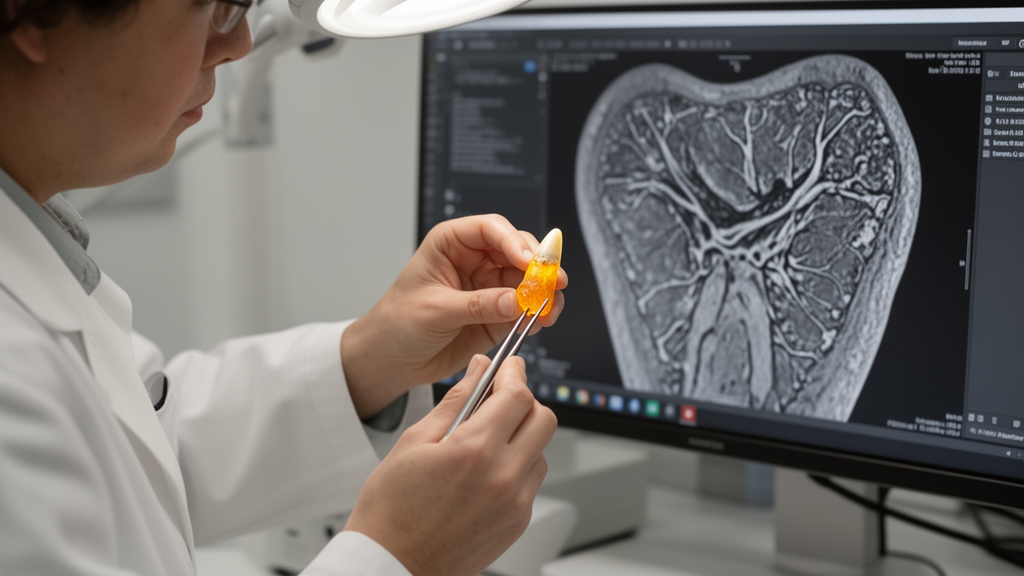
Deep in the Sunwu–Jiayin Basin of Heilongjiang Province, northeastern China, the rocks of the Yuliangzi Formation have been surrendering dinosaur fossils for nearly a century. This formation famously yielded the first dinosaur remains ever identified in China, and it is best known for its abundant duck-billed hadrosaurids. But scattered among the plant-eater bones are isolated theropod teeth, and many of them have never been examined in detail. Now, a new study in the Swiss Journal of Palaeontology has taken two of these teeth — one freshly discovered, one previously documented — and pushed them through high-resolution computed tomography, producing the first comprehensive three-dimensional reconstruction of troodontid teeth from this Late Cretaceous ecosystem.
The two specimens, catalogued as SC000900 and SC000908, are isolated right maxillary teeth collected from the lower member of the Yuliangzi Formation at Longgushan, Jiayin County. SC000900 is an almost complete tooth crown with the basalmost portion of its root preserved, suggesting it may represent a shed tooth. SC000908, previously designated DMJY V-815, is a broken crown lacking its apex. Both are remarkably small — SC000900 has a crown height of just 9 millimeters — and both were scanned at Yinghua NDT in Shanghai using Phoenix V|tome|x systems. The scans produced voxel sizes of roughly 3.5 and 3.3 micrometers, fine enough to resolve individual dental tissues and microstructures that optical microscopy had never revealed.
Troodontids are a clade of small, bird-like theropod dinosaurs whose teeth are instantly recognizable to specialists: proportionally large denticles with an apically hooked morphology, and a distinct constriction between the crown and the root. Despite more than 170 years of documentation of troodontid fossils, stretching back to Leidy’s 1856 descriptions, the internal anatomy of their teeth has remained largely unexplored. The new CT data change that. For the first time, researchers have segmented the enamel, dentin, and pulp cavity of troodontid teeth in three dimensions, revealing a suite of previously unrecognized features that could reshape how paleontologists interpret this clade.
The pulp cavity is the star of the show. In both specimens it exhibits a blade-like shape, compressed in the labiolingual dimension, tapering sharply toward the apex, and curving distally. Its apex sits significantly lower than that of the crown. Most strikingly, the basal half of the distal margin of the pulp cavity displays nine distinct finger-like projections, spaced at approximately 0.5 millimeters, each extending toward the corresponding interdenticular diaphysis. The mesial margin is markedly convex, while the distal margin is concave. The consistency of these projections between the two teeth suggests they are genuine anatomical characters of this Yuliangzi troodontid population rather than intraspecific variation — potentially informative traits that had been hidden inside the teeth all along.
The enamel tells an equally unexpected story. In SC000900, enamel thickness measures 31, 29, and 17 micrometers at the apical, middle, and basal regions of the crown respectively, thinning progressively toward the base. The ratio of enamel thickness at the crown base to crown height is just 0.19 percent — comparable to the early bird Jeholornis prima and far lower than most other sampled early birds, such as Sapeornis chaoyangensis at 1.3 percent or Longipteryx chaoyangensis at 4.0 percent. This confirms that enamel reduction is a hallmark of troodontids. But the real surprise lies in the denticles: in both specimens, the enamel on the labial side of each mesial and distal denticle is systematically thicker than on the lingual side. This labiolingual enamel asymmetry, localized to the denticles rather than the entire crown, has never been documented in any theropod subgroup before.
Asymmetrical enamel has long been known in sauropod and ornithischian dinosaurs, where it affects the entire crown. Finding it in theropods — but confined to the denticle margins — raises intriguing functional questions. The researchers suggest this localized thickening may represent a biomechanical adaptation associated with stress distribution during feeding, or enhanced resistance to wear along the denticle margins. Testing these hypotheses will require three-dimensional finite element analysis, but the consistency of the pattern across both specimens indicates it is a real structural feature of these teeth, not a scanning artifact or a quirk of preservation.
External anatomy reinforces the troodontid identity of the teeth. SC000900 shows labiolingual compression, distal recurvature, and denticulation along both carinae — features that confidently assign it to Theropoda. The pronounced crown-root constriction and exceptionally large, hook-like denticles place it within Troodontidae. Among troodontids, the presence of large apically hooked denticles with a density of 2.2 per millimeter distally distinguishes it from genera like Byronosaurus, Mei, and Urbacodon, which lack denticles entirely. Its morphology is particularly comparable to the maxillary teeth of Troodon itself, given the denticles along the entire length of both carinae and a similar crown base length. Because the specimen is represented solely by a tooth, the authors conservatively classify it as a Troodon-morphotype tooth rather than assigning it to a named species.
That classification carries real biogeographic weight. The Troodon dental morphotype is prevalent in the Late Cretaceous of North America, and Troodon-like teeth have been recovered from Maastrichtian deposits at Kakanaut in Chukotka, in the Russian Far East. The identification of a relatively complete Troodon-morphotype tooth from the Yuliangzi Formation adds further evidence for faunal exchange between East Asia and western North America via the Cretaceous Beringia land bridge. Comparable assemblages showing strong Asian–North American affinities have been documented from the Udurchikan Formation along the Heilongjiang (Amur) River, the Kakanaut Formation, and the Hell Creek Formation of western North America — a network of records that underscores how connected these terminal Cretaceous ecosystems really were.
Within China, Maastrichtian dinosaur assemblages are distributed across Heilongjiang, Jiangxi, and Guangdong provinces, from the Yuliangzi Formation in the north to the Nanxiong Group and the Dalangshan Formation in the south. Notably, tyrannosaurids are present in all of these formations, suggesting faunal exchange among them, while differences in composition — oviraptorids and sauropods in the Ganzhou Basin, therizinosaurids and nodosaurids in the Nanxiong Basin, only tyrannosaurids in the Dalangshan Formation — may reflect paleoenvironmental factors, sampling biases, or both. In the Yuliangzi Formation itself, the only theropods definitively identified to date are tyrannosaurids and troodontids; earlier reports of dromaeosaurids, carcharodontosaurids, and other taxa may be exaggerated, as some researchers have argued that all of those teeth could be attributable to tyrannosaurids based on similar measurements.
The wear facet on SC000900 adds a final layer of detail. Situated on the lingual surface, it is elliptical in shape with smooth margins, measuring 4.3 millimeters along its longest axis and 1.0 millimeter along its shortest. Fine parallel scratches on the polished surface — slightly offset from the longest axis, positioned more apically on the mesial side and more basally on the distal side — strongly suggest a genuine wear facet rather than a fossilization artifact. Together with the internal structures revealed by CT scanning, these features establish a baseline dataset for future comparative analyses within Troodontidae. The researchers also note that the reported diversity of theropods from the Yuliangzi Formation might be exaggerated owing to the absence of comprehensive studies, and that the presence of these troodontid teeth implies the formation may yet yield theropod body fossils in addition to isolated teeth — a tantalizing prospect for future paleontological discoveries in this already storied corner of China.
Subject of Research: Paleontology
Article Title: The anatomy of two troodontid teeth from the Upper Cretaceous of Jiayin, Heilongjiang Province, China
Article References: The anatomy of two troodontid teeth from the Upper Cretaceous of Jiayin, Heilongjiang Province, China. (n.d.). https://doi.org/10.3897/sjp.145.195625
Image Credits: AI Generated
Keywords: troodontids, paleontology, CT scanning, Cretaceous, Beringia, theropod teeth, Jiayin, Yuliangzi Formation, enamel, dinosaur biogeography, anatomy, troodontid
Cite Scienmag News
Gavin Prescott. (October 16, 2026). Hidden inside two tiny teeth: CT scans reveal the secret anatomy of China’s last troodontids. Scienmag. https://scienmag.com/hidden-inside-two-tiny-teeth-ct-scans-reveal-the-secret-anatomy-of-chinas-last-troodontids/
Gavin Prescott. "Hidden inside two tiny teeth: CT scans reveal the secret anatomy of China’s last troodontids." Scienmag, 16 October 2026, https://scienmag.com/hidden-inside-two-tiny-teeth-ct-scans-reveal-the-secret-anatomy-of-chinas-last-troodontids/. Accessed 16 October 2026.
Gavin Prescott. "Hidden inside two tiny teeth: CT scans reveal the secret anatomy of China’s last troodontids." Scienmag. October 16, 2026. https://scienmag.com/hidden-inside-two-tiny-teeth-ct-scans-reveal-the-secret-anatomy-of-chinas-last-troodontids/


