


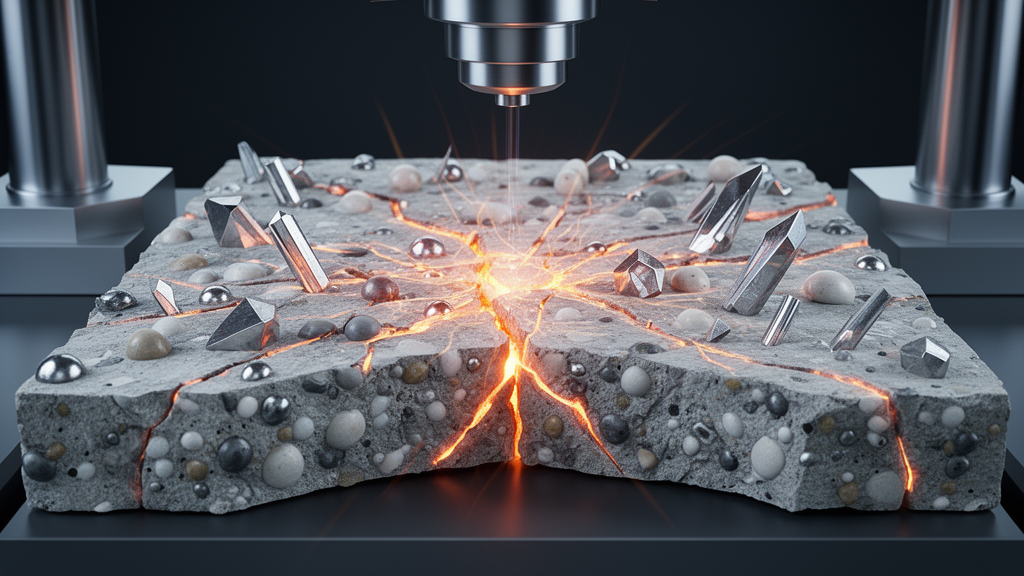
Silicon carbide particles tucked inside an aluminum alloy can turn a soft metal into a material strong enough for aerospace frames, brake rotors, and electronic packaging, but the same particles can also become the seeds of catastrophic failure. For decades, engineers have treated the amount of ceramic added to the metal as the master variable, assuming that a fixed volume fraction of reinforcement would deliver predictable performance. A new computational study upends that assumption by showing that the spatial architecture of the particles, not just their quantity, determines whether a composite gains strength or loses it. The research, published in Frontiers in Materials, reveals that two composites with identical global ceramic content can behave in dramatically different ways depending on how the particle-rich regions are arranged and connected.
The team, led by researchers from Bohai University, Foshan University, Shenzhen Polytechnic University, and Zhejiang University, focused on particle-reinforced metal matrix composites, or PRMMCs, in which silicon carbide particles strengthen a 6061 aluminum matrix. These materials are prized because the hard ceramic carries load while the ductile metal absorbs energy, but their mechanical response has always been complicated by the fact that particles rarely distribute uniformly during processing. Clusters, particle-depleted zones, and quasi-cellular patterns emerge naturally, and the study set out to clarify how this heterogeneity governs deformation and failure.
Using two-dimensional mesoscale finite element models, the researchers built virtual composites that all contained the same global silicon carbide volume fraction but featured distinct cellular architectures. By systematically varying the local particle concentration within reinforcement-rich regions and the connectivity between those regions, they isolated the effects of heterogeneity on stress transfer, strain localization, crack initiation, and crack propagation. The approach allowed them to decouple two factors that are usually entangled in real materials: how much ceramic sits in a given neighborhood, and whether the ceramic-rich zones form a continuous network across the sample.
The simulations produced a striking result about strength. Moderate localization of silicon carbide particles actually improved tensile strength by increasing the efficiency of stress transfer from the ductile aluminum matrix to the stiff ceramic reinforcement. When particles concentrate moderately, load flows more directly into the hard phase, allowing the composite to carry more force before yielding. However, the benefit has a sharp limit. When localization becomes excessive and the particle-rich regions lose their connections to one another, the macroscopic load-bearing capability deteriorates. A fragmented architecture cannot distribute stress across the sample, and the composite fails at loads it would otherwise sustain.
Perhaps the most important finding is that damage initiation and crack propagation are controlled by different aspects of the topology. Local silicon carbide concentration primarily determines where and when damage begins, because mismatched deformation between particle-rich and particle-poor zones intensifies strain incompatibility. The stiffer particle-rich regions deform less than the surrounding matrix, generating localized stress concentrations that nucleate cracks. In contrast, the connectivity of the reinforcement network governs what happens after a crack forms, dictating whether the fracture races through the material or is deflected into a more tortuous, energy-absorbing path.
This division of labor has direct consequences for design. A continuous particle-rich framework promotes efficient load transfer across the entire sample, boosting strength, but it also provides a highway for cracks: once damage initiates, the fracture propagates rapidly along the connected particle-rich network. A disconnected network behaves in the opposite manner. It enhances crack deflection, forcing fractures to change direction and dissipate energy, which improves damage tolerance, but the lack of continuity reduces strengthening efficiency because load cannot flow as effectively into the ceramic phase.
The study establishes a topology-based design principle for heterogeneous silicon carbide-aluminum composites, emphasizing that reinforcement connectivity is essential for achieving a favorable balance between strength and damage tolerance. Rather than tuning only the global volume fraction, engineers should think about the architecture of the particle distribution as a separate design variable. The ideal composite would combine moderate particle localization for efficient stress transfer with enough network continuity to distribute load, while retaining sufficient architectural complexity to deflect cracks once they form.
The mesoscale finite element approach is significant because it bridges the gap between microscopic models of individual particles and macroscopic models of entire components. At the mesoscale, researchers can resolve the actual arrangement of reinforcement clusters and capture the cellular patterns that emerge during composite processing, while still simulating enough material to observe realistic crack paths. This scale is where heterogeneity matters most, and the new findings demonstrate that ignoring it can lead to serious mispredictions of composite performance.
For the broader materials community, the work reframes heterogeneity from a processing nuisance into a design opportunity. The same mechanisms that cause failure in poorly arranged composites can be exploited to create materials that are simultaneously strong and damage-tolerant. By controlling the local concentration and connectivity of reinforcement during manufacturing, whether through stir casting, powder metallurgy, or additive processing, it may be possible to engineer particle architectures that deliver the best of both regimes. The research suggests that the next generation of ceramic-metal composites will be designed not by adding more ceramic, but by arranging it more intelligently.
Subject of Research: Topology-mediated deformation and failure mechanisms in heterogeneous cellular SiCp/Al composites analyzed by mesoscale finite element simulation
Article Title: Topology-mediated deformation and failure mechanisms in heterogeneous cellular SiCp/Al composites revealed by mesoscale finite element analysis
Article References: Chen, H., Zheng, Z., Yuan, B., Ma, S., Wang, L., Gong, B., Ouyang, W., Chen, D., Liu, C., & Gao, X. (2026). Topology-mediated deformation and failure mechanisms in heterogeneous cellular SiCp/Al composites revealed by mesoscale finite element analysis. Frontiers in Materials, 13, Article 1961834. https://doi.org/10.3389/fmats.2026.1961834
Image Credits: AI Generated
DOI: 10.3389/fmats.2026.1961834
Keywords: metal matrix composites, silicon carbide, finite element analysis, crack propagation, topology, damage tolerance, 6061Al, heterogeneous microstructure, Topology-mediated, deformation, failure, mechanisms
Cite Scienmag News
Denise Maddox. (October 16, 2026). Hidden Geometry of Particles Decides Whether Tough Ceramic-Metal Composites Snap or Bend. Scienmag. https://scienmag.com/hidden-geometry-of-particles-decides-whether-tough-ceramic-metal-composites-snap-or-bend/
Denise Maddox. "Hidden Geometry of Particles Decides Whether Tough Ceramic-Metal Composites Snap or Bend." Scienmag, 16 October 2026, https://scienmag.com/hidden-geometry-of-particles-decides-whether-tough-ceramic-metal-composites-snap-or-bend/. Accessed 16 October 2026.
Denise Maddox. "Hidden Geometry of Particles Decides Whether Tough Ceramic-Metal Composites Snap or Bend." Scienmag. October 16, 2026. https://scienmag.com/hidden-geometry-of-particles-decides-whether-tough-ceramic-metal-composites-snap-or-bend/


