


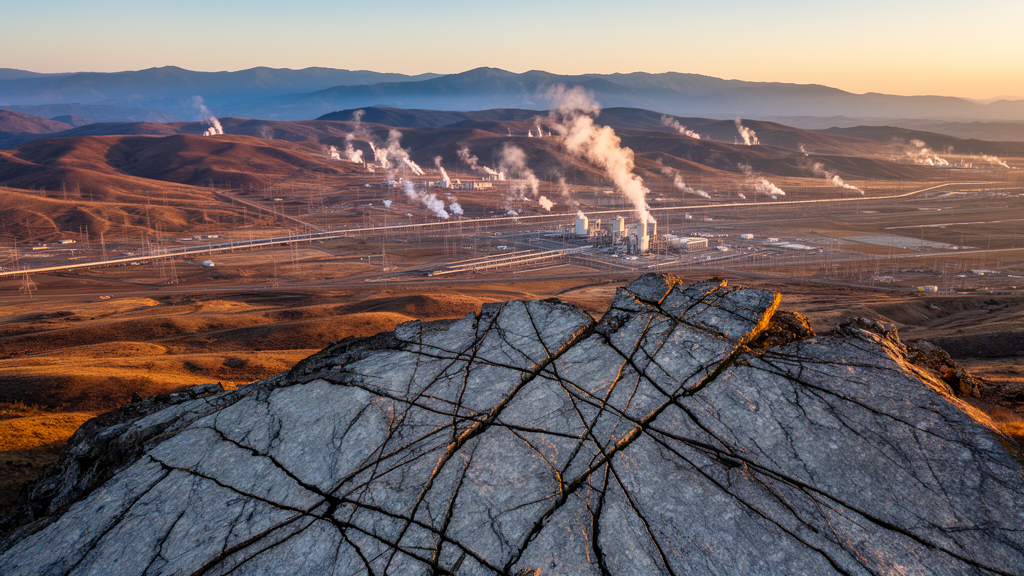
Deep beneath the Mayacamas Mountains of northern California, steam is being pulled from one of the most productive geothermal reservoirs on Earth. Now a team of researchers has shown that the invisible architecture of that reservoir, its connected fracture networks, is the decisive factor controlling where injected fluids travel and where tiny earthquakes follow. Using deep learning and Markov clustering, the scientists built a high-resolution microseismic catalog covering the past decade at The Geysers geothermal field, and their observations reveal distinctive clustering patterns and inferred fracture systems tightly correlated with injection operations.
The Geysers, located in the Mayacamas Mountains about 120 kilometers north of San Francisco, is the largest geothermal field in the United States and has supplied commercial steam power since 1960. Operators inject water into the reservoir to sustain steam production, and that injection perturbs pore pressure along faults and fractures, triggering microearthquakes. Most of these events are far too small to be felt, but their locations and mechanisms encode valuable information about the subsurface pathways through which fluids diffuse.
Conventional earthquake catalogs at The Geysers have long been limited in resolution, obscuring the fine structure of induced seismicity. The research team, led by Lei Li of Central South University and including researchers from Stanford University, Massachusetts Institute of Technology, and The University of Texas at Austin, applied deep learning methods to continuous waveform data provided by the Northern California Earthquake Data Center. The approach allowed them to detect and characterize vastly more microearthquakes than traditional processing, producing a catalog of unprecedented detail spanning roughly ten years of reservoir activity.
With the enriched catalog in hand, the scientists used Markov clustering to group events into multiplets, sequences of highly similar earthquakes that repeat on the same patch of fault. These repeating sequences act like seismic flashlights, illuminating individual fractures that are being pressurized by injected fluids. The analysis revealed distinctive clustering patterns that outline inferred fracture systems, and those systems correlate tightly with injection operations, mapping out the connected fracture network that provides pathways for rapid and directional pore pressure diffusion.
Source mechanism analyses, which determine the orientation and style of faulting for each microearthquake, combined with pore pressure simulations, indicated that the inferred connected fracture network provides pathways for rapid and directional pore pressure diffusion. The simulations showed that heterogeneous permeability controls the localized migration of fluids and the associated microseismic response. In other words, the reservoir does not behave like a uniform sponge; it behaves like a network of channels with wildly varying conductance, and the earthquakes trace the channels.
This finding carries substantial technical weight for geothermal operations. The efficiency of geothermal energy extraction depends directly on fracture networks, which govern how easily heat can be transferred from rock to circulating fluids. If operators can characterize the connected fracture network through continuous seismic monitoring, they can anticipate where injected fluids will migrate, where steam will be replenished, and where pore pressure changes are likely to trigger larger earthquakes. The study highlights the importance of continuous and integrated seismic monitoring for ensuring the sustainability of long-term reservoir development and exploitation.
The implications extend beyond The Geysers. Enhanced geothermal systems, which involve injecting fluids into hot dry rock to create artificial reservoirs, rely on controlling fracture permeability. The methods demonstrated at The Geysers, combining deep learning detection, multiplet clustering, source mechanism analysis, and pore pressure modeling, offer a template for characterizing fluid migration in any fractured reservoir, from geothermal fields to sites of induced seismicity associated with wastewater injection or carbon storage.
The research also demonstrates the power of modern machine learning in seismology. Deep learning models can detect events that human analysts and conventional algorithms miss, and clustering algorithms can organize those events into physically meaningful groups. Applied to a decade of data at one of the world’s most intensively monitored geothermal fields, the workflow produced observations that reveal how heterogeneous permeability controls fluid migration and microseismicity evolution, observations that were previously inaccessible with lower-resolution catalogs.
As the world seeks low-carbon energy sources, geothermal power stands out for its reliability and small surface footprint. But its success depends on understanding and managing the subsurface. This study shows that the key to that understanding lies in listening carefully to the microearthquakes that fracture networks generate, and in recognizing that the reservoir’s hidden plumbing, not its average properties, determines where fluids go and where the ground trembles. The Geysers, with its decade of high-resolution seismicity now mapped, offers a vivid demonstration that permeability heterogeneity is the master variable of the geothermal underworld.
The Geysers sits atop a reservoir unlike most geothermal systems worldwide. Whereas many high-temperature fields produce water or two-phase fluids, The Geysers is a vapor-dominated system, meaning the rock matrix is largely undersaturated and steam fills the fracture network. This unusual state makes the field especially sensitive to external water: injected fluid does not simply boil off at the production zones but instead diffuses through connected fractures, perturbing pore pressure over considerable distances. That sensitivity is precisely why the field has become a natural laboratory for studying how fluids induce earthquakes, and why a decade-scale, high-resolution view of microseismicity offers such an unusually complete picture of reservoir behavior.
The connection between injection and seismicity at The Geysers has been recognized for decades, but earlier studies typically relied on statistical correlations between injection volumes and earthquake rates. What distinguishes the new work is the physical chain it assembles: individual earthquake source mechanisms reveal the orientation and slip style of the fractures that produced them, multiplet clustering ties those fractures into coherent networks, and pore pressure diffusion simulations test whether the inferred network can actually transmit pressure fast enough and in the right directions to explain the observed seismicity. When the simulated pressure fronts and the migrating earthquake clouds line up, the case that permeability heterogeneity is the controlling variable becomes far more than a correlation.
The directional character of the pressure diffusion is particularly telling. In a homogeneous medium, injected pore pressure would spread outward roughly symmetrically from the injection point, decaying with distance. Instead, the observed microearthquake migration follows elongated pathways consistent with the inferred fracture systems, indicating that pressure travels preferentially along high-permeability conduits while neighboring rock remains comparatively insulated. This channelized behavior explains a long-standing puzzle at The Geysers: why seismicity sometimes appears at distances far from any injection well, and why earthquake swarms can jump between discrete patches rather than expanding smoothly.
For reservoir engineers, the practical value of this approach lies in its potential as a monitoring tool. Because the microseismic catalog is built from passive seismic recordings, it can in principle be updated continuously as operations proceed, giving operators a near-real-time picture of where injected fluids are actually going rather than where models assume they should go. That matters for both production and safety. On the production side, knowing which fracture corridors are being replenished helps target injection and manage steam deliverability. On the safety side, tracking pressure diffusion toward larger, critically stressed faults could provide early warning that seismic hazard is evolving, allowing injection schedules to be adjusted before felt earthquakes occur.
The decade-long span of the catalog also matters scientifically. Reservoir conditions at The Geysers are not static: injection patterns have shifted over the years, seasonal demand changes the balance of steam extraction and water input, and the fracture network itself evolves as minerals precipitate in some conduits and pressure opens others. A ten-year record makes it possible to ask whether the same fracture systems light up repeatedly under similar injection conditions, or whether the network reorganizes over time. Repeating multiplets that recur across years would suggest stable, long-lived conduits, whereas migrating activity would point to a more dynamic permeability structure.
Methodologically, the study reflects a broader shift in seismology toward automated, data-driven processing at scale. Deep learning detectors can lower the magnitude threshold of completeness substantially, revealing populations of tiny events that collectively trace fluid pathways with far greater spatial density than the handful of larger earthquakes once used for the same purpose. Markov clustering then imposes an organizing principle on this flood of detections, grouping events by waveform similarity rather than by arbitrary spatial bins. The combination turns a diffuse cloud of hypocenters into a map of discrete, repeating fault patches, which is the level of detail needed to infer connectivity.
The transferability of the workflow is one of its most consequential aspects. Induced seismicity concerns extend well beyond geothermal energy: wastewater disposal wells in the central United States, carbon dioxide storage sites, compressed air energy storage, and even mining operations all perturb pore pressure in fractured rock. A monitoring strategy that infers permeability structure from microearthquake statistics, validated against physics-based diffusion modeling, could be adapted to any of these settings, provided sufficient seismic instrumentation exists. The Geysers, with its dense local network and decades of continuous recording, represents something of a best-case scenario, but the underlying logic scales to sparser networks as long as enough events are recorded.
There are also open questions the study leaves for future work. Quantitative estimates of permeability values, not just their relative heterogeneity, would strengthen the link between the inferred network and the diffusion simulations. Coupling the seismic observations to coupled thermal-hydraulic-mechanical models could clarify how steam production and water injection interact within the vapor-dominated reservoir. And extending the approach to other geothermal fields with different geological settings, whether sedimentary basins or volcanic calderas, would test how universal the relationship between fracture heterogeneity and induced seismicity truly is. What the current results establish firmly is that the fine structure of permeability, once invisible, can now be mapped through the earthquakes the reservoir itself produces.
Subject of Research: Earth and environmental sciences
Article Title: Permeability heterogeneity controls fluid migration and microseismicity evolution in The Geysers geothermal field, California
Article References: Li, L., Zeng, X., McBrearty, I. W., Cui, X., Tan, X., Mao, S., Beroza, G. C., Tan, J., Liu, J., Segall, P., & Ellsworth, W. L. (2026). Permeability heterogeneity controls fluid migration and microseismicity evolution in The Geysers geothermal field, California. Nature Communications. https://doi.org/10.1038/s41467-026-78210-8
Image Credits: AI Generated
DOI: 10.1038/s41467-026-78210-8
Keywords: The Geysers, geothermal energy, microseismicity, permeability, fracture networks, pore pressure, deep learning, induced seismicity, fluid migration, reservoir monitoring, heterogeneity, controls
Cite Scienmag News
Violet Maxwell. (October 17, 2026). Hidden Fracture Networks Steer Fluids and Quakes at The Geysers Geothermal Field. Scienmag. https://scienmag.com/hidden-fracture-networks-steer-fluids-and-quakes-at-the-geysers-geothermal-field/
Violet Maxwell. "Hidden Fracture Networks Steer Fluids and Quakes at The Geysers Geothermal Field." Scienmag, 17 October 2026, https://scienmag.com/hidden-fracture-networks-steer-fluids-and-quakes-at-the-geysers-geothermal-field/. Accessed 17 October 2026.
Violet Maxwell. "Hidden Fracture Networks Steer Fluids and Quakes at The Geysers Geothermal Field." Scienmag. October 17, 2026. https://scienmag.com/hidden-fracture-networks-steer-fluids-and-quakes-at-the-geysers-geothermal-field/


