


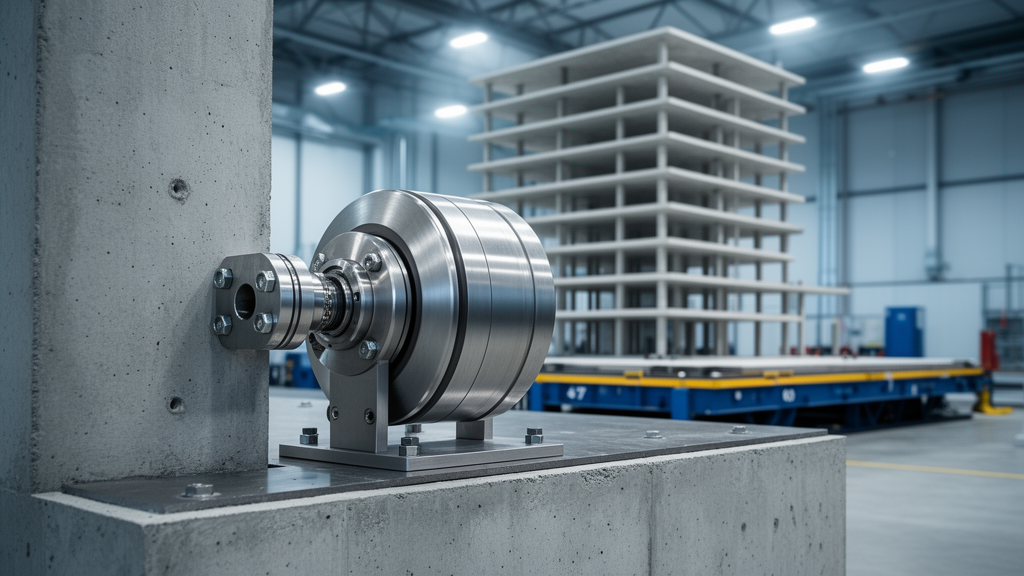
When the ground shakes, buildings have only two real options: resist or absorb. For decades, engineers have strengthened structures by adding strength, stiffness, and ductility, or by retrofitting them with jackets, braces, and base isolation systems. But a quieter revolution has been unfolding in vibration control laboratories, one that promises seismic protection without the bulk. At its heart is a deceptively simple mechanical element called the inerter, a two-terminal device that can make a structure behave as though it carries vastly more mass than it actually does. A comprehensive review published in Frontiers in Built Environment by Madhu Beerabbi Eshapurada and K. S. K. Karthik Reddy of Vellore Institute of Technology now takes stock of how well these inerter-based damping systems actually perform when earthquakes strike, and the picture that emerges is both promising and sobering.
The inerter concept was first introduced in 2002 by Malcolm Smith, who described it as the mechanical dual of a spring. Where a conventional mass has one end permanently anchored to a fixed reference, an inerter connects two points within a structure and generates equal and opposite forces at its terminals in proportion to their relative acceleration. The constant that governs this behaviour, known as the inertance, is measured in kilograms, yet the device itself requires only a fraction of that physical mass. This apparent mass amplification is what makes the inerter so compelling for vibration control: it can deliver substantial inertial effects in applications where space and weight are constrained, from automobile suspensions and railway vehicles to buildings and bridges. In structural engineering, the device has been integrated into tuned mass damper inerter systems, tuned inerter dampers, and a growing family of hybrid configurations that combine the inerter with viscous, hysteretic, or self-centering mechanisms.
Where the inerter is installed matters enormously. The review systematically catalogues the placement strategies reported across the literature, and the findings reveal how strongly configuration shapes performance. A tuned mass damper inerter connected between the top storey and the ground can significantly lower inter-storey drift and response variability, exploiting the large relative acceleration across the device terminals. Tuned inerter dampers placed at the position of maximum modal inter-storey drift yield better vibration suppression than other locations. Inter-storey installations between adjacent or non-adjacent floors improve control of higher vibration modes, while devices coupled between adjacent buildings mitigate pounding and reduce relative displacement. In bridges, inerters installed between deck and pier or integrated with stay cables reduce deck displacement and pier forces. Even clutched configurations, which engage only when dynamic excitation demands it, have been shown to improve control efficiency. The optimal inertance-to-mass ratio, meanwhile, tends to increase with structural period, and studies consistently report that response reduction becomes relatively insensitive beyond an inertance ratio of roughly 0.30 for selected damper configurations, meaning that simply adding more inertance does not guarantee better seismic performance.
Quantifying how well these devices work requires appropriate performance metrics, and the review organizes them into four families. Displacement-based measures, including peak roof displacement, inter-storey drift, residual drift, and base-isolation displacement, remain the most widely used indicators because they directly capture structural deformation, serviceability, and damage potential. Force and acceleration-based indices, such as base shear, floor acceleration, damper force, and root-mean-square acceleration, characterize the dynamic demands imposed on occupants, non-structural components, and the damper devices themselves. Energy-based metrics, including input energy, energy dissipation ratio, and hysteretic energy, reveal how effectively the devices absorb or redistribute the seismic energy that would otherwise flow into the primary structure. Performance-based metrics, the most holistic category, connect structural behaviour to predefined performance objectives through probabilistic frameworks rather than focusing solely on minimizing peak responses.
The reported numbers are striking. Across the reviewed studies, inerter-based damping systems achieved reductions of 20 to 85 percent in peak displacement and inter-storey drift, 18 to 45 percent in floor or roof acceleration, and up to 32 percent in base shear. A grounded tuned mass damper inerter on a base-isolated structure reduced secondary mass displacement and stroke by more than 50 percent compared with a conventional tuned mass damper under far-field ground motion. On a ten-storey shear building, a single-inerter configuration delivered a 45 percent reduction in mean maximum roof acceleration under 25 far-field earthquake records. An inerter-enhanced self-centering damper on a six-storey reinforced concrete frame cut seismic losses by up to 20.46 percent and recovery time by 19.46 percent, while raising the peak ground acceleration associated with a 50 percent probability of failure by as much as 43.86 percent for slight damage states. A low-cost passive inerter system on a two-storey shear frame outperformed traditional tuned mass dampers by 18.5 percent in energy dissipation efficiency.
But the review also exposes a critical caveat that could reshape how these devices are deployed: performance is strongly dependent on the character of the ground motion itself. Near-fault records dominated by early-arriving, low-frequency pulses reduced the effectiveness of grounded inerter systems, and highly impulsive motions produced limited or even adverse responses in some configurations. One study reported a 19.30 percent increase in top-floor acceleration under a near-field excitation condition, despite observing reductions under other ground motions and intensity levels. Relative device efficiency also declined with increasing structural nonlinearity and seismic intensity, and non-clutched inerter configurations were found to amplify ground-storey shear in rocking timber buildings. These contrasting observations demonstrate that improvement in one response measure does not necessarily imply consistent improvement across all structural responses, and that the reported percentages should not be treated as directly comparable across studies with different structural properties, modelling assumptions, and ground motion selection procedures.
Methodologically, the field has undergone a profound transformation. Early performance evaluation relied on frequency-domain analyses, closed-form optimization, and variance-minimization methods applied to simplified single-degree-of-freedom systems excited by stationary white noise or harmonic base excitation. As research progressed, H2 optimization frameworks produced explicit design formulae and robust performance criteria, followed by nonlinear time history analysis, statistical linearization, and experimental shake table testing. The most significant shift, however, has been toward the Performance-Based Earthquake Engineering framework, an integrated probabilistic methodology that connects seismic hazard with structural response and estimates repair costs, downtime, functionality, and associated risk. Rather than asking whether a structure meets code-prescribed strength requirements, PBEE asks what damage is likely to occur and what it will cost to recover, providing a decision-oriented basis for design and retrofit.
Within this probabilistic landscape, fragility analysis has emerged as a key tool for evaluating inerter-equipped structures. Fragility curves express the probability that a structure will exceed a predefined damage state under varying levels of earthquake intensity, typically assuming a lognormal cumulative distribution characterized by a median intensity measure and a logarithmic standard deviation. These curves are developed through incremental dynamic analysis, where nonlinear structural responses under scaled ground motions are evaluated against damage state thresholds drawn from the HAZUS manual, FEMA P-58, and ASCE 41 standards. One of the earliest applications developed a reliability-based design framework for the tuned mass damper inerter, optimizing device parameters to minimize the probability of exceedance. More recent work has extended the approach to hysteretic multi-storey steel buildings, where designs relying only on linear models tend to overestimate device performance once structural yielding occurs, and to structures subjected to pulse-like ground motions, which can cause large displacement demands and significantly alter the effectiveness of vibration control devices.
Despite the promise, the review identifies substantial practical limitations that stand between laboratory success and widespread implementation. Physical inerters deviate from ideal behaviour due to mechanical non-idealities such as friction, bearing losses, and transmission inefficiencies. Large inertial forces impose significant demands on supporting members and connections, while finite device stroke, installation space, and geometric requirements constrain certain configurations. Long-term durability issues, including wear, lubrication requirements, fatigue, and degradation of moving components, remain insufficiently investigated and require further experimental validation. Large-scale or full-scale experimental validation is comparatively limited across the literature, particularly for systematic performance comparisons under real earthquake ground motion records, leaving a gap between analytical models and field-ready devices.
Looking forward, the authors chart an ambitious research agenda. Future work should integrate engineering demand parameters, probabilistic fragility, repair cost, downtime, and resilience measures into comprehensive performance-based seismic design frameworks. Extensive investigations are needed under complex earthquake scenarios, including near-fault pulse-like ground motions and multi-hazard loading conditions. Artificial intelligence and machine learning offer opportunities for optimized parameter selection, probabilistic fragility forecasting, and surrogate models that accelerate seismic decision-making. Life-cycle optimization should incorporate initial construction costs, maintenance demands, anticipated seismic losses, repair expenses, downtime, and environmental impacts within multi-objective frameworks, while large-scale shake-table experiments and full-scale field studies verify analytical models. Digital twin frameworks, creating virtual replicas that continuously reflect physical structural response, could support adaptive parameter tuning, damage detection, and life-cycle performance assessment. For a device born in Formula 1 suspension systems and now poised to protect buildings from catastrophe, the inerter’s journey from mechanical curiosity to seismic guardian is well underway, but the road to reliable, field-proven earthquake protection still demands rigorous validation across the full spectrum of ground motions that nature can deliver.
Subject of Research: Earthquake Engineering
Article Title: Seismic performance assessment of inerter-based damping systems for structural vibration control – a comprehensive review
Article References: Eshapurada, M. B., & Reddy, K. S. K. K. (2026). Seismic performance assessment of inerter-based damping systems for structural vibration control – a comprehensive review. Frontiers in Built Environment, 12, Article 1966528. https://doi.org/10.3389/fbuil.2026.1966528
Image Credits: AI Generated
DOI: 10.3389/fbuil.2026.1966528
Keywords: inerter, seismic damping, structural vibration control, earthquake engineering, performance-based design, fragility analysis, passive dampers, tuned mass damper inerter, Seismic, performance, assessment, inerter-based
Cite Scienmag News
Violet Maxwell. (October 17, 2026). The Inerter Effect: How a Tiny Device Could Shield Buildings From Devastating Earthquakes. Scienmag. https://scienmag.com/the-inerter-effect-how-a-tiny-device-could-shield-buildings-from-devastating-earthquakes/
Violet Maxwell. "The Inerter Effect: How a Tiny Device Could Shield Buildings From Devastating Earthquakes." Scienmag, 17 October 2026, https://scienmag.com/the-inerter-effect-how-a-tiny-device-could-shield-buildings-from-devastating-earthquakes/. Accessed 17 October 2026.
Violet Maxwell. "The Inerter Effect: How a Tiny Device Could Shield Buildings From Devastating Earthquakes." Scienmag. October 17, 2026. https://scienmag.com/the-inerter-effect-how-a-tiny-device-could-shield-buildings-from-devastating-earthquakes/


