


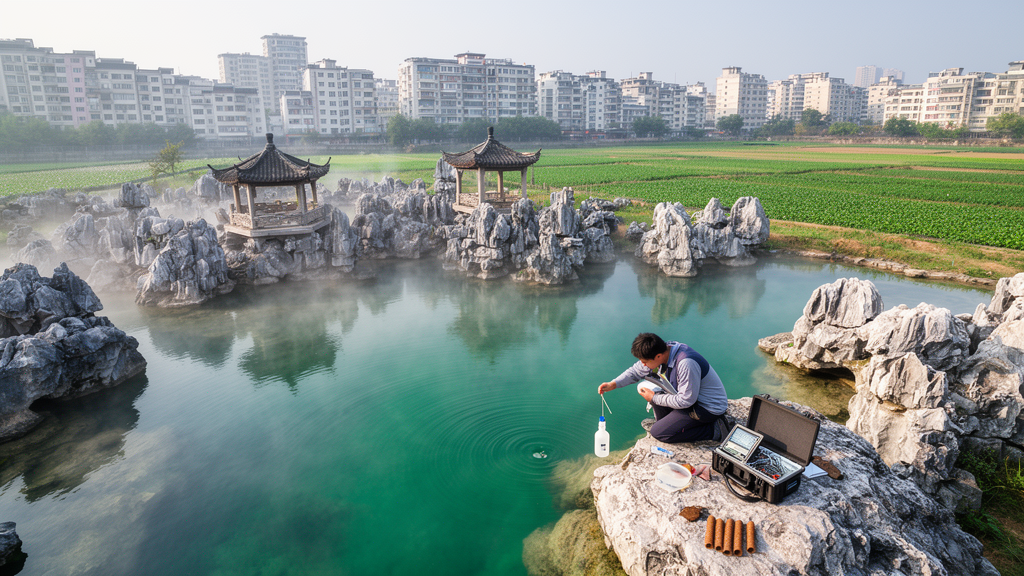
Beneath the bustling streets of Jinan, the Chinese city famed as the “City of Springs,” an invisible battle is unfolding in the fractured limestone aquifers that feed its ancient springs. A new study has revealed that while most groundwater in the Baiquan spring system remains of acceptable quality, two localized zones—one in the central corridor and another in the southwestern sector—harbor persistent nitrate contamination that poses potential non-carcinogenic health risks to adults drinking from affected wells. The research, published in Frontiers in Earth Science, offers one of the most comprehensive diagnoses yet of how urban karst aquifers respond to the combined pressures of natural geochemical processes and human nitrogen loading.
The Baiquan spring system covers roughly 25 square kilometers in eastern Jinan and is one of twelve spring domains protected under the city’s “Famous Springs” plan. Unlike the dramatic jetting outlets of Baotu Spring, Baiquan discharges through diffuse, sheet-like seepage across sandy beds, creating tranquil rippling surfaces that have sustained local ecosystems and culture for centuries. Geologically, the system sits on the northern flank of the Taishan uplift, where Cambrian and Ordovician carbonate rocks dip gently northward beneath Quaternary alluvium. Recharge enters through intensely fractured limestones and dolomites in the southern hills, flows northward through dissolution-enhanced fractures and cavities, and rises artesianly through roughly 70 to 80 meters of overlying deposits in the discharge zone.
This intricate plumbing makes karst aquifers extraordinarily vulnerable to contamination. The coexistence of fractures, conduits, and porous media creates highly heterogeneous flow pathways, allowing solutes to travel rapidly with limited natural attenuation. When fertilizer leaching, sewage infiltration, or urban wastewater discharge enters such a system, hydrochemical disturbances can propagate quickly through the subsurface, producing pronounced spatial variability in groundwater quality. Understanding how these coupled natural and anthropogenic forcings shape hydrochemical regimes has become a critical scientific and management challenge for spring-fed cities worldwide.
To tackle this challenge, a research team led by Chunhui Zhang of the Shandong Provincial Geo-mineral Engineering Exploration Institute and Xiao Yang of the Institute of Marine Science and Technology at Shandong University developed an integrated analytical framework combining hydrochemical analysis, entropy-weighted water quality index evaluation, probabilistic health-risk assessment, numerical transport modeling, and multivariate clustering. The team collected 15 groundwater samples from monitoring wells distributed across recharge, flow-through, and discharge zones, measuring field parameters in situ and analyzing major ions using ion chromatography, ICP-OES, and titration. All samples satisfied the ±5 percent charge balance criterion, confirming analytical reliability.
The hydrochemical results revealed groundwater characterized by moderate mineralization, calcium-dominated cation chemistry, and mixed bicarbonate–chloride anion compositions. Total dissolved solids ranged from 395 to 1008 milligrams per liter, with a median of 697, while total hardness varied from 321 to 782 milligrams per liter, indicating generally hard groundwater shaped by carbonate dissolution. Nitrate showed substantial spatial variability, ranging from 1.24 to 98.3 milligrams per liter, with four of the 15 samples exceeding the 50 milligram per liter drinking-water guideline. The Piper diagram classified most samples as mixed chloride–magnesium·calcium and chloride–calcium types, suggesting that carbonate dissolution controls the dominant cation composition while anion chemistry is modified by ion exchange, groundwater mixing, and localized chloride inputs.
Applying the entropy-weighted water quality index, which derives parameter importance directly from the intrinsic variability of the dataset rather than subjective assignment, the researchers found generally good to medium water quality across most of the domain. However, two pronounced deterioration hotspots emerged in the central and southwestern sectors, where interpolated EWQI values exceeded 100. The frequency distribution of EWQI values was multimodal, with one group of samples between 55 and 70, a second around 80 to 90, and a third above 110, indicating that local hydrogeochemical conditions or anthropogenic inputs can significantly degrade quality at specific sites rather than uniformly across the aquifer.
The health-risk assessment revealed a more alarming picture in those same hotspots. Deterministic hazard quotients for nitrate ingestion ranged from 0.02 to 1.93, with four wells exceeding the threshold value of 1, implying potential non-carcinogenic risk. Monte Carlo simulations with 10,000 iterations, assuming lognormally distributed nitrate concentrations, showed that most simulated hazard quotients fell between 0.3 and 0.7, confirming generally low regional risk. Yet four wells exhibited exceedance probabilities of 0.80 to 0.99, indicating persistent rather than occasional risk in those zones. The long upper tail of the ensemble distribution extended beyond the safety threshold, illustrating that exceedances could occur under unfavorable hydrochemical conditions or during episodic nitrate inputs.
To explain why these hotspots persist, the team developed a coupled MODFLOW–MT3DMS model simulating groundwater flow and nitrate transport across the Baiquan domain. The flow model reproduced observed groundwater levels with an RMSE of 0.374 meters and an R² of 0.889, while the transport model captured nitrate variability with an RMSE of 8.01 milligrams per liter and an R² of 0.942. Simulations extending from 2030 to 2045 revealed contrasting temporal trajectories: the central high-concentration core gradually contracted through groundwater flushing, hydrodynamic dispersion, and dilution, whereas the southwestern hotspot persisted throughout the entire simulation period, suggesting sustained source influence and relatively weak flushing conditions.
Multivariate clustering further distinguished two hydrochemically interpretable groundwater regimes. The first two principal components explained 65.5 percent of total variance, with PC1 associated primarily with mineralization and hardness variables and PC2 reflecting pH and bicarbonate variations. K-means classification separated a dilute, recharge-dominated regime from a more mineralized, anthropogenically influenced regime that coincided spatially with water-quality deterioration and risk hotspots. Notably, nitrate showed weak correlations with the major-ion assemblage, indicating that nitrate variability is largely decoupled from the regional chloride-associated mineralization pattern and instead reflects spatially heterogeneous nitrogen inputs and transport pathways.
The spatial overlay with land use revealed that the northern and central vulnerability zones intersect extensively with cropland and built-up land, forming a mixed agricultural–urban landscape, while the southwestern hotspot is predominantly embedded within built-up terrain. The authors emphasize that these patterns delineate potential source sectors rather than direct nitrate-source attribution, which would require independent isotopic verification using δ¹⁵N and δ¹⁸O analyses. The study’s principal advantage lies in linking present groundwater condition, health-risk probability, and future contaminant persistence within a unified assessment, distinguishing transient hotspots from structurally persistent vulnerability zones. The southwestern sector requires priority nitrate-source investigation and sustained monitoring, while the central corridor demands adaptive surveillance of plume evolution and recharge-dominated areas should be protected from further anthropogenic disturbance. The framework provides a transferable basis for risk-oriented groundwater management in other urban karst aquifers worldwide.
Subject of Research: Revealing hydrochemical regimes and health risks in an urban karst spring system
Article Title: Revealing hydrochemical regimes and health risks in an urban karst spring system
Article References: Zhang, C., Yang, X., Wei, R., Zhi, C., Li, C., Wu, X., Wang, J., Su, Q., & Jiang, Q. (2026). Revealing hydrochemical regimes and health risks in an urban karst spring system. Frontiers in Earth Science, 14, Article 1873012. https://doi.org/10.3389/feart.2026.1873012
Image Credits: AI Generated
DOI: 10.3389/feart.2026.1873012
Keywords: Revealing, hydrochemical, regimes, health, risks, urban, karst, spring, system, scientific research
Cite Scienmag News
Violet Maxwell. (October 17, 2026). Hidden Nitrate Hotspots Threaten Groundwater in Jinan’s Ancient Karst Springs. Scienmag. https://scienmag.com/hidden-nitrate-hotspots-threaten-groundwater-in-jinans-ancient-karst-springs/
Violet Maxwell. "Hidden Nitrate Hotspots Threaten Groundwater in Jinan’s Ancient Karst Springs." Scienmag, 17 October 2026, https://scienmag.com/hidden-nitrate-hotspots-threaten-groundwater-in-jinans-ancient-karst-springs/. Accessed 17 October 2026.
Violet Maxwell. "Hidden Nitrate Hotspots Threaten Groundwater in Jinan’s Ancient Karst Springs." Scienmag. October 17, 2026. https://scienmag.com/hidden-nitrate-hotspots-threaten-groundwater-in-jinans-ancient-karst-springs/


