


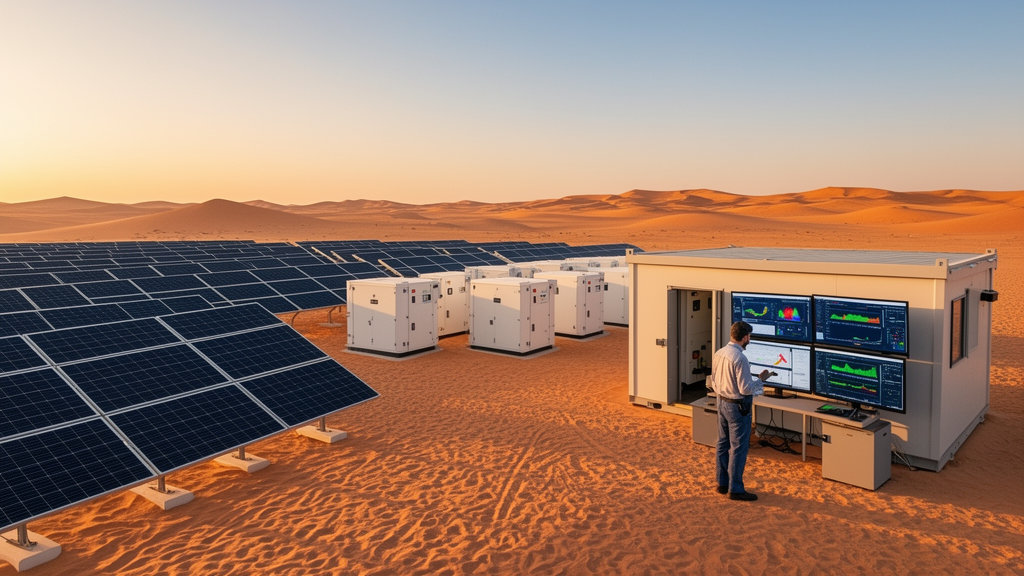
Deep in the desert campus of King Saud University in Riyadh, a small fleet of solar panels and wind turbines is quietly teaching artificial intelligence how to predict the future. A new study published in Frontiers in Environmental Chemistry shows that attention-enhanced deep learning models, fed with a rich stream of environmental data, can forecast the power output of a renewable energy microgrid with remarkable precision, achieving a mean absolute percentage error of just 2.01 percent. The finding could reshape how operators manage the delicate balance between sun, wind, and electricity demand in one of the harshest climates on Earth.
The research, led by Amanul Islam of the University of Colorado Colorado Springs and Fazidah Othman of the University of Malaya, tackles one of the central obstacles of the global energy transition: intermittency. Solar and wind power are environmentally sustainable, but their output swings with the weather, and traditional statistical forecasting methods struggle to capture the nonlinear, non-stationary, and stochastic character of that variability. Microgrids, localized energy systems that can operate autonomously or alongside the main grid, promise reliability and resilience, yet their success hinges on knowing, hour by hour, how much power the panels and turbines will deliver.
To find out which computational approach handles that uncertainty best, the team assembled an unusually broad lineup of contenders. On one side stood the traditional artificial intelligence workhorses: Artificial Neural Networks, Fuzzy Logic systems, and Adaptive Neuro-Fuzzy Inference Systems, known as ANFIS. On the other stood modern deep learning architectures, including Long Short-Term Memory networks, Temporal Convolutional Networks, Transformers, and a hybrid model that grafts a Squeeze-and-Excitation attention block onto an LSTM backbone. Every model was trained and evaluated under identical preprocessing, training, and validation conditions, a level playing field that comparative studies of this kind rarely achieve.
The data came from a real-world testbed rather than a simulation. The King Saud University microgrid combines photovoltaic panels, small-scale horizontal-axis wind turbines, weather stations, and energy storage units across a campus of roughly 900 hectares. Over the full calendar year 2022, calibrated sensors on meteorological towers recorded 8,760 hourly observations of solar irradiance in its three components, global horizontal, direct normal, and diffuse horizontal, along with wind speed, wind direction, temperature, relative humidity, and air pressure. The measurements flowed through a SCADA platform, and the recorded power output of the solar and wind installations served as the ground truth the models had to learn to predict.
Before training began, the researchers normalized all variables with Min-Max scaling, repaired gaps caused by sensor downtime using linear interpolation, and ran Pearson correlation analysis to identify which meteorological features genuinely carried predictive weight. The dataset was then split into training, validation, and testing subsets of 70, 15, and 15 percent, with stratified sampling to preserve seasonal representation across the desert’s dramatic annual cycle. Hyperparameters were tuned through grid search within a five-fold cross-validation framework, so that the final configurations reflected the lowest average validation error rather than a lucky single run.
When the results arrived, the attention-based models pulled decisively ahead. The SE+LSTM hybrid achieved the best overall performance, with a root mean square error of 0.7015 kilowatts and a MAPE of 2.01 percent for one-hour-ahead forecasts, and it also showed the smallest variation across validation folds, a sign of genuine stability rather than statistical luck. The Transformer, with its multi-head self-attention mechanism, came in a close second at 0.712 kilowatts. Conventional sequential models lagged behind: the Temporal Convolutional Network recorded an RMSE of 0.765 kilowatts and the standard LSTM 0.783 kilowatts over the same horizon. Among the traditional models, ANN led with an RMSE of 1.12 kilowatts, followed by ANFIS at 1.15 and Fuzzy Logic at 1.28.
The advantage widened as the forecasting horizon stretched. At six hours ahead, where forecasts guide battery scheduling and demand-side coordination, the SE+LSTM model still managed an RMSE of 1.015 kilowatts, while the LSTM’s error ballooned from 0.783 to 1.204 kilowatts. The researchers also found that the optimal model depends on the energy source itself. For solar power, whose daily cycles are smooth and anchored to the sun’s predictable position, the simple ANN excelled with an RMSE of 12 watts per square meter. For wind power, with its gusts and turbulence, the SE+LSTM model dominated, achieving an RMSE of just 0.0276 kilowatts and a MAPE of 1.45 percent, thanks to the LSTM’s temporal memory combined with the attention block’s ability to emphasize the most informative features.
Perhaps the most striking result concerns the environmental data itself. In an ablation analysis, removing solar irradiance from the model’s inputs pushed the RMSE up to 0.924 kilowatts and the MAPE to 3.87 percent; dropping wind speed raised the error to 0.881 kilowatts and 3.45 percent. When the model was fed only historical power data, stripped of all environmental context, the RMSE climbed to 1.147 kilowatts and the MAPE to 6.72 percent, more than triple the baseline error. In other words, the weather is not a side detail but the very signal that makes accurate renewable forecasting possible, and models that ignore it are fighting with one hand tied behind their back.
The team did not stop at raw accuracy. Statistical significance testing using paired t-tests and Wilcoxon signed-rank tests confirmed that the improvements of SE+LSTM over the Transformer, LSTM, and TCN were not products of random variation, with p-values below 0.05 across both error metrics. Confidence intervals and boxplots of cross-validation errors showed that the attention-based models also exhibited narrower error distributions, particularly at the six-hour horizon, where conventional architectures proved most sensitive to how the data were partitioned. Training loss curves converged smoothly for all deep models, with no abrupt rebounds that would signal overfitting.
The implications reach well beyond a single desert campus. Accurate, environmentally informed forecasts allow operators to schedule energy dispatch, manage battery storage, and anticipate supply-demand imbalances, reducing reliance on carbon-intensive backup generation and lowering the overall carbon footprint of the grid. The authors caution that their findings come from a single geographic location and that energy storage dynamics and economic costs were not yet modeled, leaving room for future work across diverse climates and full microgrid optimization. Still, the study marks a meaningful shift from purely data-driven prediction toward context-aware energy management, embedding ecological intelligence into the foundation of the smart grids that a decarbonizing world increasingly depends on.
Subject of Research: AI-based power forecasting for renewable energy microgrids using environmental data
Article Title: Renewable energy MicroGrid power forecasting: AI techniques with environmental perspective
Article References: Islam, A., & Othman, F. (2026). Renewable energy MicroGrid power forecasting: AI techniques with environmental perspective. Frontiers in Environmental Chemistry, 7, Article 1759525. https://doi.org/10.3389/fenvc.2026.1759525
Image Credits: AI Generated
DOI: 10.3389/fenvc.2026.1759525
Keywords: microgrid, renewable energy, power forecasting, deep learning, LSTM, Transformer, attention mechanism, solar power, wind power, artificial intelligence, environmental data, Saudi Arabia
Cite Scienmag News
Blake Davidson. (October 17, 2026). Attention-Enhanced AI Models Deliver Precise Microgrid Power Forecasting in Saudi Desert. Scienmag. https://scienmag.com/attention-enhanced-ai-models-deliver-precise-microgrid-power-forecasting-in-saudi-desert/
Blake Davidson. "Attention-Enhanced AI Models Deliver Precise Microgrid Power Forecasting in Saudi Desert." Scienmag, 17 October 2026, https://scienmag.com/attention-enhanced-ai-models-deliver-precise-microgrid-power-forecasting-in-saudi-desert/. Accessed 17 October 2026.
Blake Davidson. "Attention-Enhanced AI Models Deliver Precise Microgrid Power Forecasting in Saudi Desert." Scienmag. October 17, 2026. https://scienmag.com/attention-enhanced-ai-models-deliver-precise-microgrid-power-forecasting-in-saudi-desert/


