


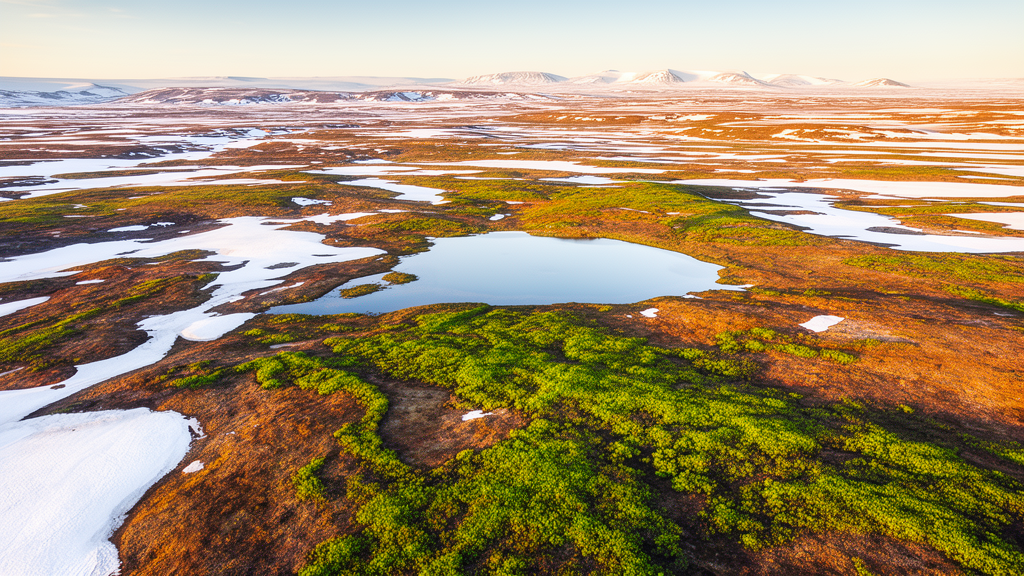
Deep in the tundra of northern Fennoscandia, two plants growing a few hundred meters apart may live through entirely different climates. One may bask in summer warmth that arrived in May; the other may still lie under snow until August. This is not a metaphor but the striking empirical finding of a new study published in Theoretical and Applied Climatology, in which researchers from the Finnish Meteorological Institute and partner universities deployed 347 microclimate loggers across three regions of northern Finland and Norway between 2020 and 2024 to measure, at an ecological scale, how the growing season actually unfolds across northern landscapes.
The team, led by Mika Rantanen of the Finnish Meteorological Institute together with ecologists and geographers including Juha Aalto, Miska Luoto, Julia Kemppinen and Pekka Niittynen, installed Tomst TMS-4 dataloggers in three contrasting study areas: Kilpisjärvi in northwestern Finland, dominated by oro-arctic tundra and mountain birch forest; Rásttigáisá in Norway, a rugged treeless mountain terrain; and Värriö Strict Nature Reserve in northeastern Finland, a largely boreal forest landscape with open wetlands. The loggers recorded near-surface air temperature at 15 centimeters height and soil temperature at 6 to 8 centimeters depth at 15-minute intervals, with a precision of 0.0625 degrees Celsius, capturing the thermal world as most organisms actually experience it rather than as represented by standard weather stations or climate models.
From these dense measurements, the researchers calculated four key variables that characterize the thermal growing season: its beginning, its end, its length in days, and the accumulated growing degree day sum, defined as the cumulative sum of daily mean temperatures exceeding the 5 degrees Celsius threshold during the season. The growing season onset was identified using the so-called integral method, which finds the date when daily mean temperature permanently rises to or above 5 degrees Celsius by locating the minimum of the cumulative sum of temperature minus threshold. A single warm day does not start the season if subsequent cold days lower the cumulative sum, making the definition robust against short-term weather fluctuations.
The results reveal a pronounced asymmetry between the start and the end of the growing season. The onset exhibited substantial spatial heterogeneity, particularly in the tundra environments, where the earliest and latest onsets within the same season differed by up to 40 days. In Rásttigáisá, the median standard deviation of the onset across loggers was 13.5 days, 82 percent higher than in Kilpisjärvi and nearly four times higher than in Värriö. In the exceptionally snowy year 2020, the range of variation in onset across the Rásttigáisá loggers reached 74 days, with one logger on a northeast-facing slope recording a growing season that began only on 4 August and lasted just 41 days, accumulating a mere 104 growing degree days.
In contrast, the end of the growing season showed remarkably little spatial variability, with standard deviations between loggers ranging from just 0.2 to 2.8 days. The termination often occurred in distinct pulses, with many sites reaching the end of the season within just a few days, and sometimes a cold spell was intense enough to end the season on the same day for all loggers in an area, as happened in Rásttigáisá on 12 September 2023 and 19 September 2024. This pattern indicates that the end of the growing season is primarily controlled by large-scale meteorological forcing, such as the passage of cold air masses associated with changing weather patterns, rather than by local landscape factors like topography or vegetation.
Consequently, the spatial variability in growing season length was primarily driven by differences in its onset, which were largely associated with spatial variations in snowmelt timing. The correlation between average snowmelt timing and growing season onset was high in the tundra areas, reaching 0.93 in Rásttigáisá and 0.81 in Kilpisjärvi, compared with a weaker 0.51 in the boreal forest of Värriö. The researchers estimated average snowmelt dates using PlanetScope satellite imagery at 3-meter resolution, classifying each pixel as snow or no-snow with a pre-trained Random Forest model and applying a pixel-based binomial generalized linear model to identify the date at which snow probability drops below 0.5. In Kilpisjärvi alone, 429 individual satellite scenes were used for this analysis.
The study also found that growing degree sums varied markedly within areas, with differences of about 400 degree days between the warmest and coldest places. In the predicted fields based on linear regression models using topographic predictors derived from 2-meter resolution digital terrain models, the modelled growing degree day values differed by more than 300 degree days between the summit and base of the Saana mountain in Kilpisjärvi. Interestingly, the relationship between growing degree days and elevation showed opposing patterns between tundra and boreal forest landscapes: in the tundra areas, growing degree days were negatively correlated with elevation, with correlation coefficients of -0.85 in Kilpisjärvi and -0.75 in Rásttigáisá, while in Värriö the correlation was positive at 0.36, likely because the fell tops above the surrounding forested valleys receive more direct solar radiation and accumulate more degree days than the shaded depressions below.
The exceptionally warm summer of 2024 provided a rare opportunity to examine an extreme growing season in high-latitude microclimates. In Kilpisjärvi, the median growing degree day sum of the 185 loggers reached 820 degree days in 2024, exceeding even the highest values recorded at individual sites during 2020 to 2023, and corresponding to conditions normally experienced approximately 200 kilometers further south. The highest logger value in Kilpisjärvi reached 1005 degree days, matching the typical sum observed in Rovaniemi, 300 kilometers south. In Rásttigáisá, the 2024 values were almost entirely above the previously observed microclimatic range, where even the coldest locations in 2024 were at least as warm as the warmest loggers in earlier years, with a median of 891 degree days. In Värriö, the median reached 1037 degree days with a maximum of 1229 degree days.
Placing these values in longer-term context using data from the Finnish Meteorological Institute’s weather stations, the 2024 growing season was the warmest on record at both Kilpisjärvi stations, and at the Sodankylä Tähtelä station, where observations extend back to 1908, the growing degree day sum reached 1314 degree days, clearly surpassing the previous record of 1204 degree days from 1937. Recent analysis suggests that summer 2024 in Sodankylä was very likely the warmest in at least 2,000 years, meaning the growing degree day values observed in 2024 were probably the highest of the entire Common Era. Notably, the exceptionally high degree day sums in 2024 were primarily driven by sustained, unseasonably high temperatures during the growing season rather than by an unusually early start or late termination, and in most cases the within-area variability in 2024 did not differ significantly from previous years according to Levene’s test, indicating that warmer average conditions did not substantially alter the spatial heterogeneity of the thermal landscape.
The findings demonstrate the value of dense microclimate observation networks for advancing understanding of microclimatic processes at ecological scales in cold ecosystems. Because the Arctic is warming two to four times faster than the global average, and because comparisons with climate projections suggest that the 2024 growing season in northern Fennoscandia roughly resembles typical conditions expected at the end of the 21st century, the study provides an early glimpse of the thermal conditions that northern ecosystems may encounter more frequently in the future. The results also suggest that the substantial spatial heterogeneity of growing season characteristics, driven primarily by local environmental conditions such as snowmelt timing and topography rather than by the precise threshold used to define the season, would persist even as average conditions warm, meaning that the fine-scale thermal mosaic of northern landscapes will remain a fundamental feature of these environments as climate change continues.
Subject of Research: Climate Science
Article Title: Substantial spatial heterogeneity in growing season dynamics across northern environments
Article References: Rantanen, M., Niittynen, P., Kämäräinen, M., Kemppinen, J., Rissanen, T., Tyystjärvi, V., Luoto, M., & Aalto, J. (2026). Substantial spatial heterogeneity in growing season dynamics across northern environments. Theoretical and Applied Climatology, 157(11), Article 719. https://doi.org/10.1007/s00704-026-06648-3
Image Credits: AI Generated
DOI: 10.1007/s00704-026-06648-3
Keywords: microclimate, Arctic warming, phenology, growing season, tundra, boreal forest, snowmelt, Fennoscandia, Substantial, spatial, heterogeneity, growing
Cite Scienmag News
Violet Maxwell. (October 17, 2026). Growing Seasons in the Far North Are Far More Local Than Climate Models Ever Imagined. Scienmag. https://scienmag.com/growing-seasons-in-the-far-north-are-far-more-local-than-climate-models-ever-imagined/
Violet Maxwell. "Growing Seasons in the Far North Are Far More Local Than Climate Models Ever Imagined." Scienmag, 17 October 2026, https://scienmag.com/growing-seasons-in-the-far-north-are-far-more-local-than-climate-models-ever-imagined/. Accessed 17 October 2026.
Violet Maxwell. "Growing Seasons in the Far North Are Far More Local Than Climate Models Ever Imagined." Scienmag. October 17, 2026. https://scienmag.com/growing-seasons-in-the-far-north-are-far-more-local-than-climate-models-ever-imagined/


