When athletes push their bodies through intense exercise, they lose water and salts through sweat, and this dehydration can quietly undermine the very organ they rely on most: the brain. A new preliminary study published in BMC Neuroscience suggests that the consequences of exercise-induced hypohydration for the brain’s prefrontal cortex may depend on an athlete’s body mass index, offering an intriguing clue about why some individuals seem to maintain sharp mental performance on the field while others falter. The research, led by Cigdem Bediz of the University of Kyrenia together with colleagues at Dokuz Eylul University, Izmir Demokrasi University, and Manisa Celal Bayar University in Türkiye, used a non-invasive brain-imaging technique to watch, in real time, how oxygen delivery to the prefrontal cortex changed as trained male athletes became dehydrated during a standardized cycling session.
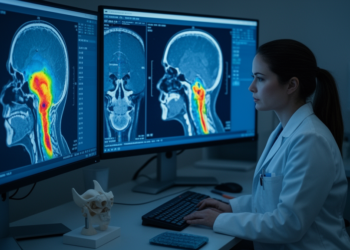
The prefrontal cortex is the brain region responsible for what scientists call executive functions: working memory, attention, decision-making, and the ability to plan and adapt. These are precisely the mental skills an athlete needs when reading a game, anticipating an opponent’s next move, or adjusting tactics mid-competition. Because the prefrontal cortex sits directly beneath the skull at the front of the head, it is uniquely accessible to functional near-infrared spectroscopy, or fNIRS, the optical method the researchers employed. fNIRS works by shining near-infrared light through the scalp and skull and measuring how much of it is absorbed or scattered by the blood flowing underneath. Because oxygenated hemoglobin and deoxygenated hemoglobin absorb light at slightly different wavelengths, the technique can distinguish between the two and track changes in local brain oxygenation with fine temporal resolution, all while a person is awake, moving, or performing a cognitive task.
The study team recruited twelve trained male athletes and divided them into two groups based on body mass index. The low-BMI group had an average BMI of 24.68 plus or minus 2.54 kilograms per square meter, while the high-BMI group averaged 33.91 plus or minus 5.73 kilograms per square meter, a level that falls into the obese range on standard clinical classifications. Each participant completed a familiarization session first, followed by an experimental session in which body mass and hematocrit, the proportion of blood volume occupied by red blood cells, were measured both before and after exercise. Hematocrit served as a physiological marker of dehydration: as plasma volume shrinks with fluid loss, the relative concentration of red blood cells rises, so a post-exercise increase in hematocrit indicates that hypohydration has occurred.
The exercise protocol itself was deliberately standardized so that any differences between the groups could be attributed to their physiological responses rather than to different workloads. Participants cycled at a constant load of 100 watts at a cadence of 60 revolutions per minute for 30 minutes, followed by four 20-second sprint intervals designed to push them closer to their physiological limits. This combination of steady submaximal work and short, intense bursts mirrors the demands of many real-world sports, from soccer and basketball to cycling races, where sustained effort is punctuated by moments of all-out exertion. Throughout the session, the researchers monitored how much body mass each athlete lost, providing a direct estimate of sweat-driven fluid loss.
The cognitive centerpiece of the experiment was the 2-back task, a widely used test of working memory. In this task, participants view a sequence of stimuli and must indicate whenever the current item matches the one presented two steps earlier. Holding that running comparison in mind requires sustained engagement of the prefrontal cortex, which is why the task is a favorite among cognitive neuroscientists studying executive function. The researchers recorded prefrontal hemodynamic activity with fNIRS while the athletes performed the 2-back task, both before and after the exercise protocol, allowing them to compare how the same brain region responded to the same mental challenge in two very different hydration states.
The physiological results confirmed that the exercise protocol successfully induced hypohydration in both groups. Hematocrit levels rose significantly after exercise compared with pre-exercise baseline values in both the high-BMI and low-BMI groups, but the increase was significantly greater in the high-BMI athletes, with a reported p-value of 0.045. This suggests that, under identical exercise conditions, the athletes with higher BMI experienced a more pronounced shift in blood composition, consistent with greater fluid loss or a larger reduction in plasma volume. Because blood volume and cardiovascular stability are tightly linked to cerebral blood flow, this difference set the stage for the brain-level findings that followed.
Those brain-level findings were striking precisely because the two groups diverged in opposite directions. In the low-BMI group, prefrontal oxyhemoglobin increased during the post-exercise 2-back test compared with pre-exercise performance, a statistically robust change with a p-value of 0.002. Rising oxyhemoglobin during a cognitive task is generally interpreted as a sign of increased neural recruitment: the brain is calling in more oxygenated blood to support the working-memory demands of the task. In the high-BMI group, by contrast, the researchers observed an increase in deoxyhemoglobin, with a p-value of 0.033, and an increase in total hemoglobin that just reached the conventional significance threshold at p equal to 0.050. Rising deoxyhemoglobin alongside increased total hemoglobin can indicate that oxygen extraction from the blood is outpacing oxygen delivery, a pattern that may reflect a less efficient hemodynamic response or a mismatch between neural demand and vascular supply under the combined stress of dehydration and cognitive load.
The behavioral data added a further layer of concern for the high-BMI athletes. When the researchers tallied the number of missing answers on the post-exercise 2-back test, the high-BMI group produced significantly more omissions than the low-BMI group. Missing answers on a working-memory task can reflect lapses in attention, reduced task engagement, or genuine degradation in working-memory capacity, and the authors of the study interpret this pattern as evidence of reduced task engagement or diminished working-memory performance in the dehydrated high-BMI athletes. Taken together with the divergent hemodynamic signatures, the picture that emerges is one in which higher body mass index appears to alter both the brain’s vascular response to dehydration and the cognitive performance that depends on it.
It is important to emphasize, as the researchers themselves do, that these are preliminary findings and must be interpreted with caution. The sample size was small, with only twelve participants divided across two groups, and the study lacked a euhydrated control condition, meaning there was no group that performed the same exercise and cognitive testing while maintaining normal hydration. Without that control, it is difficult to fully separate the effects of dehydration itself from the effects of exercise, fatigue, or individual variability. The authors explicitly state that their conclusions should be confirmed in larger, controlled studies before firm recommendations can be drawn. Nevertheless, the study’s design was rigorous for a preliminary investigation: it was reviewed and approved by the Dokuz Eylul University Non-Invasive Research Ethics Committee, conducted in accordance with the Helsinki Declaration, and all adult participants provided written informed consent before taking part.
If the findings hold up in larger trials, the implications could be significant for sports science and athletic practice. Hydration strategies are already a cornerstone of elite performance planning, but they are typically designed around physical metrics such as core temperature, heart rate, and sweat rate. This study raises the possibility that cognitive protection, preserving the prefrontal cortex’s ability to support decision-making and working memory under physiological stress, should be an explicit goal of hydration protocols, and that individualized targets may be needed for athletes with higher body mass index. The work also highlights the value of fNIRS as a portable, exercise-compatible window into the working brain, allowing researchers to study cognition in contexts that traditional imaging methods such as MRI cannot easily reach. As the authors and the broader field continue to explore how body composition, hydration status, and cerebral hemodynamics interact, this preliminary study offers a compelling early signal that the brain’s response to dehydration is not one-size-fits-all, and that the athletes who most need sharp thinking in the final minutes of competition may be the ones whose brains are most vulnerable to the fluid they have lost.
Subject of Research: Effects of body mass index on prefrontal cortex hemodynamics and working memory during exercise-induced hypohydration in male athletes
Article Title: The effect of body mass index on prefrontal cortex hemodynamic and cognitive functions in exercise-induced hypohydration in male athletes: preliminary study
Article References: Bediz, C., Uylas, E., Guducu, C., Manci, E., & Gunay, E. (2026). The effect of body mass index on prefrontal cortex hemodynamic and cognitive functions in exercise-induced hypohydration in male athletes: preliminary study. BMC Neuroscience. https://doi.org/10.1186/s12868-026-01062-x
Image Credits: AI Generated
DOI: 10.1186/s12868-026-01062-x
Keywords: exercise-induced hypohydration, prefrontal cortex, body mass index, fNIRS, working memory, 2-back task, hemodynamics, athletes, dehydration, cognitive performance, sports physiology, BMC Neuroscience
Cite Scienmag News
Cassandra Pierce. (October 9, 2026). Heavier Athletes’ Brains Respond Differently to Dehydration During Exercise, Study Finds. Scienmag. https://scienmag.com/heavier-athletes-brains-respond-differently-to-dehydration-during-exercise-study-finds/
Cassandra Pierce. "Heavier Athletes’ Brains Respond Differently to Dehydration During Exercise, Study Finds." Scienmag, 9 October 2026, https://scienmag.com/heavier-athletes-brains-respond-differently-to-dehydration-during-exercise-study-finds/. Accessed 9 October 2026.
Cassandra Pierce. "Heavier Athletes’ Brains Respond Differently to Dehydration During Exercise, Study Finds." Scienmag. October 9, 2026. https://scienmag.com/heavier-athletes-brains-respond-differently-to-dehydration-during-exercise-study-finds/