


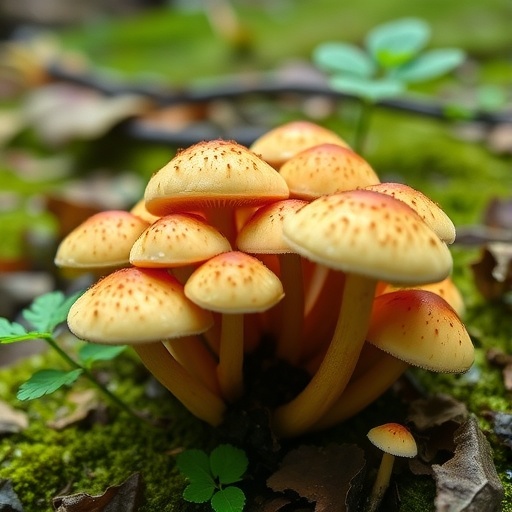
In an exciting leap forward for natural product chemistry and plant pathology, researchers have uncovered a novel antibacterial agent from the bitter and hallucinogenic mushroom Gymnopilus orientispectabilis, native to East Asia. This breakthrough shines a spotlight on a class of compounds known as polyisoprenepolyol esters, specifically the gymnopilins, which not only exhibit hallucinogenic properties but now reveal promising potential against serious plant diseases. The discovery emerges from a meticulous investigation into the mushroom’s chemical constituents, leading to the identification of gymnopilin A10 as a potent antibacterial compound.
The impetus for this study derived from the observation of antibacterial activity in crude extracts of G. orientispectabilis against the notorious plant pathogen Ralstonia solanacearum SUPP1541. This Gram-negative bacterium poses a significant threat to solanaceous crops such as tomatoes, potatoes, and eggplants by causing bacterial wilt, a devastating disease responsible for substantial agricultural losses worldwide. The pressing need for effective biocontrol agents against R. solanacearum has driven scientists to explore natural sources, and mushrooms like G. orientispectabilis are emerging as promising reservoirs of bioactive metabolites with unique mechanisms of action.
By subjecting the mushroom extracts to a detailed fractionation process, scientists pinpointed a mixture of gymnopilins responsible for the observed antibacterial effects. Among the purified compounds, gymnopilin A10 stood out, displaying a clear inhibitory impact on R. solanacearum at 200 μg per disk in bioassays. In contrast, related compounds, including gymnopilin A11 and metabolites derived from deacylation processes—gymnoprenols A10 and A11—as well as gymnopilene, a structurally unique derivative from G. aeruginosus, displayed no such antibacterial activity at equivalent dosages.
The research further illuminated the structural subtleties that dictate bioactivity, revealing the critical role of specific molecular features. Gymnopilin A10’s antibacterial potency appears intimately linked to the presence of a 3-hydroxy-3-methylglutaryl moiety and the precise length and hydroxylation pattern of its polyisoprenyl chain. This structural insight presents a compelling blueprint for designing new antibacterial agents inspired by nature’s chemical diversity. It also underscores how minor modifications in molecular architecture can dramatically alter biological function, a key consideration for future synthetic efforts and drug development.
In addition to gymnopilin A10, the investigation unveiled a new polyisoprenepolyol compound, designated gymnoprenol B13, alongside three previously recognized congeners—gymnoprenols B10, B11, and B12. Notably, these gymnoprenol B derivatives eluted faster during high-performance liquid chromatography (HPLC) than the active fraction containing gymnopilin A10, yet they exhibited no antagonistic activity against R. solanacearum. This distinction highlights the nuanced relationship between chemical structure, chromatographic behavior, and biological activity within this metabolite family.
The structural elucidation of gymnoprenol B13 involved comprehensive nuclear magnetic resonance (NMR) spectroscopy and tandem mass spectrometry (MS/MS) fragmentation analysis, showcasing advanced analytical techniques critical to natural product chemistry. These methodologies enable precise determination of planar structures and facilitate the identification of subtle molecular features that can influence bioactivity. This robust approach is vital in the ongoing quest to discover and characterize novel compounds with therapeutic or agricultural applications.
This pioneering research not only broadens our understanding of the chemical ecology of Gymnopilus mushrooms but also opens new avenues for sustainable agriculture. The ability to harness natural antibacterial agents such as gymnopilin A10 offers a promising strategy to combat bacterial pathogens while potentially reducing reliance on synthetic chemicals. Given the global threat of antimicrobial resistance and the environmental impact of conventional pesticides, such discoveries carry profound implications for plant health management.
Interestingly, the findings emphasize how structural differences within a closely related group of compounds govern biological efficacy. The inactivity of gymnopilins and gymnoprenols lacking the critical 3-hydroxy-3-methylglutaryl unit highlights the specificity of molecular interactions required for antibacterial action. This discovery encourages more targeted chemical modifications and analog design to amplify activity or tailor compounds toward broader or more selective pathogen spectra.
Moreover, the study underscores how traditional natural products, often sidelined due to their hallucinogenic or toxic effects, can harbor untapped potential for beneficial applications. The dual nature of G. orientispectabilis as both a psychedelic fungus and a source of antibacterial metabolites exemplifies the complex bioactivity profiles that mushroom-derived chemicals can possess. Such paradoxes enhance the scientific allure of exploring fungi beyond their recreational or toxicological roles.
The revelation of gymnopilin A10’s efficacy also fuels the conversation about the secondary metabolites’ ecological functions within mushrooms. These compounds may serve as chemical defenses against microbial competitors in the mushroom’s natural environment, inadvertently providing leads for human use. This ecological perspective enriches our comprehension of natural product evolution and utility.
In light of these findings, the authors propose further investigations into the biosynthetic pathways underpinning gymnopilin and gymnoprenol production. Understanding the enzymatic machinery and genetic basis for assembling these intricate molecules could pave the way for bioengineering approaches to yield more abundant or optimized antibacterial agents. Such molecular biology advances could accelerate translation from laboratory discovery to practical agricultural solutions.
Beyond the immediate implications for plant pathology, there is potential for gymnopilin A10 and its derivatives to serve as scaffolds in medicinal chemistry. Their unique structural features and mode of action might inspire new classes of antibiotics or antimicrobial agents, addressing broader challenges in infectious disease management. Consequently, the significance of this study transcends agricultural boundaries.
The work also exemplifies the power of interdisciplinary collaboration between mycologists, chemists, microbiologists, and plant pathologists. By combining expertise in natural product chemistry with rigorous biological assays, the researchers demonstrate a model for accelerating discovery and validation of bioactive natural products. This synergy is essential to harnessing nature’s molecular repertoire effectively.
The reported discovery comes at a crucial time when innovation in sustainable agriculture and alternative antimicrobials is paramount. The increasing resistance of phytopathogens to existing antibacterial agents necessitates novel strategies grounded in natural product diversity. Gymnopilin A10 represents an exciting addition to the arsenal of natural antibacterials with promise to improve crop protection and yield.
In summary, the identification of gymnopilin A10 as a selective antibacterial agent against Ralstonia solanacearum, along with the structural characterization of new gymnoprenol derivatives, marks a significant advancement in the search for novel bioactive compounds from fungi. This study illuminates the delicate balance between molecular structure and biological function and sets the stage for future developments in natural-product-based plant disease management. With continued research, gymnopilins could emerge as powerful tools to safeguard global food security from bacterial wilt and related plant maladies.
Cite Scienmag News
Alan Morgan. (May 16, 2026). Gymnopilus Mushrooms Yield Antibacterial Gymnopilin A10, Gymnoprenol B13. Scienmag. https://scienmag.com/gymnopilus-mushrooms-yield-antibacterial-gymnopilin-a10-gymnoprenol-b13/
Alan Morgan. "Gymnopilus Mushrooms Yield Antibacterial Gymnopilin A10, Gymnoprenol B13." Scienmag, 16 May 2026, https://scienmag.com/gymnopilus-mushrooms-yield-antibacterial-gymnopilin-a10-gymnoprenol-b13/. Accessed 3 September 2026.
Alan Morgan. "Gymnopilus Mushrooms Yield Antibacterial Gymnopilin A10, Gymnoprenol B13." Scienmag. May 16, 2026. https://scienmag.com/gymnopilus-mushrooms-yield-antibacterial-gymnopilin-a10-gymnoprenol-b13/


