


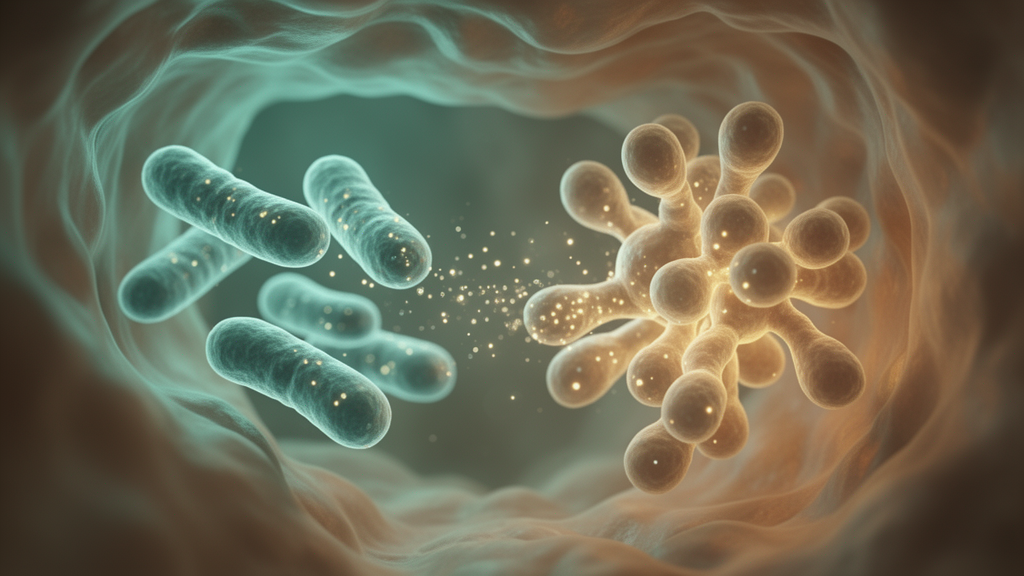
Deep inside the human gut, a microscopic drama unfolds every second. Hundreds of bacterial species crowd together in a dense, nutrient-scarce environment, competing for resources while simultaneously depending on one another in ways scientists are only beginning to unravel. For decades, microbiome research has concentrated on cataloguing which bacteria live in our intestines and in what numbers, with dominant groups such as Bacteroides receiving most of the attention. What has remained largely hidden is the molecular conversation happening between the less abundant residents—species that persist at low levels yet clearly survive for a reason. A new study from Hosei University in Japan now reveals one such conversation in remarkable molecular detail, showing that Escherichia coli, a bacterium famous more for its laboratory utility than its gut prominence, actively monitors the metabolic activity of its neighbor Bifidobacterium by reading the chemical footprints that neighbor leaves behind.
The research, led by Professor Kaneyoshi Yamamoto of the Department of Frontier Bioscience and Research Institute of Micro-Nano Technology at Hosei University, was published in Volume 16 of the journal Scientific Reports on August 25, 2026. The team set out to examine how two non-dominant gut inhabitants—E. coli and Bifidobacterium—interact at the level of individual molecules rather than at the level of population statistics. Traditionally, gut research has mostly focused on discovering the different species of bacteria in our gut, Professor Yamamoto explains. We were, however, fascinated by the social life of these bacteria. We focused on E. coli and Bifidobacterium, which are two minority species in our gut. In this study, we have discovered a new mechanism through which one bacterium detects the metabolic activity of the other.
Bifidobacterium species are widely regarded as beneficial gut bacteria, celebrated for their capacity to break down complex carbohydrates that human digestive enzymes cannot handle, including human milk oligosaccharides, the intricate sugars found in breast milk. As these bacteria metabolize such substrates, they release a variety of metabolic byproducts into their surroundings. The Japanese team discovered that E. coli does not ignore this chemical exhaust. Instead, it deploys specialized sensory systems to detect specific molecules among the released products, effectively gathering intelligence about what its neighbor is doing. From these chemical footprints, E. coli can infer the metabolic state of nearby Bifidobacterium cells and adjust its own metabolism in preparation. The researchers gave this behavior an evocative name: metabolic eavesdropping.
Identifying the sensory machinery behind this eavesdropping required a systematic search. E. coli possesses an extensive array of transport and sensing systems, each tuned to particular nutrients. The researchers screened 54 different transport systems corresponding to 61 carbon sources that E. coli can utilize, testing which ones responded to metabolites released by Bifidobacterium. The screen pointed to two sensory pathways: the Uhp and Idn systems. Of these, the Uhp system emerged as the star of the show. It is a well-characterized two-component system—a bacterial signaling architecture in which a membrane sensor detects a molecule outside the cell and relays the message to a regulator inside—that is dedicated to sensing and transporting hexose phosphates, a class of phosphorylated sugars, with glucose-6-phosphate, abbreviated G6P, being the prototypical member.
The specificity of the response proved to be the most striking finding. When the researchers exposed E. coli to metabolites from Bifidobacterium, the Uhp system switched on. But when they exposed it to metabolites from Bacteroides species—the bacteria that numerically dominate the human gut—the system remained silent. This result carries a significant implication: the hexose phosphates that activate Uhp, including G6P, are not simply universal waste products that any metabolizing bacterium would release. Rather, they appear to be specifically secreted by Bifidobacterium, making them a chemical signature that E. coli can use to identify this particular neighbor. In a gut crowded with dozens of competing species, such a discriminating sensor would allow E. coli to distinguish friend from background noise.
To nail down G6P as the primary sensing molecule, the team devised an elegant kinetic trapping experiment. They treated Bifidobacterium-conditioned medium—liquid in which Bifidobacterium had been growing—with two versions of the enzyme G6P dehydrogenase: a fast-acting form and a slower-acting variant of the same enzyme. The logic was straightforward. If G6P were the true signal, the fast enzyme would consume it quickly and strip the medium of its ability to activate the Uhp system, while the slow enzyme would leave more of the signal intact. That is precisely what happened. The fast-acting enzyme metabolized the G6P signals and significantly decreased Uhp sensory activity compared with the slow-acting enzyme, providing strong evidence that G6P is the molecule E. coli is actually listening for. The researchers also found that Bifidobacterium consistently releases G6P while metabolizing different sugars, suggesting that the molecule serves as a universal signal associated with Bifidobacterium metabolism regardless of the specific food source.
One further detail transformed the finding from a laboratory curiosity into a statement about how the gut is physically organized. G6P is an unstable, short-lived molecule, which means the signal decays rapidly once released. For E. coli to detect it, the two species must be living within roughly 40 micrometers of each other—a distance the researchers describe as a spatial hub. Forty micrometers is less than the width of a human hair, meaning the eavesdropping only works when the bacteria are essentially neighbors. This constraint implies that non-dominant gut bacteria may not be scattered randomly through the intestinal landscape. Instead, they may cluster into spatial hubs where different species interact through specific molecular links, forming localized communication networks that operate beneath the radar of bulk microbiome surveys.
Such non-dominant networks could help resolve a long-standing puzzle in microbiome science: how so many bacterial species coexist in a single environment without the strongest competitors simply wiping out the rest. If minority species form close-range partnerships anchored in specific metabolic exchanges, diversity becomes not just tolerated but structurally supported. The researchers suggest that these spatial hubs, stitched together by molecular conversations like the one between E. coli and Bifidobacterium, may contribute to the stability and resilience of the gut microbiome as a whole. Our results reveal a new model for microbiome regulation in the gut that contributes to the stabilization of the gut environment, notes Professor Yamamoto.
The practical implications extend well beyond basic biology. This research could help with the development of next-generation probiotics designed to enhance beneficial microbial interactions, Professor Yamamoto says. In addition, this could help with the development of targeted gut therapies, potentially allowing harmful bacteria to be suppressed while minimizing disruption to healthy gut flora. Current probiotics largely work by adding beneficial species and hoping they take hold; a probiotic designed around metabolic eavesdropping could instead be engineered to strengthen the communication channels that keep beneficial communities stable. Similarly, targeted therapies might exploit the same sensory channels to starve or mislead pathogenic bacteria without the broad-spectrum collateral damage of antibiotics.
By identifying the hidden interactions that shape the gut microbiome, this study opens a window onto the social life of bacteria that has been invisible to most previous research. The work was supported by a Grant-in-Aid for Scientific Research (C) from MEXT, grants 20K05795 and 23K04998, and the authors declared no competing interests. The research team included Tomotsugu Ohno, Masato Hoshino, Tsubasa Niino, Masanori Tamura, Miho Yoshimura, and Kaneyoshi Yamamoto, all affiliated with the Department of Frontier Bioscience and Research Institute of Micro-Nano Technology at Hosei University. As the field moves from cataloguing who lives in the gut to understanding how those residents talk to each other, studies like this one suggest that the most important conversations may be happening quietly, at distances of mere micrometers, between species that barely register in a sequencing readout—and that listening in on them could pave the way for specialized gut therapies that enhance health and quality of life for all.
Subject of Research: How E. coli senses Bifidobacterium metabolites in the human gut
Article Title: How Escherichia coli eavesdrops and senses Bifidobacterium
Article References: How Escherichia coli eavesdrops and senses Bifidobacterium. (n.d.). Original publication
Image Credits: AI Generated
DOI: Not provided
Keywords: gut microbiome, Escherichia coli, Bifidobacterium, metabolic eavesdropping, Uhp system, glucose-6-phosphate, microbiome stability, Scientific Reports, Hosei University, probiotics, Escherichia, coli
Cite Scienmag News
Morgan Morrow. (October 17, 2026). Gut bacteria caught eavesdropping: E. coli reads chemical signals from Bifidobacterium. Scienmag. https://scienmag.com/gut-bacteria-caught-eavesdropping-e-coli-reads-chemical-signals-from-bifidobacterium/
Morgan Morrow. "Gut bacteria caught eavesdropping: E. coli reads chemical signals from Bifidobacterium." Scienmag, 17 October 2026, https://scienmag.com/gut-bacteria-caught-eavesdropping-e-coli-reads-chemical-signals-from-bifidobacterium/. Accessed 17 October 2026.
Morgan Morrow. "Gut bacteria caught eavesdropping: E. coli reads chemical signals from Bifidobacterium." Scienmag. October 17, 2026. https://scienmag.com/gut-bacteria-caught-eavesdropping-e-coli-reads-chemical-signals-from-bifidobacterium/


