


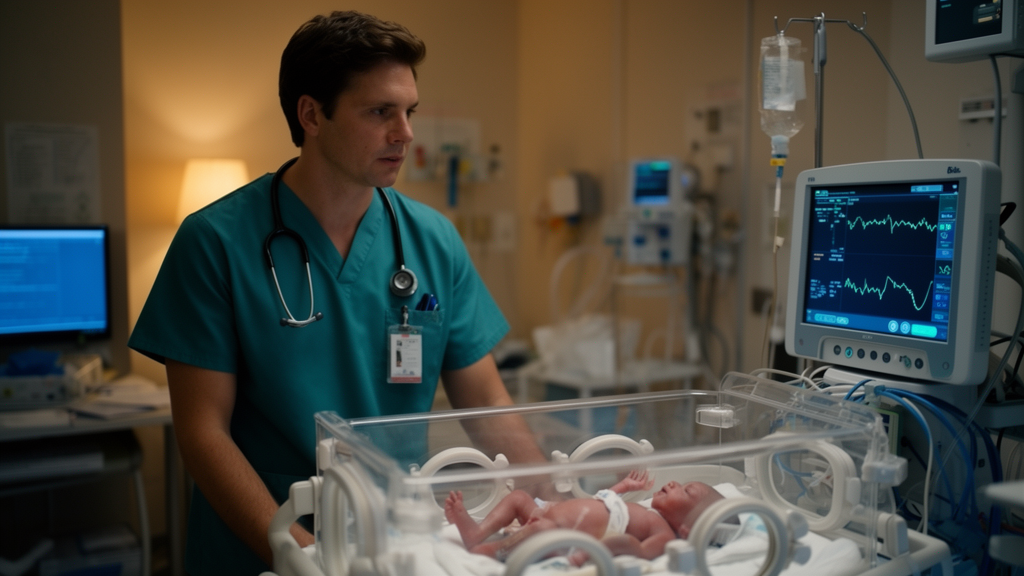
Artificial intelligence has already proven itself in radiology reading rooms, where algorithms detect fractures and tumors with remarkable accuracy. But the next frontier for medical AI is far more delicate: the neonatal intensive care unit, where physicians make life-and-death decisions about the tiniest and most vulnerable patients. A new qualitative study from the University Medical Center Utrecht, published in BMC Pediatrics, offers one of the most detailed portraits yet of how specialists actually think about trusting AI at the bedside—and the findings reveal a strikingly nuanced psychology of trust that could shape how these systems are deployed in hospitals worldwide.
The research team, led by Lotte Schuitmaker and colleagues in the Department of Bioethics and Health Humanities, conducted in-depth, semi-structured interviews with 17 neonatologists at a Dutch academic hospital. Using thematic analysis, a rigorous qualitative method that systematically codes interview transcripts to identify recurring patterns of meaning, the researchers distilled the physicians’ perspectives into three overarching themes: trusting AI in practice, maintaining control over trusted AI systems, and the limits of trust. The study protocol was reviewed by the research quality control committee of the University Medical Center Utrecht and deemed exempt from the Medical Research Involving Humans Act under research proposal number 23U-0364, and the work was carried out in accordance with the Declaration of Helsinki.
Perhaps the most technically significant finding is the physicians’ insistence on a conceptual distinction that has often been blurred in the AI ethics literature: the difference between trust, confidence, and reliance. In the philosophical sense the neonatologists invoked, trust implies a relationship in which the trusted party is expected to act in the trustor’s interest even under uncertainty, whereas confidence describes a settled expectation based on evidence of performance, and reliance describes the practical act of depending on a system’s output. The neonatologists argued that these are not interchangeable. They can rely on an AI tool’s output without trusting it, and they can trust a colleague’s judgment without relying on it in every case. This distinction matters because much of the current debate about medical AI treats the problem as one of calibration—getting physicians to have the right degree of confidence in an algorithm’s accuracy. The Utrecht interviews suggest the real challenge is deeper: physicians want to know what kind of relationship they are entering into with these systems before they decide whether trust is appropriate at all.
Across the interviews, one condition for trust emerged as non-negotiable: AI’s role must be supplemental to the physician’s own role. The neonatologists welcomed AI in neonatal clinical settings overall, but only on the understanding that the technology augments rather than replaces human judgment. This is not mere professional self-protection. In neonatology, where patients cannot communicate their symptoms and clinical data streams continuously from monitors, ventilators, and laboratory tests, the physician’s integrative judgment—weighing ambiguous signals against the individual patient’s trajectory—is precisely the kind of reasoning that current AI systems, however impressive in narrow imaging tasks, cannot fully replicate. The specialists’ insistence on supplementarity reflects a technically informed understanding of where AI’s strengths and weaknesses lie in data-rich but context-heavy medical domains.
The second pillar of trust identified in the study is validation combined with adequate oversight. The physicians considered rigorous validation of AI systems essential before those systems earn a place in bedside decision-making, and they regarded ongoing human oversight as equally indispensable. This aligns with the well-documented gap between AI’s technical advancement and its practical use in clinical care: a disparity persists between what algorithms can demonstrably do in controlled evaluations and what they can safely do in the messy, evolving conditions of real patient care. The neonatologists’ demand for validation and oversight is a demand for evidence that performance holds up outside the laboratory, and for institutional structures that keep humans in the loop as systems evolve.
Equally important to the physicians was preserving human expertise while working with AI in clinical settings. This concern goes beyond the immediate question of whether an algorithm’s output is accurate. If AI systems gradually take over parts of clinical reasoning, the physicians worried, the expertise needed to supervise those systems—and to catch their failures—could erode. This is a technically recognized phenomenon in human factors research: skills that are rarely exercised degrade, and physicians who habitually defer to algorithmic recommendations may lose the very competence that makes their supervision meaningful. The Utrecht interviews show that neonatologists see this erosion risk as a genuine limit on how much responsibility AI can be given, not as a vague anxiety about change.
The third theme, the limits of trust, surfaced most frequently in the form of two specific worries: overreliance and the incompatibility of clinical intuition with AI in practice. Overreliance—the tendency of humans to accept algorithmic outputs even when those outputs are wrong—is a documented failure mode in human-AI interaction, and the neonatologists named it as a primary reason they might lose trust in AI systems. The second worry is subtler and arguably more consequential for the future of medical AI. Clinical intuition in neonatology is built on years of pattern recognition across thousands of patient encounters, integrating signals that resist formalization into training data. When an AI recommendation conflicts with that intuition, the physician faces a genuine epistemic dilemma: the algorithm may be drawing on population-level patterns the physician has not consciously registered, or it may be failing to capture context the physician knows matters. The interviews reveal that neonatologists experience this incompatibility not as a bug to be engineered away but as a structural feature of how AI and human reasoning differ.
The study’s conclusions carry practical weight for hospitals and regulators moving to deploy AI in neonatal care. The researchers recommend clarifying what is expected of physicians in terms of reliance on AI at the bedside, and formulating concrete guidance for trust in AI. This is a pointed recommendation: in the absence of explicit institutional guidance, individual physicians are left to improvise their own standards for when to accept algorithmic output, when to override it, and when to distrust it entirely. The Utrecht findings suggest that improvisation is already happening, guided by the physicians’ own conceptual frameworks of trust, confidence, and reliance—but that hospitals would do better to make these expectations explicit rather than leave them to bedside discretion.
What makes this study resonate beyond neonatology is its methodological honesty. Rather than surveying physicians with predetermined questions about AI acceptance, the researchers let the themes emerge from open-ended conversation, capturing the ambivalence that quantitative surveys often flatten. The result is a portrait of physicians who are neither AI enthusiasts nor AI skeptics: they welcome the technology’s promise to improve patient outcomes, increase efficiency, and reduce healthcare costs, while insisting on conditions—supplementarity, validation, oversight, preserved expertise—that current deployment strategies often treat as afterthoughts. As AI expands from radiology into neonatology and other data-rich domains, the Utrecht interviews offer a technically grounded answer to the question that will determine medical AI’s real-world success: not whether the algorithms are accurate enough, but whether physicians can determine when they can reasonably be trusted.
Subject of Research: Physicians' trust in medical AI in neonatology
Article Title: Trust in artificial intelligence at the bedside: a qualitative interview study with neonatologists
Article References: Schuitmaker, L., Drogt, J., Hartman, S. D., & Jongsma, K. (2026). Trust in artificial intelligence at the bedside: a qualitative interview study with neonatologists. BMC Pediatrics. https://doi.org/10.1186/s12887-026-07890-4
Image Credits: AI Generated
DOI: 10.1186/s12887-026-07890-4
Keywords: artificial intelligence, neonatology, medical AI, clinical decision-making, trust in AI, qualitative research, BMC Pediatrics, healthcare ethics, Trust, artificial, intelligence, bedside
Cite Scienmag News
Ophelia Keating. (October 17, 2026). Neonatologists Reveal What Makes AI Trustworthy at the Bedside. Scienmag. https://scienmag.com/neonatologists-reveal-what-makes-ai-trustworthy-at-the-bedside/
Ophelia Keating. "Neonatologists Reveal What Makes AI Trustworthy at the Bedside." Scienmag, 17 October 2026, https://scienmag.com/neonatologists-reveal-what-makes-ai-trustworthy-at-the-bedside/. Accessed 17 October 2026.
Ophelia Keating. "Neonatologists Reveal What Makes AI Trustworthy at the Bedside." Scienmag. October 17, 2026. https://scienmag.com/neonatologists-reveal-what-makes-ai-trustworthy-at-the-bedside/


