


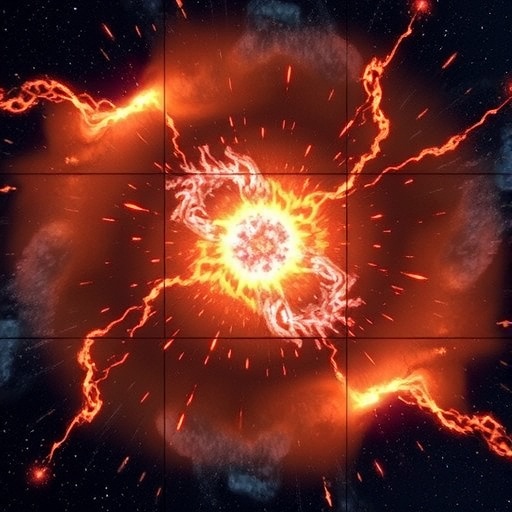
In a groundbreaking discovery that promises to reshape our understanding of stellar death throes, an international team of astronomers led by researchers at Northwestern University has identified an unprecedented type of supernova, dubbed SN2021yfj. Unlike typical stellar explosions that manifest signatures dominated by light elements such as hydrogen and helium, this extraordinary supernova exhibited spectral lines rich in silicon, sulfur, and argon—elements forged deep within a massive star’s furnace. This observation offers an unparalleled glimpse into the internal workings of one of the universe’s most cataclysmic events and challenges long-standing astrophysical models of stellar evolution.
Massive stars, those weighing anywhere from 10 to 100 times the mass of our Sun, live tumultuous lives governed by nuclear fusion processes. Over millions of years, these celestial behemoths fuse lighter elements into heavier ones in a stratified, onion-like layering inside their cores. Traditionally, astronomers have been able to observe explosions revealing outer shells rich in lighter elements, as these layers are typically shed during a star’s final phases. However, the discovery of SN2021yfj marks a dramatic departure from this norm. Its progenitor star astonishingly lost almost all of its external envelopes—hydrogen, helium, and even carbon—before its spectacular detonation, exposing at last the deep, silicon- and sulfur-rich layers.
Detecting this rare event required the confluence of serendipity and state-of-the-art observational technology. The initial discovery of the bright transient object was made in September 2021 through the Zwicky Transient Facility (ZTF), a wide-field survey instrument situated near San Diego. The ZTF is renowned for its ability to scan large swaths of the sky rapidly, capturing transient phenomena like supernovae that emerge suddenly and fade swiftly. Following discovery, the team urgently sought spectroscopic observations to decode the chemical makeup of the explosion. While initial efforts were hampered by unfavorable weather conditions and telescope scheduling conflicts, a particularly fortunate intervention by colleagues at the W. M. Keck Observatory in Hawai‘i led to the collection of crucial spectral data.
The spectrum of SN2021yfj defied all prior expectations. Unlike common supernovae that prominently showcase light elements, this supernova’s spectrum was dominated by absorption and emission lines corresponding to silicon, sulfur, and argon. These elements are synthesized in the innermost burning regions of a massive star during its terminal evolutionary stages. The prominence of these features signals that the progenitor star was stripped nearly “to the bone,” leaving only its inner fusible core exposed at the time of explosion. This rare configuration grants astronomers direct observational insight into a star’s interior composition moments before collapse—something previously relegated to theoretical modeling.
This extraordinary stellar event compels significant re-examination of the mechanisms underlying massive star evolution and death. It suggests not only that stars can lose their outer layers early on, but also that such mass loss can proceed all the way down to the innermost burning shells without preventing a powerful supernova explosion. The implications for stellar physics are profound because they challenge the prevailing models, which often assume that outer envelopes persist until the final moments. SN2021yfj’s violent shedding of silicon and sulfur layers hints at exotic pre-supernova phenomena, which may include episodic mass ejections driven by dramatic nuclear burning phases or interactions with otherwise unseen binary partner stars.
One compelling hypothesis proposed by the research team involves repeated pair-instability pulses within the dying star’s core. In this scenario, the core’s escalating temperature and density ignite runaway nuclear reactions that unleash energetic pulses, blasting away successive shells of stellar material. Each pulse drives an outward explosion that sheds a layer before the final catastrophic collapse. When these ejected shells collide, they generate the intense luminous emission that was detected by astronomers, painting a vivid picture of the star’s final violent spasms.
While this theory offers a tantalizing explanation, some uncertainty remains, particularly because SN2021yfj represents the first identified example of such a stripped-core supernova. The rarity of such phenomena suggests they may arise under finely tuned astrophysical conditions or from previously unconsidered evolutionary pathways. The discovery underscores the need for continuous and comprehensive sky surveys, coupled with high-resolution spectroscopic follow-ups, to uncover further examples that could reveal patterns needed to refine or overhaul existing theoretical models.
The implications extend beyond stellar evolution into broader cosmic contexts. Supernovae are fundamental to galactic chemical enrichment, dispersing heavy elements forged in stellar cores into the interstellar medium. The identification of supernovae that predominantly eject silicon and sulfur-rich material could alter our understanding of how these elements are distributed across galaxies, influencing subsequent star formation and planetary system development. Additionally, such peculiar explosions may serve as critical benchmarks for testing nucleosynthesis pathways and the physics of extreme stellar interiors.
This discovery also exemplifies the collaborative and cross-institutional nature of modern astrophysics. Instruments like the Zwicky Transient Facility and the Keck Observatory are pivotal in capturing ephemeral cosmic events that would otherwise elude detection. The rapid coordination between observatories and researchers enabled by digital communication networks showcases the agility required to study fleeting astronomical phenomena with the necessary resolution and depth.
Moreover, the findings highlight the importance of maintaining versatile and robust astronomical infrastructure capable of time-sensitive observations. Given that transient events often fade within days or even hours, timely data collection is essential to extract meaningful scientific insights. The serendipitous acquisition of SN2021yfj’s spectrum by a colleague at UC Berkeley underscores how distributed expertise and goodwill are instrumental in advancing the frontier of knowledge.
Looking forward, the astrophysical community is poised to leverage forthcoming observational facilities and instruments to deepen study of such enigmatic objects. Missions like the Vera C. Rubin Observatory promise to exponentially increase transient detections, potentially identifying many more examples of stripped-core supernovae. Comprehensive multi-wavelength follow-up campaigns will be essential to building a holistic understanding of the physical processes at play, from progenitor evolution to explosive nucleosynthesis and eventual remnant formation.
In conclusion, SN2021yfj presents a rare yet profoundly informative window into the death throes of massive stars. Its unusual chemical signature and stripped structure challenge traditional paradigms and force a reevaluation of the complex lifecycle pathways that stars may follow. As astronomers continue to uncover more of nature’s cosmic oddities, these findings will undoubtedly refine our grasp of the universe’s elemental origins and the dynamic processes that govern stellar demise.
News Publication Date: 20-Aug-2025
Web References: 10.1038/s41586-025-09375-3
Keywords
Supernovae, Silicon, Stars, Stellar evolution, Stellar explosions
Cite Scienmag News
Bethany Barker. (August 20, 2025). Groundbreaking Supernova Discovery Unveils the Inner Secrets of a Dying Star. Scienmag. https://scienmag.com/groundbreaking-supernova-discovery-unveils-the-inner-secrets-of-a-dying-star/
Bethany Barker. "Groundbreaking Supernova Discovery Unveils the Inner Secrets of a Dying Star." Scienmag, 20 August 2025, https://scienmag.com/groundbreaking-supernova-discovery-unveils-the-inner-secrets-of-a-dying-star/. Accessed 4 September 2026.
Bethany Barker. "Groundbreaking Supernova Discovery Unveils the Inner Secrets of a Dying Star." Scienmag. August 20, 2025. https://scienmag.com/groundbreaking-supernova-discovery-unveils-the-inner-secrets-of-a-dying-star/


