


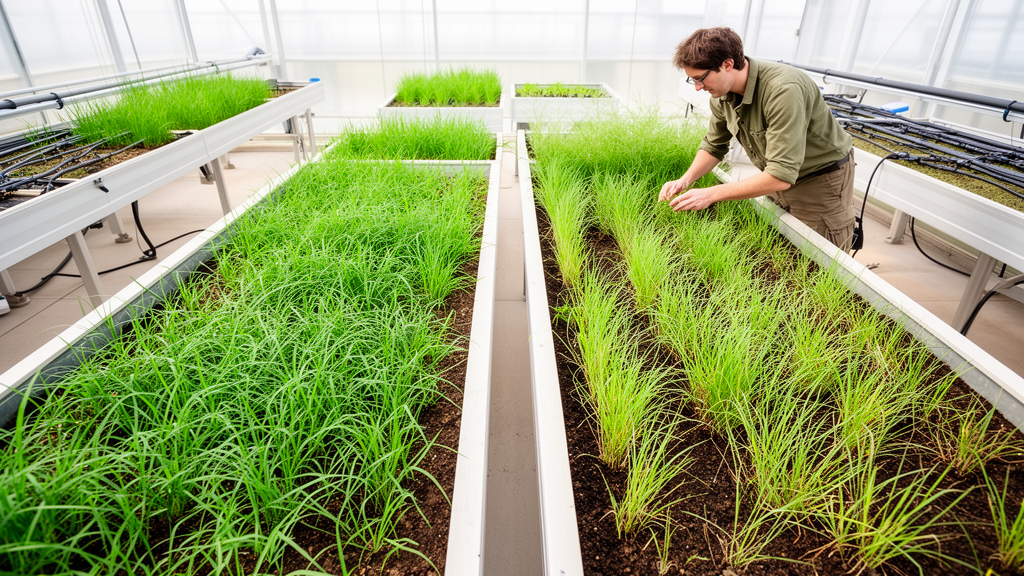
A two-phase greenhouse experiment found that soil associated with invasive annual grasses can alter their later growth and competition, with the clearest evidence pointing to weakened intraspecific competition in soil conditioned by the same species. The study focused on cheatgrass, Bromus tectorum , and ventenata, Ventenata dubia , two cool-season grasses that invade semi-arid rangelands in the western United States. Researchers grew the grasses in soils collected from sites with different invasion histories, then replanted them in the same pots after 10 weeks.
The results suggest that plant–soil feedbacks may help these invaders sustain dense stands, but the greenhouse design could not determine whether microbes, nutrients or other soil properties produced the effects. The experiment used field soil from three nearby locations near Springhill Community in Gallatin County, Montana. One treatment came from land historically confirmed to be uninvaded by either grass; the others came from sites occupied by B. tectorum but not V. dubia , or by V. dubia but not B. tectorum .
Each pot contained pasteurized potting soil topped with a 1-centimeter layer of one of these field soils. Seeds were planted at densities ranging from one to 16 plants, with monocultures and mixed-species arrangements. After the first 10-week growth period, plants were harvested, the pots were left dry for two weeks, and the same planting arrangements were restored for a second 10-week period.
No additional soil or sterilization was applied between phases, allowing the second planting to experience both the field legacy and the conditioning produced during the first phase. In the first phase, which tested growth in soils carrying their pre-existing field legacies, B. tectorum had the greatest average per-capita biomass in V. dubia soil, at 0.112 grams, followed by B. tectorum soil at 0.094 grams and neutral soil at 0.063 grams. V. dubia also grew best in soil from the two invaded sites: mean per-capita biomass was 0.020 gram in V. dubia soil and 0.018 gram in B. tectorum soil, with no significant difference between them, versus 0.014 gram in neutral soil.
Thus, before experimental conditioning, plants of both species performed better in soils associated with invasive grass occupancy than in the uninvaded reference soil. Density nevertheless shaped performance substantially. Each additional B. tectorum plant reduced its own per-capita biomass by an estimated 15% in neutral soil and by 11% in B. tectorum soil, while the corresponding decline was not significant in V. dubia soil.
The influence of V. dubia on B. tectorum varied by soil: biomass fell by 3% for each added V. dubia plant in neutral soil, by 9% in V. dubia soil, and showed no significant change in B. tectorum soil. Across soils, an additional V. dubia plant reduced mean per-capita V. dubia biomass by 4%, whereas an additional B. tectorum reduced it by 15%. These phase-one responses indicate that both aboveground competition and soil origin influenced the grasses, with the strength of some effects depending on the soil treatment.
The second phase produced more distinct patterns associated with experimental soil conditioning. For B. tectorum , soil origin alone did not significantly affect per-capita biomass, but its interactions with plant density did. Intraspecific competition was pronounced in neutral soil, where each added B. tectorum plant reduced biomass by 22%, and weaker in V. dubia soil, where the reduction was 14%.
In soil previously conditioned by B. tectorum , however, increasing its own density produced less than a 1% change in per-capita biomass. That near stabilization was interpreted as evidence of positive plant–soil feedback: the grass may have altered its soil in a way that reduced the density-dependent limitation experienced by its own kind. The conditioning effect for V. dubia was more complex and did not support the study’s prediction that B. tectorum soil would benefit it.
Mean per-capita biomass was highest in V. dubia soil at 0.014 gram, lowest in B. tectorum soil at 0.004 gram, and intermediate in neutral soil at 0.008 gram. The difference between V. dubia and B. tectorum soils was significant, whereas the neutral-soil value did not differ significantly from either. Intraspecific density dependence was absent in neutral and V. dubia soils, but appeared in B. tectorum soil, where each additional V. dubia reduced per-capita biomass by 16%.
By contrast, B. tectorum strongly reduced V. dubia biomass: the estimated decrease was 42% per added B. tectorum in neutral soil, 32% in V. dubia soil and 18% in B. tectorum soil. The response of V. dubia therefore depended on both soil origin and the competing plants present. Nonlinear competition models offered a second, partly contrasting view.
Their bootstrapped coefficients generally indicated stronger intraspecific than interspecific competition for both grasses, with overlapping confidence intervals preventing firm comparisons among soil treatments. B. tectorum was consistently less affected by competition than V. dubia . The estimated effect of V. dubia on B. tectorum remained below the estimated effect of B. tectorum on V. dubia in every treatment and phase.
These models use a different parameterization from the mixed-effects analyses and assume the same resource-use efficiency for both species, so their coefficients are not directly comparable. The apparent tension between the two approaches illustrates that the evidence for feedback depends on the model and the soil treatment rather than pointing to one uniform mechanism. Why the two grasses can form dense monocultures is therefore partly a question about what happens beneath their feet, not only about competition for light above ground.
B. tectorum has shallow fibrous roots, can alter litter cover and nitrogen cycling, and has been associated with neutral or negative effects on arbuscular mycorrhizal fungi in invaded areas. V. dubia produces leaves with high silica content, which may slow litter decomposition, and its effects on mycorrhizal fungi vary among study locations. A soil legacy could also involve shifts in nutrient partitioning or interactions with pathogens and other organisms.
The experiment did not include a sterilized-soil control and did not directly measure microbial communities, so its treatment differences represent combined soil effects and cannot be assigned to microbes or abiotic properties individually. The results carry implications for secondary invasion—the establishment or expansion of one invasive species after another is removed—without demonstrating that outcome in the field. Both grasses germinate in autumn and are commonly targeted with pre- or early post-emergent herbicides, but V. dubia also has a spring cohort that shorter-residual treatments may miss.
Because B. tectorum exerted the stronger estimated effect on V. dubia under the experiment’s watering regime, removing B. tectorum could release V. dubia from competition in some circumstances. That is a plausible management scenario, not a tested field prediction. The authors also caution that the relationship may change with temperature, moisture and the density of established conspecifics, while noting that a dense V. dubia population could reduce the per-plant effect of invading B. tectorum .
Overall, the study provides greenhouse evidence that soil legacies can modify density dependence in two invasive annual grasses associated with western rangelands. The strongest positive-feedback signal occurred when B. tectorum grew in soil conditioned by B. tectorum , whereas V. dubia showed a more context-dependent response and performed worst in B. tectorum -conditioned soil. Neither species displayed a simple, universal advantage through soil conditioning.
Field experiments across moisture and temperature gradients, together with direct measurements of arbuscular mycorrhizal fungi, nutrient cycling and other soil biota, will be needed to determine whether the observed feedback helps sustain monocultures, promotes species replacement or alters the consequences of management in western rangelands.
Subject of Research: Greenhouse testing of plant–soil feedbacks and competition between Bromus tectorum and Ventenata dubia
Article Title: Plant–Soil Feedbacks May Underlie Competitive Dynamics Between Co‐Occurring Invasive Annual Grasses Bromus tectorum and Ventenata dubia
Article References: Sencenbaugh, L., Mangold, J. M., Maxwell, B. D., Ulrich, D. E. M., & Rew, L. J. (2026). Plant–Soil Feedbacks May Underlie Competitive Dynamics Between Co‐Occurring Invasive Annual Grasses Bromus tectorum and Ventenata dubia. Ecology and Evolution, 16(10), Article e74516. https://doi.org/10.1002/ece3.74516
Image Credits: AI Generated
DOI: 10.1002/ece3.74516
Keywords: plant–soil feedback, soil legacy, invasive grasses, Bromus tectorum, Ventenata dubia, plant competition, greenhouse experiment, rangeland invasion, density dependence, mycorrhizal fungi, Plant, Soil
Cite Scienmag News
Drew Townsend. (October 22, 2026). Greenhouse study links soil legacies to competition between invasive annual grasses. Scienmag. https://scienmag.com/greenhouse-study-links-soil-legacies-to-competition-between-invasive-annual-grasses/
Drew Townsend. "Greenhouse study links soil legacies to competition between invasive annual grasses." Scienmag, 22 October 2026, https://scienmag.com/greenhouse-study-links-soil-legacies-to-competition-between-invasive-annual-grasses/. Accessed 22 October 2026.
Drew Townsend. "Greenhouse study links soil legacies to competition between invasive annual grasses." Scienmag. October 22, 2026. https://scienmag.com/greenhouse-study-links-soil-legacies-to-competition-between-invasive-annual-grasses/


