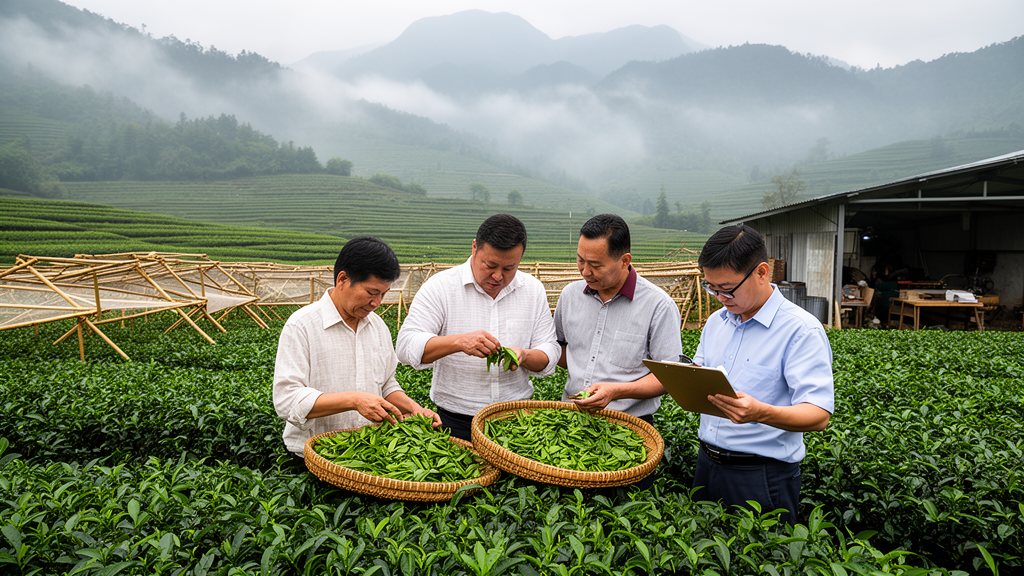
State-backed branding has helped Enshi Yulu tea gain wider recognition and higher-value market access, but a qualitative study of southwestern Hubei shows that certification does not eliminate farmers’ adaptive practices. Instead, the geographical-indication and intangible-cultural-heritage regime creates boundaries around accepted varieties, processing methods and sales channels, while smallholders selectively adapt those rules to cope with mountain conditions, seasonal labour demands and uncertain markets. Researchers describe this as selective institutional translation: authorities convert selected elements of local knowledge into official standards and authorized expressions of regional authenticity, leaving other practices outside or only ambiguously inside the formal system.
The study examines Enshi City in the Wuling Mountain region, where Enshi Yulu is a nationally recognized geographical-indication product known for steamed-green processing and an identity associated with selenium-rich soils. Fieldwork conducted in 2023 and 2024 included semi-structured interviews with nine participants: four tea farmers or tea-making practitioners, three traders or distributors, one local-government official and one industry expert. The researchers also analyzed local gazetteers, policy documents, certification materials, heritage archives, brand-promotion reports and statistical yearbooks. Because the sample was small and purposively recruited, the findings identify mechanisms and lived practices rather than estimating their prevalence or demonstrating causal effects across the tea industry.
Government policy has transformed Enshi Yulu from a dispersed regional product into an organized public brand. Since national geographical-indication protection in 2007, local authorities have used production standards, designated cultivation areas, heritage recognition, enterprise authorization and branding to make the tea easier to inspect, certify and sell. The 2006 processing regulations established steamed-green production as the authorized technical route and codified stages including steaming, drying, rolling and shaping. Mechanized steam-fixation and shaping equipment subsequently helped convert sensory craft practices into operations governed by measurable temperature, pressure and timing parameters. Direct-operated stores, e-commerce platforms and enterprise procurement networks have further integrated production and marketing.
This standardization has clear economic and organizational advantages. It can make quality more consistent, improve traceability and connect smallholders to procurement contracts, cooperatives, public branding and broader markets. The study notes that output value grew substantially between 2016 and 2022, although its design did not estimate the causal contribution of geographical-indication governance to prices, incomes or output. Citywide statistics also report tea output of 26,500 tonnes in 2019, rising to 27,700 tonnes in 2024, with a dip to 25,300 tonnes in 2022. These figures cover tea across Enshi City rather than Enshi Yulu alone, so they cannot isolate the branded product or demonstrate an effect of certification.
At the same time, the regime narrows the range of production that can be represented as authentic Enshi Yulu. The Wuling Mountains have historically supported more than forty recorded local tea varieties adapted to differences in altitude, slope, soil and microclimate, but government programs have promoted a narrower institutional hierarchy built around Yulu No. 1, Longjing 43 and Zhongcha 108. Cultivars suitable for uniform processing gain greater symbolic and economic value and become easier to incorporate into enterprise procurement. The result is a paradox: geographical indication depends on ecological specificity to create market value, yet commercial scalability often requires some of that diversity to be simplified.
Farmers nevertheless retain mixtures of local and introduced varieties. Interviewed growers described using different cultivars to spread the spring harvest, reduce dependence on hired labour and protect household income when weather, prices or labor availability change. Local varieties may bud and mature outside the narrow window required for the standard “one bud, one leaf” standard, extending the period during which a family can earn income. Older growers also associated traditional cultivars with longer harvest cycles, processing flexibility and flavors that reflect particular mountain environments. These practices were not necessarily acts of resistance. They combined ecological adaptation with a household logic that considered labor returns, family availability and the timing of income alongside yield and formal compliance.
Processing reveals an equally practical tension between rules and sensory judgment. Tea makers in the study adjusted steaming time, rolling pressure, spreading duration and drying intensity according to humidity, leaf tenderness, mist, slope exposure and customer preferences. Fresh leaves from gardens with similar elevations could still vary because of sunlight, soil and slope orientation. Experienced makers judged texture, color, vapor, aroma and feel, then calibrated equipment accordingly. Many did not view mechanization as incompatible with tradition; instead, they treated machinery as a tool whose use still required sensory expertise. The central conflict was therefore less manual production versus machines than a contest between fixed parameters and flexible responses to heterogeneous leaves and changing demand.
Marketing practices also retained a relational dimension. Some customers placed advance orders during the spring season, while producers reserved tea from selected gardens or batches for repeat buyers. Such arrangements linked price, quality, trust and obligation across time, allowing buyers to manage uncertainty and sellers to secure demand before peak sales. Small traders differentiated tea by location, slope, picking time, processing style, aroma and individual preferences, turning local variation into a market advantage. WeChat groups, livestreaming and private customer networks extended these exchanges during periods of disruption, including the COVID-19 pandemic. Such channels sometimes operated alongside, rather than entirely within, the formal certified system.
The findings do not support a simple opposition between state institutions and local farmers. Public governance created brand recognition, coordinated standards and opened routes into wider markets, while producers used those opportunities while modifying, supplementing or working around particular requirements. Habitus, in the study’s sociological sense, describes durable but generative dispositions that help farmers make context-sensitive decisions without mechanically applying official rules; it is not another name for local knowledge or proof that tradition inevitably defeats innovation. The resulting pattern is selective institutional participation rather than wholesale compliance or complete withdrawal. The study’s authors argue that more adaptive governance could retain non-negotiable food-safety, origin and traceability requirements while documenting permissible variation in cultivar mixtures and processing. Consultation, pilot authorizations and differentiated sub-labels are proposed as design possibilities, but their effects were not evaluated.
The main limitation is the exploratory single-case design. Only one interviewed participant worked in local government, so that person’s account cannot represent municipal agencies or establish consensus among officials. Recruitment through bureaus, associations, committees, cooperatives and personal networks may also have favored accessible actors, while the analysis did not systematically compare practices by farm size, age or market access. Documents recorded formal rules but could not by themselves prove implementation, and the research did not isolate geographical-indication governance from household resources, market demand or ecological conditions. Its contribution is therefore an institution-specific explanation of how standards classify some local knowledge as authentic and other useful practices as marginal, generating propositions for comparative and longitudinal research rather than statistical generalization or proof of economic benefits.
Subject of Research: How geographical-indication governance interacts with smallholder practices in China’s Enshi Yulu tea industry
Article Title: Regulation penetrating the countryside and the persistence of habitus: governance tensions and smallholder practices in the modernisation of the Enshi tea industry
Article References: Wang, Y. (2026). Regulation penetrating the countryside and the persistence of habitus: governance tensions and smallholder practices in the modernisation of the Enshi tea industry. Frontiers in Sustainable Food Systems, 10, Article 1976545. https://doi.org/10.3389/fsufs.2026.1976545
Image Credits: AI Generated
DOI: 10.3389/fsufs.2026.1976545
Keywords: Enshi Yulu tea, geographical indication, smallholder farming, agricultural governance, tea certification, cultural heritage, ecological adaptation, farmer agency, China, Regulation, penetrating, countryside
Cite Scienmag News
Courtney Benton. (October 22, 2026). Tea certification standardizes Enshi farmers without erasing local practices. Scienmag. https://scienmag.com/tea-certification-standardizes-enshi-farmers-without-erasing-local-practices/
Courtney Benton. "Tea certification standardizes Enshi farmers without erasing local practices." Scienmag, 22 October 2026, https://scienmag.com/tea-certification-standardizes-enshi-farmers-without-erasing-local-practices/. Accessed 22 October 2026.
Courtney Benton. "Tea certification standardizes Enshi farmers without erasing local practices." Scienmag. October 22, 2026. https://scienmag.com/tea-certification-standardizes-enshi-farmers-without-erasing-local-practices/