

Tuesday, October 27, 2026
Science
No Result
View All Result
  • Login
  • HOME
  • SCIENCE NEWS
  • CONTACT US
  • HOME
  • SCIENCE NEWS
  • CONTACT US
No Result
View All Result
Scienmag
No Result
View All Result
Home Science News Earth Science

Green Pedagogy Framework Aims to Ready Sub-Saharan Teachers for Climate Curricula

October 27, 2026
in Earth Science
Sloane Callahan
By Sloane Callahan Scienmag Editorial Profile - Climate Mitigation
Reading Time: 3 mins read
0
Green Pedagogy Framework Aims to Ready Sub-Saharan Teachers for Climate Curricula

Green Pedagogy Framework Aims to Ready Sub-Saharan Teachers for Climate Curricula

65
SHARES
587
VIEWS
Share on FacebookShare on Twitter
ADVERTISEMENT

A perspective article published in Discover Sustainability argues that foundational teachers in Sub-Saharan Africa need a defined set of pedagogical competencies to integrate greening concepts into national school curricula, as part of efforts to advance Education for Sustainable Development (ESD) targets in the region’s marginalised communities. The author, Gideon Mensah Anapey, positions the work as a conceptual contribution rather than an empirical study, addressing a gap he identifies between research on foundational learning outcomes and the practical knowledge teachers need for climate-focused teaching.

The article frames its motivation around the pressures that climate change places on developing countries, citing extreme weather events, rising temperatures, and environmental degradation as threats to both livelihoods and the quality of learning outcomes. According to the author, scholarly work on foundational learning has concentrated heavily on literacy and numeracy while overlooking the knowledge that scholar-practitioners require for creative pedagogy supporting climate sustainability in many third-world nations. The study therefore asks what kinds of competencies early grade teachers should possess to bring greening concepts into classrooms serving vulnerable communities.

Methodologically, the piece takes a pamphlet approach, drawing on dialogic and illustrative material described as coming from experts’ stables, with the Learning Sciences philosophy guiding the expositions. Through this framing, the author builds a case for what he terms greening curriculum readiness in marginalised early grade classrooms. Because the work is a perspective, its outputs are proposals and frameworks rather than measured results from classroom trials or teacher surveys, a distinction that matters for how the recommendations should be read.

The central output is a green pedagogical framework built around teacher continuous professional development. The framework also includes greening assessment, learner reflexivity, problem-solving activities, and climate projects that celebrate indigenous knowledge, all oriented toward ESD readiness in Sub-Saharan African foundational learning. In practical terms, the author suggests the model could influence sustainability learning goals such as transdisciplinary knowledge, critical thinking, problem-solving skills, and climate adaptation in marginalised communities.

Beyond classroom practice, the article argues that climate-resilient discourse and foundational pedagogy policy must expand beyond curriculum propositions alone, so that environmental challenges can be meaningfully conceptualised for children in vulnerable communities. The contribution is thus aimed at both teacher educators and policymakers, proposing that professional development pathways and assessment design be aligned with sustainability objectives from the earliest years of schooling.

Readers should note the limitations inherent in the article’s design. As a perspective piece published open access in September 2026, it sets out a proposed framework and conceptual arguments; it does not report tested effects on teacher practice or pupil outcomes, and any impact on sustainability learning in African classrooms remains a prediction of the model rather than a demonstrated finding. Its value lies in offering a structured starting point for researchers, teacher-training institutions, and education ministries seeking to connect foundational learning with climate education in contexts where such integration has received limited scholarly attention.

Subject of Research: Foundational teachers’ greening curriculum readiness for advancing education for sustainable development targets in Sub-Saharan Africa

Article Title: Foundational teachers’ greening curriculum readiness for advancing education for sustainable development targets in Sub-Saharan Africa

Article References: Anapey, G. M. (2026). Foundational teachers’ greening curriculum readiness for advancing education for sustainable development targets in Sub-Saharan Africa. Discover Sustainability. https://doi.org/10.1007/s43621-026-04465-2

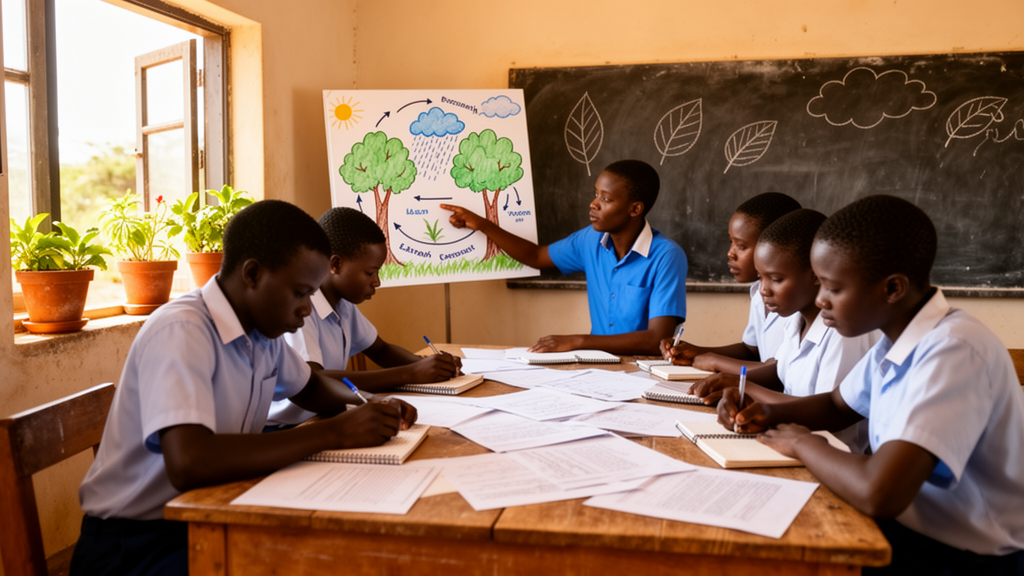
Image Credits: AI Generated

DOI: 10.1007/s43621-026-04465-2

Keywords: Foundational, teachers, greening, curriculum, readiness, advancing, education, sustainable, development, targets, Sub-Saharan, Africa

Cite Scienmag News

Sloane Callahan. (October 27, 2026). Green Pedagogy Framework Aims to Ready Sub-Saharan Teachers for Climate Curricula. Scienmag. https://scienmag.com/green-pedagogy-framework-aims-to-ready-sub-saharan-teachers-for-climate-curricula/


Sloane Callahan. "Green Pedagogy Framework Aims to Ready Sub-Saharan Teachers for Climate Curricula." Scienmag, 27 October 2026, https://scienmag.com/green-pedagogy-framework-aims-to-ready-sub-saharan-teachers-for-climate-curricula/. Accessed 27 October 2026.

Sloane Callahan. "Green Pedagogy Framework Aims to Ready Sub-Saharan Teachers for Climate Curricula." Scienmag. October 27, 2026. https://scienmag.com/green-pedagogy-framework-aims-to-ready-sub-saharan-teachers-for-climate-curricula/

Tags: AdvancingAfricaclimate change adaptation in African schoolscurriculumcurriculum development for climate resiliencedevelopmentEducationeducation for sustainable development in marginalized communitiesfoundationalfoundational teacher training for climate literacygreen pedagogy for sustainable developmentgreeningintegrating climate change into primary educationLearning Sciences approach to climate educationpedagogical frameworks for environmental sustainabilitypromoting climate awareness through early childhood educationreadinessSub-SaharanSub-Saharan Africa climate educationsustainabletargetsteacher capacity building in Sub-Saharan Africateacher competencies for climate curriculumteachers
Share26Tweet16
Previous Post

Sri Lankan Teenagers Use Many Routes, Not One, to Seek Help for Emotional Problems

Next Post

Medicinal Plants in Northern Tanzania Face Conservation Risks as Trade Intensifies

Related Posts

Medicinal Plants in Northern Tanzania Face Conservation Risks as Trade Intensifies
Earth Science

Medicinal Plants in Northern Tanzania Face Conservation Risks as Trade Intensifies

October 27, 2026
Green Soil Stabilization Review Maps Low-Carbon Alternatives to Cement
Earth Science

Green Soil Stabilization Review Maps Low-Carbon Alternatives to Cement

October 27, 2026
Heavy metals and salt push Mekong Delta groundwater past drinking limits in Tien Giang
Earth Science

Heavy metals and salt push Mekong Delta groundwater past drinking limits in Tien Giang

October 27, 2026
Pine needles turned into bio-oil and biochar in bench-scale pyrolysis study
Biotechnology

Pine needles turned into bio-oil and biochar in bench-scale pyrolysis study

October 27, 2026
AI Model Predicts Strength of Coal Mine Backfill Materials with High Accuracy
Earth Science

AI Model Predicts Strength of Coal Mine Backfill Materials with High Accuracy

October 27, 2026
Singapore’s Skies Are Dominated by Pollution Aerosols, 17-Year Study Finds
Athmospheric

Singapore’s Skies Are Dominated by Pollution Aerosols, 17-Year Study Finds

October 27, 2026
Next Post
Medicinal Plants in Northern Tanzania Face Conservation Risks as Trade Intensifies

Medicinal Plants in Northern Tanzania Face Conservation Risks as Trade Intensifies

  • Mothers who receive childcare support from maternal grandparents show more optimized

    Mothers who receive childcare support from maternal grandparents show more parental warmth, finds NTU Singapore study

    27656 shares
    Share 11059 Tweet 6912
  • University of Seville Breaks 120-Year-Old Mystery, Revises a Key Einstein Concept

    1061 shares
    Share 424 Tweet 265
  • Bee body mass, pathogens and local climate influence heat tolerance

    682 shares
    Share 273 Tweet 171
  • Researchers record first-ever images and data of a shark experiencing a boat strike

    546 shares
    Share 218 Tweet 137
  • Groundbreaking Clinical Trial Reveals Lubiprostone Enhances Kidney Function

    531 shares
    Share 212 Tweet 133
Science

Embark on a thrilling journey of discovery with Scienmag.com—your ultimate source for cutting-edge breakthroughs. Immerse yourself in a world where curiosity knows no limits and tomorrow’s possibilities become today’s reality!

RECENT NEWS

  • Rebuilding Aghdam: how a destroyed city is testing sustainable urban recovery
  • Scientists can predict low birthweights in West Africa up to a year ahead using climate data
  • Explainable AI models track EV battery health over 6G networks
  • Nurses Emerge as Key Players in Taming Targeted Cancer Therapy Side Effects

Categories

  • Agriculture
  • Anthropology
  • Archaeology
  • Athmospheric
  • Biology
  • Biotechnology
  • Blog
  • Bussines
  • Cancer
  • Chemistry
  • Climate
  • Earth Science
  • Editorial Policy
  • Marine
  • Mathematics
  • Medicine
  • Pediatry
  • Policy
  • Psychology & Psychiatry
  • Science Education
  • Science News
  • Social Science
  • Space
  • Technology and Engineering

Subscribe to Blog via Email

Success! An email was just sent to confirm your subscription. Please find the email now and click 'Confirm Follow' to start subscribing.

Join 5,151 other subscribers

© 2025 Scienmag - Science Magazine

Welcome Back!

Login to your account below

Forgotten Password?

Retrieve your password

Please enter your username or email address to reset your password.

Log In
No Result
View All Result
  • HOME
  • SCIENCE NEWS
  • CONTACT US

© 2025 Scienmag - Science Magazine