


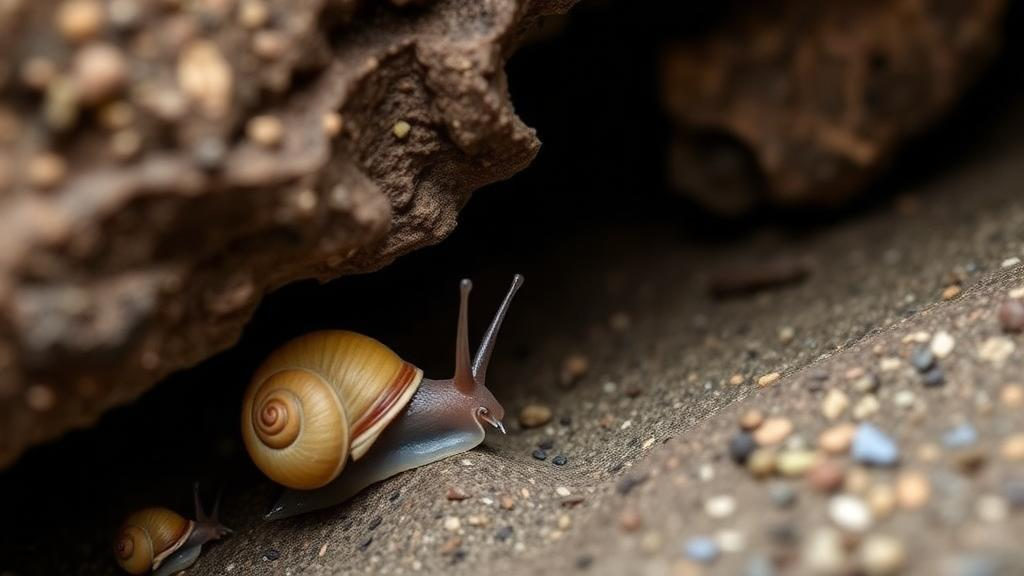
Darkness, constant temperature and an abundance of limestone make caves ideal refuges for gastropods, but the scale of life living beneath Greece has only begun to emerge. A new national inventory records terrestrial snails and slugs from 182 caves, nearly tripling the previous tally of caves with gastropod records and almost doubling the number of known species. The catalogue, assembled by combining published records with specimens held at the Natural History Museum of Crete, identifies 113 species in 49 genera and 23 families. It also highlights 14 species restricted to subterranean habitats, 12 of them endemic to Greece and several confined to a single cave or island.
The numbers reflect both real diversity and a major gap in exploration. Greece has more than 10,000 known caves, largely formed in carbonate rocks that cover about 41% of the country, yet only 558 have received speleobiological study. Before the new synthesis, terrestrial gastropods had been reported from 68 species in 70 caves. The expanded list therefore marks the first time that collections, historical reports and taxonomic revisions have been combined into a comprehensive picture of the country’s cave snails. It raises the number of caves with records from 70 to 182 and supplies first records for 113 caves.
The study drew on a collection built up between 1976 and 2019, principally by speleologist and co-author Kaloust Paragamian, who donated his material to the Natural History Museum of Crete in 2018. The holdings include specimens from 137 caves and potholes, preserved in 96% ethanol or represented by empty shells. Most were identified using current MolluscaBase taxonomy, while reproductive anatomy was examined where shell characters were insufficient or specimens required confirmation. Damaged or ambiguous material was retained at genus level, and records for which collection inside a cave could not be established were excluded.
Not every snail recorded underground is a permanent cave dweller. The researchers applied the Schiner-Racovitza classification: troglobionts live exclusively in caves; troglophiles live and reproduce above ground but can also complete their life cycle underground; and trogloxenes are occasional visitors that do not normally live or reproduce in caves. Among the 98 species that could be classified, 14 are troglobionts, 39 are troglophiles and 45 are trogloxenes. These proportions should be treated cautiously because the ecological status of many taxa remains uncertain, and empty shells found in caves may have been carried inside by rainwater rather than deposited by animals that actively entered them.
The obligate cave dwellers are nevertheless striking. They belong to nine genera: Balcanodiscus, Gyralina, Lindbergia, Vitrea, Mediterranea, Pholeoteras, Sciocochlea, Tsoukatosia and the monotypic Speleodentorcula. Twelve of the 14 troglobionts are Greek endemics. Twelve of those endemic cave species are also listed as threatened or near threatened on the IUCN Red List, although none currently has legal protection. The distribution is strikingly insular as well as continental: five endemic troglobionts occur on the mainland, while eight are found on islands. Corfu alone contains four troglobiont species in four genera, three of them endemic to the island.
Several records reveal how patchy knowledge of subterranean populations can be. Mediterranea amaltheae, a critically endangered Cretan snail classified as a cave specialist, was previously known only from Diktaio Antro Cave on the mountain of Dikti. The new material demonstrates that it also inhabits six other caves, turning a presumed single-cave endemic into an island endemic. In contrast, Vitrea ossaea remains known from only Profitis Ilias Cave in Thessaly, while Lindbergia spiliaenymphis is confined to Keratea Cave near Athens. Some apparently local species may not be so restricted, and others may be far more local than their current records suggest.
The inventory also exposes taxonomic puzzles that future fieldwork will need to resolve. Specimens assigned to Sciocochlea nordsiecki have been recovered from debris associated with deep limestone fissures, but no living animals have yet been found, leaving open the possibility that the species inhabits subterranean habitats beyond caves. Similarly, no living Tsoukatosia christinae has been observed; empty shells have been recovered from Agioi Anargyroi Cave and from coarse gravel elsewhere, so its true habitat remains uncertain. Other records require anatomical verification, including some specimens whose shells resemble particular species without matching them conclusively. The presence of an Orcula record on Thira is considered likely to be a misidentification because the genus is not otherwise known from the Aegean.
Crete dominates the current picture because it contains 55% of the explored caves, but the researchers stress that this is largely a sampling bias rather than evidence that the island holds most of Greece’s subterranean diversity. Only 101 caves are known to contain a single gastropod species, 60 contain two or three, and 19 contain between four and seven. The maximum recorded richness is nine species, found in Gerani Cave on Crete and Megalos Votsos Panagias Pothole in the Fournoi island group. Broad areas of mainland Greece and many Aegean and Ionian islands remain under-surveyed, and specialist sampling can overlook snails when a cave survey focuses on bats, insects or another group.
Wider comparisons are difficult because underground faunas are unevenly studied, collection methods differ and authorities disagree over what qualifies as a troglobiont. Europe contains about 59% of the world’s known subterranean terrestrial gastropods, with the Dinaric region accounting for roughly a quarter of the global total. Greece belongs to this Mediterranean karst system, whose caves can act as isolated evolutionary arenas: populations become restricted, lose light-dependent traits and may diverge into species found nowhere else. The 113-species checklist provides a foundation for testing those patterns, while the underlying records have been deposited in the Global Biodiversity Information Facility for future analysis.
For conservation, the key message is both alarming and hopeful. Greece’s cave snails include numerous ancient-looking but recently recognised endemics, many known from empty shells alone and classified as vulnerable, endangered or critically endangered. Yet the gap between 182 snail-bearing caves and more than 10,000 known caves means that much of this biodiversity has not even been catalogued. Continued exploration, live-animal searches and anatomical study could reveal range extensions, settle uncertain identifications and expose species that science has not yet named. The dark interiors of Greece’s limestone labyrinths are proving to be crowded with life, and the full census is only beginning.
Subject of Research: The diversity, distribution and conservation of terrestrial gastropods in Greek caves
Article Title: What`s crawling in the dark? An annotated list of gastropods in Greek caves
Article References: Karakasi, D., Paragamian, K., Mylonas, M., & Vardinoyannis, K. (2024). What`s crawling in the dark? An annotated list of gastropods in Greek caves. Subterranean Biology, 48, 73-116. https://doi.org/10.3897/subtbiol.48.113383
Image Credits: AI Generated
DOI: 10.3897/subtbiol.48.113383
Keywords: Greek caves, terrestrial gastropods, cave snails, subterranean biodiversity, troglobionts, karst ecosystems, species endemism, speleobiology, IUCN Red List, crawling, dark, annotated
Cite Scienmag News
Margaret Porter. (October 19, 2026). Greek cave census reveals 113 snail species and hidden endemism. Scienmag. https://scienmag.com/greek-cave-census-reveals-113-snail-species-and-hidden-endemism/
Margaret Porter. "Greek cave census reveals 113 snail species and hidden endemism." Scienmag, 19 October 2026, https://scienmag.com/greek-cave-census-reveals-113-snail-species-and-hidden-endemism/. Accessed 19 October 2026.
Margaret Porter. "Greek cave census reveals 113 snail species and hidden endemism." Scienmag. October 19, 2026. https://scienmag.com/greek-cave-census-reveals-113-snail-species-and-hidden-endemism/


