


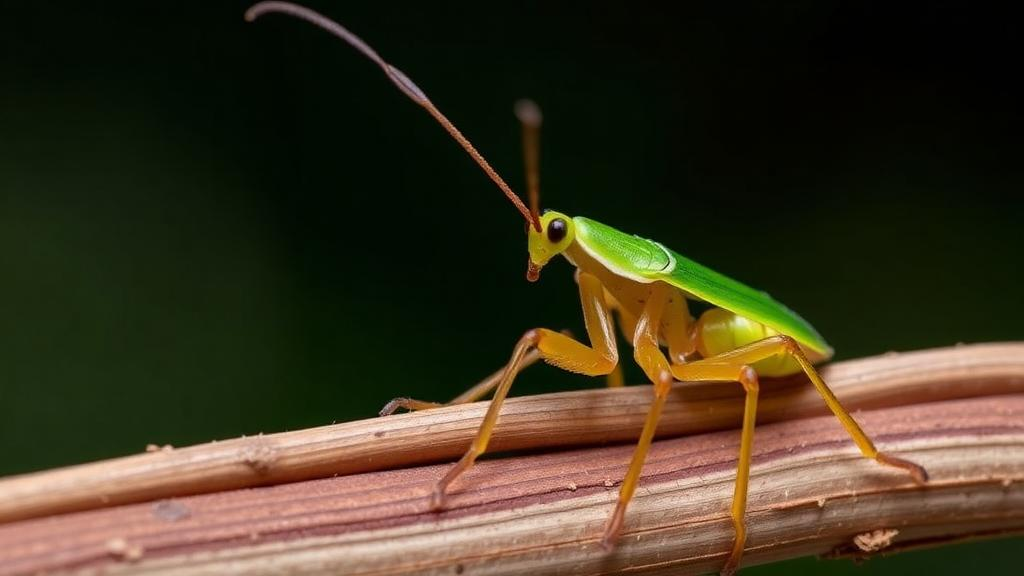
A nearly 150-year-old collision in scientific naming has forced one genus of tropical stick insects to change its identity. The genus had been called Bostra since Carl Stål established it in 1875 for a group of phasmids, or stick insects, in the family Diapheromeridae. But Francis Walker had already used Bostra in 1863 for a different kind of insect, a pyralid moth. Because Walker’s name came first, Stål’s Bostra is a junior homonym: a scientific name identical to an earlier one for a different taxon. To resolve the conflict while preserving as much continuity as possible, a 2023 study in the Journal of Orthoptera Research proposes Bostranova Villet as the replacement name and transfers 27 recognized species to it.
The problem illustrates how names can collide even when their authors are working with widely separated organisms. Walker’s Bostra was created as a monotypic genus of pyralid moths and now contains about 50 species distributed across Africa, Turkey and India. It was later treated as a synonym of the moth genus Therapne, a change made in 2003. Stål’s Bostra, by contrast, became a stick-insect genus with 27 species ranging from Brazil to Mexico. Walker died in 1874, the year before Stål published the phasmid name, and Stål died in 1878. His principal taxonomic interests included Hemiptera, especially insects from southern Africa, along with Orthoptera, Phasmida, Coleoptera and Hymenoptera, but not Lepidoptera, the order containing moths and butterflies. The overlapping names were apparently overlooked by both authors and remained unresolved for more than a century.
The conflict was eventually noticed by lepidopterist Roger Kendrick, who brought it to the attention of phasmid specialist Paul Brock. Brock recorded the issue in a scrutiny note in 2009 in the Phasmida Species File Online, but the name was not corrected at that time. One possible route would have been to replace Bostra Stål with a junior synonym under Article 60b of the International Code of Zoological Nomenclature. No such synonym could be found, however. The researchers therefore followed the alternative provision in Article 60 by introducing a new replacement name. The act is a nomen novum, or “new name”: it does not create a newly discovered species or a separate biological lineage, but supplies a valid, unique label for an already recognized genus.
The new name is Bostranova, authored by Villet, and is feminine in grammatical gender. It retains the root Bostra and adds a suffix derived from the Latin novum, meaning “new,” with the intended sense of “the new Bostra.” This conservative approach was intended to limit disruption for scientists, collectors, databases and natural-history institutions already using the older name. It also preserves Stål’s apparent intention. The authors found no definitive alternative explanation for the original name, but noted that Stål frequently used classical place names in the genera he established, including Macynia, Banasa and Stagira, all named for ancient towns. Bostra, also written Bosra or Busra, was a commercial and administrative center of the Nabataean kingdom in southern Syria and later the capital of the Roman province of Arabia under Trajan. The source material says the reason Walker or Stål selected the name remains unclear.
Before proposing Bostranova, the researchers checked four major online resources to ensure that it was not already occupied: the Phasmida Species File Online, the Catalogue of Life, the Encyclopedia of Life and the Global Biodiversity Information Facility. These resources cross-reference one another and connect to other biodiversity-data initiatives, providing broad collective coverage of scientific names. The authors also considered cultural issues in modern nomenclature, including the potential significance of names tied to particular places or histories. They concluded that preserving the established root was preferable to selecting a wholly new geographical name, particularly because Stål’s 1875 work predated modern expectations concerning the cultural origins of taxonomic names. The authors even expressed the whimsical hope that the insects’ movement might evoke the rhythm of the Latin dance style bossa nova, a name also associated with the geographic region in which Bostra arose.
The replacement affects the entire species list, not merely the name of the genus. Species transferred from Bostra now include Bostranova arcuata, B. bifida, B. championi, B. deplanata, B. exigua, B. incompta, B. innocens, B. jaliscensis, B. lobata, B. magistralis, B. magnifica, B. margaritata, B. mirata, B. nuptialis, B. obtusecornuta, B. procoppi, B. pruinosa, B. reductedentata, B. remiformis, B. saussurei, B. similis, B. submutica, B. tabida, B. tobagoensis, B. tridenticulata, B. turgida and B. vacca. Their recorded type specimens are distributed among major museums in Austria, France, Germany, Hungary, Spain, Switzerland, the United Kingdom and the United States, as well as private collections. Some names now carry parentheses around the original author and date because the species were originally described in a different genus, while others retain the standard form of a new genus combination.
Bostranova turgida has a particularly important place in the nomenclatural history. It was described by Westwood in 1859 as Bacteria turgida and is the type species of Stål’s genus, inherited by Bostranova through the replacement of the genus name. The species is represented in the Natural History Museum in London by a male lectotype and a female paralectotype, with its type locality recorded as Venezuela. Several other transfers have complicated histories. Bostranova exigua was originally placed in Bacteria, and B. innocens was described in Dyme. Some species previously included in Bostra were removed as taxonomic concepts developed and assigned to newer genera, including Oncotophasma, Alienobostra and Caribbiopheromera. The revised list therefore reflects a genus that has experienced repeated transfers, additions and revisions rather than a stable taxonomic unit whose membership has remained unchanged since 1875.
The formal work behind the change combined nomenclatural rules with a reconstruction of the genus’s species inventory. The researchers compiled a contemporary list by examining taxonomic literature and museum catalogues published across more than a century. Their table links every new species combination with the original genus, the repository and condition of type material, and the country or locality recorded in the relevant descriptions. It documents a geographically varied collection: species attributed to Brazil, Venezuela, Colombia, Guyana, Cuba, Peru, Mexico, Guatemala, Costa Rica, Panama and Tobago. The most recent addition was Bostranova tobagoensis, described from Tobago in 2012, with a female holotype and male and female paratypes held in France. Several other types are missing or destroyed, while others are syntypes, showing why consolidated museum information could be valuable for future work.
Replacing Bostra is not merely a clerical correction. It gives the phasmid genus a name that can coexist with the moth genus without ambiguity and provides a consolidated foundation for a comprehensive revision. The authors hope that the act will draw renewed attention to Bostranova and encourage taxonomic study of a group whose classification has changed repeatedly since the nineteenth century. The case also demonstrates the practical value of digital biodiversity databases: they can reveal a hidden homonymy spanning two very different insect orders, help assess whether a proposed replacement is already in use, and connect taxonomic names to museum holdings and geographic records. For the insects themselves, nothing biological has changed. Their evolutionary history and anatomy remain the subjects of ongoing research; what changes is the precise, globally usable name by which scientists can refer to them.
Subject of Research: Nomenclatural replacement of the junior homonym Bostra Stål with Bostranova for phasmid stick insects
Article Title: A replacement name for Bostra Stål ( Insecta , Phasmida , Diapheromeridae ), a junior homonym of Bostra Walker ( Insecta , Lepidoptera , Pyralidae )
Article References: Villet, M. H. (2023). A replacement name for Bostra Stål (Insecta, Phasmida, Diapheromeridae), a junior homonym of Bostra Walker (Insecta, Lepidoptera, Pyralidae). Journal of Orthoptera Research, 32(2), 149-152. https://doi.org/10.3897/jor.32.97047
Image Credits: AI Generated
DOI: 10.3897/jor.32.97047
Keywords: taxonomy, zoological nomenclature, stick insects, Phasmida, Diapheromeridae, homonymy, species classification, biodiversity databases, replacement, name, Bostra, Insecta
Cite Scienmag News
Gavin Prescott. (October 19, 2026). Stalked by a Naming Clash, Stick Insects Get a New Identity. Scienmag. https://scienmag.com/stalked-by-a-naming-clash-stick-insects-get-a-new-identity/
Gavin Prescott. "Stalked by a Naming Clash, Stick Insects Get a New Identity." Scienmag, 19 October 2026, https://scienmag.com/stalked-by-a-naming-clash-stick-insects-get-a-new-identity/. Accessed 19 October 2026.
Gavin Prescott. "Stalked by a Naming Clash, Stick Insects Get a New Identity." Scienmag. October 19, 2026. https://scienmag.com/stalked-by-a-naming-clash-stick-insects-get-a-new-identity/


