


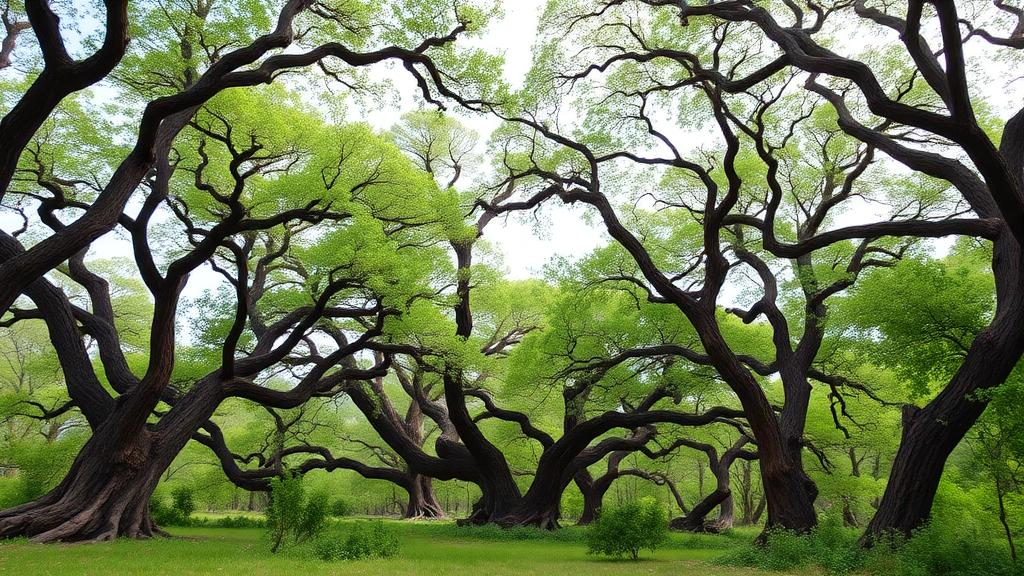
A formal proposal to correct the botanical name of a distinctive forest community could clarify decades of ecological research across northern Spain and southwestern France. The association Polysticho setiferi-Fraxinetum excelsioris has long been used to describe meso-eutrophic, thermophilic woodland in which common oak, Quercus robur, is regularly accompanied by European ash, Fraxinus excelsior, and hazel, Corylus avellana. Although the name is widely established in vegetation maps, monographs, technical reports and administrative documents, the type specimen chosen in 1994 does not represent the vegetation that most later authors understood the association to describe. The proposal therefore asks to retain the familiar name while replacing its type with a conserved neotype collected in Asturias, Spain.
The issue illustrates how the formal type of a named plant community can shape scientific interpretation far beyond the boundaries of taxonomy. Under the International Code of Phytosociological Nomenclature, a type anchors a syntaxonomic name to a particular vegetation record and helps determine which examples should be treated as typical. A poorly chosen type can therefore create a mismatch between a name and the ecological pattern for which it is routinely used. Here, the association was understood by most researchers as an oak-ash forest of moderately nutrient-rich sites, but its selected lectotype describes a stand dominated by beech. The authors argue that conservation of a more representative neotype would resolve the conflict without disturbing the name’s established usage.
The forest community was first recognizable in the vegetation of the Basque Country. In his 1941 monograph, Pierre Allorge described lowland forests dominated by common oak, with regular participation of ash and hazel, scattered deciduous trees, a rich understory and soils that were basic to neutral. Although that account included no formal vegetation plots, its description, geographic range and environmental conditions defined a recognizable forest type in the eastern Cantabrian region. The community occurs broadly in the Atlantic territories between the Adour River in southwestern France and the Nalón River in Asturias, placing its natural distribution across northern Iberia and the neighboring southwestern French coast.
Reinhold von Tüxen and Erich Oberdorfer formally described the association in their 1958 monograph on Spain as Corylo-Fraxinetum cantabricum. They explicitly related it to Allorge’s unit, compared it with the Central European Querco-Carpinetum and noted its geographic relationship to the Irish Corylo-Fraxinetum. Their original table contained two relevés assigned to a typical subassociation. Both had relatively low oak abundance, a circumstance the authors attributed partly to the historical clearance of the best oak stands for farmland. Because common oak was scarce in many of the surveyed sites, the original name emphasized ash rather than oak. The name also included the geographic epithet cantabricum, which later became ineligible under Article 34 of the code.
Rivas-Martínez consequently adopted the replacement name Polysticho setiferi-Fraxinetum excelsioris, drawing on the diagnostic Polystichum setiferum and the name-giving ash. The form first appeared in a 1981 doctoral thesis that used a nomenclatural attribution to Rivas-Martínez. Although that thesis is often cited as the validating publication, it was reproduced as a xerocopy without an ISBN and therefore did not meet the code’s requirements for effective publication. The name was consequently validated incidentally by Díaz and Fernández Prieto in 1994, who also treated Corylo-Fraxinetum cantabricum as a synonym. The accepted full citation thus identifies the earlier 1958 basionym while crediting the valid modern name to the 1994 publication.
The decisive problem arose when Díaz and Fernández Prieto selected a lectotype from the original table in accordance with the second edition of the International Code of Phytosociological Nomenclature. Their choice was relevé 139, one of two plots in the typical subassociation. It was selected because it was the only member of that pair containing any common oak, recorded at low abundance. The same plot was dominated by beech, Fagus sylvatica, however, with a cover value of 4.4 under the relevé scale. That characteristic conflicts with the community’s long-standing interpretation as a forest in which common oak has high frequency and may dominate. Beech is comparatively uncommon in the typical association, making the selected plot an atypical expression of the vegetation rather than a clear anchor for it.
Both plots cited by the original authors have environmental features that help explain their unusual composition. One represents a high-altitude site with above-average rainfall, favoring beech, while the other occupies a humid location containing plants associated with alder riverine forests. Tüxen and Oberdorfer themselves qualified the plots, observing that their species combinations might approximate the type of the association even though the relative abundance of the trees departed from the normal pattern. Later field surveys across Cantabrian territories revealed the more consistent structure of a meso-eutrophic mixed forest with frequent common oak. The proposal maintains that the 1994 lectotype failed to capture this established concept and that selecting it as the type generated interpretive problems for subsequent classification and conservation work.
To correct the mismatch, the authors invoke Article 53 of the fourth edition of the International Code of Phytosociological Nomenclature and request a conserved neotype. Their proposed record comes from Palacio de Meres in Siero, Asturias, at 180 metres above sea level on a north-west-facing slope with a gradient of 10 degrees. The 300-square-metre plot stands on marls, clays and sandstones containing whitish and pinkish Eocene limestones. Recorded on 7 July 2021, the stand has a tree layer dominated by common oak, with holly, sycamore maple, hazel and ash also present. This composition closely reflects the oak-ash structure associated with the name throughout the region.
The understory of the proposed neotype also includes the plants needed to characterize the community more comprehensively. The shrub layer contains blackthorn, spindle, dog rose, elder, wayfaring tree, common privet, evergreen rose and yew. The herb layer is diverse, with ivy, blackberry, false brome, wood sedge, a fern complex, herb-robert, ground ivy, spotted dead-nettle, honeysuckle, Solomon’s seal, soft rush, common nettle, bugle, lady’s fern, pendulous sedge, broad-leaved ragwort, St John’s wort, tormentil, lungwort, primrose, madder, common sorrel, betony, bittersweet, black bryony and violets. The presence of Polystichum setiferum, reflected in the association’s name, is confirmed in the herb layer, while oak remains conspicuous in the canopy.
If accepted, the proposal would preserve Polysticho setiferi-Fraxinetum excelsioris as the operative name while aligning its type with the association’s dominant ecological interpretation. The move is not intended to rename the forest community or redraw its range. Instead, it would correct the nomenclatural anchor used to identify it, reducing the chance that future comparisons, vegetation classifications and habitat assessments will treat a beech-rich exceptional stand as the standard. The case also demonstrates why botanical community names require careful stewardship: scientific continuity can depend on a precise formal connection between a widely used name, its type and the living vegetation it represents.
Subject of Research: Conservation of the nomenclatural type of an oak-ash forest association in northern Iberia and southwestern France
Article Title: Proposal (30) to conserve the name Polysticho setiferi-Fraxinetum excelsioris (Tüxen et Oberdorfer 1958) Rivas-Martínez ex Díaz et Fernández Prieto 1994 with a conserved type
Article References: Loidi, J., Amigo, J., Bueno, Á., Herrera, M., & Rodríguez-Guitián, M. A. (2022). Proposal (30) to conserve the name Polysticho setiferi-Fraxinetum excelsioris (Tüxen et Oberdorfer 1958) Rivas-Martínez ex Díaz et Fernández Prieto 1994 with a conserved type. Vegetation Classification and Survey, 3, 187-189. https://doi.org/10.3897/vcs.86799
Image Credits: AI Generated
DOI: 10.3897/VCS.86799
Keywords: phytosociology, plant nomenclature, oak-ash forest, conserved neotype, Quercus robur, Iberian vegetation, Cantabrian forests, International Code of Phytosociological Nomenclature, Proposal, conserve, name, Polysticho
Cite Scienmag News
Margaret Porter. (October 19, 2026). Proposal Seeks Typification Fix for an Iberian Oak-Ash Forest. Scienmag. https://scienmag.com/proposal-seeks-typification-fix-for-an-iberian-oak-ash-forest/
Margaret Porter. "Proposal Seeks Typification Fix for an Iberian Oak-Ash Forest." Scienmag, 19 October 2026, https://scienmag.com/proposal-seeks-typification-fix-for-an-iberian-oak-ash-forest/. Accessed 19 October 2026.
Margaret Porter. "Proposal Seeks Typification Fix for an Iberian Oak-Ash Forest." Scienmag. October 19, 2026. https://scienmag.com/proposal-seeks-typification-fix-for-an-iberian-oak-ash-forest/


