


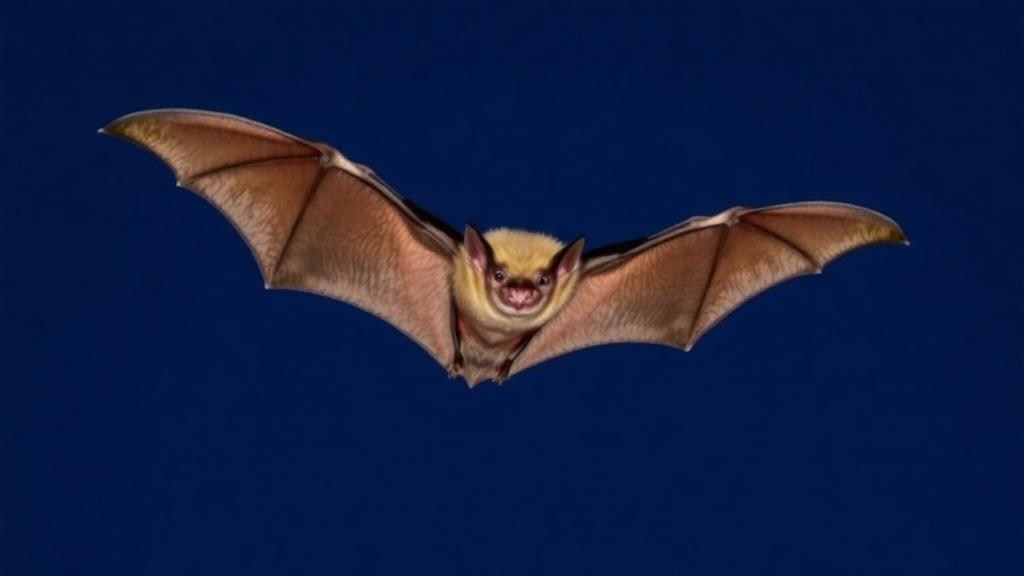
The Great Plains stretch from the Canadian prairies to the Gulf of Mexico, covering the majority of North America’s grassland ecosystems. These open landscapes are home to a surprising diversity of bats, animals that rank among the most effective natural pest controllers on the continent and whose nightly foraging delivers ecosystem services worth billions of dollars to agriculture. Yet a new systematic review published in Discover Conservation has revealed just how little scientists actually know about these grassland bats. After exhaustively searching three decades of peer-reviewed field research, a team led by Thomas Raad and Han Li of the University of Nebraska Omaha could find only 94 publications on bat ecology and conservation in the region, documenting 22 species, nearly half of all bat species found in the United States and Canada. For a region this vast, that number is strikingly small, and the review’s authors argue it is actively hindering conservation planning at a moment when bats face unprecedented threats.
The threats are mounting on multiple fronts. White-nose syndrome, the fungal disease caused by Pseudogymnoascus destructans, has devastated hibernating bat populations across eastern North America and is now pressing into the Plains. Wind energy development is concentrated here at the highest capacity of any land-based region on the continent, and wind turbines are a well-documented source of mortality, particularly for migratory species. Climate change, drought, pesticide bioaccumulation in insect prey, and ongoing conversion of native grassland to intensive agriculture all compound the pressure. Because no comprehensive synthesis of grassland bat research existed until now, conservation managers have been working largely without a map. The new review set out to change that by systematically cataloguing what has been studied, where, how, and, crucially, what has been missed.
The methodology was deliberately rigorous. The team defined the Great Plains using United States Environmental Protection Agency ecoregion boundaries, encompassing the Canadian provinces of Alberta, Saskatchewan, and Manitoba; thirteen US states from Montana and North Dakota down to Texas; and three Mexican provinces. They searched the Web of Science database using combinations of bat and grassland-related terms, added state and province names in a second round, and finally combed the publication records of 23 bat biologists known to work in the region to catch studies in smaller journals. Only primary field research published in English between 1995 and 2024 qualified; grey literature, reviews, and purely museum-based or modeling studies were excluded. After removing duplicates and irrelevant records, the three search rounds yielded the 94 publications that formed the basis of the synthesis.
The topical breakdown of those publications is revealing. Twenty-six reported simple distributional records in a natural-history style, making that the most common category. Roosting biology came second with 24 publications, followed by 20 studies of winter ecology, 12 quantitative habitat-association studies, and just 10 on foraging behavior or diet. Only two studies addressed migration movements, a striking gap given the region’s wind energy boom. Chronologically, winter ecology research was essentially absent until 2006, and habitat-association studies did not appear until 2011. Geographically, publications came from all three Canadian provinces and every US state in the region except Wyoming and Minnesota, while no English-language publications emerged from the Mexican portion of the ecoregion, a gap the authors acknowledge reflects language barriers rather than an absence of research.
One of the clearest findings concerns water. Ten of the habitat studies examined water sources, and all found them to be important components of bat habitat in this semi-arid landscape. Species including the big brown bat (Eptesicus fuscus), the hoary bat (Lasiurus cinereus), the silver-haired bat (Lasionycteris noctivagans), and the little brown bat (Myotis lucifugus) were all positively associated with water. One study even documented temporal niche partitioning, with different species drinking and foraging at different hours of the night. But the picture is complicated by the fact that in the Great Plains, water and trees tend to co-occur in riparian zones, making it difficult to disentangle which feature bats are actually responding to. Notably, two species showed negative associations with herbaceous wetlands, which offer water but lack the vertical structure bats seem to require.
That vertical structure, especially trees, emerged as the most studied biotic habitat feature. Eleven publications included vegetation variables, and most found that bat activity, abundance, or occupancy increased with proximity to trees and forest patches or with greater canopy cover. The northern long-eared myotis (Myotis septentrionalis) consistently showed positive associations with closed canopy and cluttered vegetation. Some results were contradictory, however, likely because studies measured vegetation at different spatial scales and quantified bats in different ways. Intriguingly, one study found acoustic activity of five bat species was significantly higher inside black-tailed prairie dog colonies than outside them, hinting that an umbrella species approach to conservation might benefit bats. Urban studies in Calgary, Alberta, showed that city zones hosted the highest bat abundance but the lowest diversity, dominated by little brown bats in poorer body condition, a possible ecological trap created by urbanization.
Roosting biology, the second most studied topic, highlights how bats cope with a landscape that historically offered few roosting opportunities. Ten species were documented roosting in trees, others in rock crevices and caves, and many in anthropogenic structures such as buildings, bridges, cabins, and culverts. Thermal microclimate was the most intensively studied factor in roost selection, with researchers using dataloggers and temperature-sensitive transmitters to show that stable internal conditions matter most, particularly for reproductive females. Findings on anthropogenic roosts varied with latitude: in central Texas, male Brazilian free-tailed bats (Tadarida brasiliensis) favored buildings, while at higher latitudes female big brown bats preferred buildings and enjoyed greater reproductive success than those in rock crevices. Long-term studies documented interannual fidelity to individual roost trees in several species, and big brown bats were observed relocating entire maternity colonies when roost trees were lost naturally.
Winter ecology may be the most ecologically surprising chapter of the review. Although the southern Plains stay warm enough for year-round bat activity, researchers documented bats overwintering far north in caves, rocky crevices, mines, and even road culverts. In the Badlands of North Dakota, six species were found overwintering, and in Alberta, big brown bats hibernate in rock crevices exposed to temperatures as low as minus 10.4 degrees Celsius. Winter flight activity, bats leaving hibernacula to fly during cold months, was recorded in at least eight species, typically peaking shortly after sunset and correlating with warmer ambient temperatures and calmer winds. Why bats fly in winter remains unresolved: foraging is unlikely because insects are absent, and an artificial water source experiment found no evidence bats used it for drinking. Proposed explanations include dehydration, muscle maintenance, waste elimination, and hibernacula switching, all of which matter for managing white-nose syndrome, which kills bats during the winter season.
The review’s authors are candid about why grassland bat research lags so far behind forest bat research. Logistically, the northern Plains have low human population density, few universities, and resource managers responsible for enormous tracts of land, leaving the North American Bat Monitoring Program (NABat) database conspicuously sparse for the region. Methodologically, mist-netting, the traditional capture tool, performs poorly in open grassland, and most capture-based studies were actually conducted in remnant forest patches. Biologically, Plains bats often sit at the periphery of their ranges, occurring at low densities where ecological processes may differ fundamentally from those in core populations. The authors call for multi-scale research leveraging NABat’s standardized monitoring, adoption of emerging technologies such as automated acoustic detection, radar, LiDAR, Motus tracking, and environmental DNA sampling, and urgent attention to migration, fire effects, and woody encroachment, a genuine conservation dilemma since encroaching trees may provide roosts and corridors even as they degrade native grassland. As wind farms expand and white-nose syndrome advances, the message of this synthesis is clear: the bats of the Great Plains have been flying under the scientific radar for thirty years, and closing that knowledge gap is now a conservation imperative.
Subject of Research: Ecology and conservation of bat populations in the North American Great Plains grassland ecosystem
Article Title: Bat ecology and conservation in the Great Plains: a systematic review of research in the past 30 years and future directions
Article References: Raad, T., Black, K., Peacock, D., Sanford, M., & Li, H. (2026). Bat ecology and conservation in the Great Plains: a systematic review of research in the past 30 years and future directions. Discover Conservation, 3(1), Article 11. https://doi.org/10.1007/s44353-026-00082-2
Image Credits: AI Generated
DOI: 10.1007/s44353-026-00082-2
Keywords: bats, Great Plains, grasslands, white-nose syndrome, wind energy, roosting ecology, winter ecology, habitat association, foraging behavior, NABat, conservation, systematic review
Cite Scienmag News
Gavin Prescott. (October 1, 2026). Great Plains Bats Are Flying Blind: A 30-Year Review Reveals Huge Gaps in Grassland Bat Science. Scienmag. https://scienmag.com/great-plains-bats-are-flying-blind-a-30-year-review-reveals-huge-gaps-in-grassland-bat-science/
Gavin Prescott. "Great Plains Bats Are Flying Blind: A 30-Year Review Reveals Huge Gaps in Grassland Bat Science." Scienmag, 1 October 2026, https://scienmag.com/great-plains-bats-are-flying-blind-a-30-year-review-reveals-huge-gaps-in-grassland-bat-science/. Accessed 17 October 2026.
Gavin Prescott. "Great Plains Bats Are Flying Blind: A 30-Year Review Reveals Huge Gaps in Grassland Bat Science." Scienmag. October 1, 2026. https://scienmag.com/great-plains-bats-are-flying-blind-a-30-year-review-reveals-huge-gaps-in-grassland-bat-science/


