


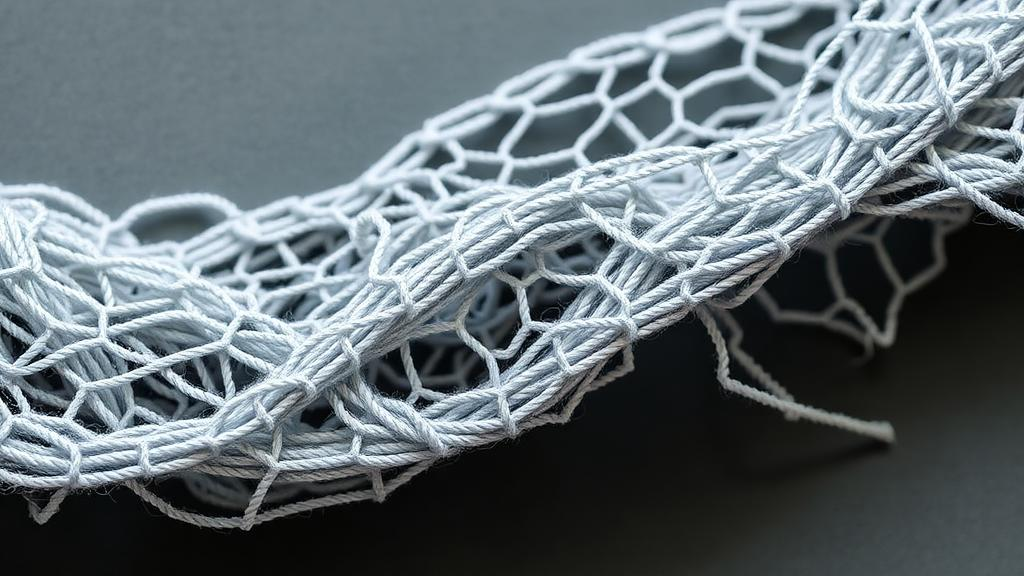
Every year, thousands of tons of abandoned fishing nets sink to the ocean floor, entangle marine life, and slowly fragment into microplastics that enter the food chain. These ghost nets are made of nylon, a tough synthetic polymer that resists degradation for decades. A new study published in Environmental Science and Pollution Research by G. L. Abishek, P. John Thangam, Siva Avudaiappan, and D. R. Anand Rejilin proposes a strikingly practical answer to this problem: pull those discarded nets out of the waste stream, cut them into fibers, and mix them into concrete. The result, according to the team’s experiments, is a material that is not only greener but measurably stronger than conventional concrete, with the most dramatic gains appearing in flexural strength, the property that governs how beams and slabs resist bending and cracking.
The research addresses a long-standing tension in construction materials science. Concrete is the most widely used human-made material on Earth, prized for its compressive strength but notoriously weak in tension. Traditional concrete can carry enormous loads when squeezed, yet it cracks readily when stretched or bent, which is why steel reinforcement is embedded in nearly every structural element. Fiber-reinforced concrete offers an alternative strategy: by dispersing small fibers throughout the mix, cracks are bridged at the microscale, delaying their propagation and improving toughness. Commercial fibers made of polypropylene, steel, or virgin nylon work well but add cost and carry their own environmental footprint. Recycling waste plastics into fibers, by contrast, turns a disposal liability into a structural asset, closing a loop between two of the world’s largest waste problems, marine plastic debris and construction material demand.
In the new study, the researchers prepared concrete mixtures containing zero, one, two, and three percent recycled nylon fibers recovered from waste fishing nets. The fibers were incorporated into otherwise conventional concrete, and the resulting material, which the authors call recycled nylon fiber reinforced concrete, or RNRC, was subjected to standard mechanical testing procedures. Three key properties were measured after 28 days of curing, the standard reference age in concrete technology: compressive strength, which reflects resistance to crushing; split tensile strength, which characterizes resistance to being pulled apart; and flexural strength, which measures the ability of a beam to withstand bending loads. These three metrics together form the backbone of structural design calculations for concrete elements.
The numbers reported are remarkable, particularly for flexural performance. Ordinary concrete in the study achieved a compressive strength of 23.37 megapascals, a split tensile strength of 2.67 megapascals, and a flexural strength of 3.27 megapascals at 28 days. The mix containing three percent recycled nylon fibers reached 28.07 megapascals in compression, an improvement of 20.11 percent, and 3.45 megapascals in tension, a gain of 29.21 percent. The standout result, however, was flexural strength, which surged from 3.27 to 8.10 megapascals, an increase of 147.71 percent. In practical terms, a concrete beam made with the recycled fishing net fibers could resist more than double the bending stress of its conventional counterpart before failing, a transformation attributable to the nylon fibers bridging cracks and redistributing stresses across the fracture zone.
Why would nylon from a fishing net perform so well inside concrete? The answer lies in the material properties of the polymer itself. Nylon is prized for its high tensile strength, elasticity, and abrasion resistance, which is precisely why it dominates the fishing industry. When chopped into short fibers and dispersed through a cement matrix, these same properties allow the fibers to act as microscopic reinforcement. As a concrete element is loaded and microcracks begin to form, the fibers spanning each crack carry tensile load that the brittle cement paste cannot. This crack-bridging mechanism is most effective under flexural loading, where crack opening is the dominant failure mode, which explains why the flexural gains in the study far exceeded the improvements in compression, where fibers play a comparatively modest role.
Beyond the laboratory testing, the study makes a second, equally significant contribution: a machine learning framework for predicting the mechanical properties of RNRC before a single batch is mixed. The team employed a Progressive Graph Convolutional Network, or PGCN, an architecture originally developed for spatial-temporal traffic forecasting, and adapted it to the concrete strength prediction problem. Graph convolutional networks learn by passing information between connected nodes in a graph structure, allowing the model to capture complex relationships between input variables that conventional regression approaches may miss. The progressive variant builds its representation in stages, refining predictions layer by layer. Input data for training was drawn from the well-known Concrete Compressive Strength dataset hosted in the UCI Machine Learning Repository, a benchmark containing 1030 instances of concrete mixes with their measured strengths.
The implementation was carried out in MATLAB, and the predictive model serves a purpose that goes beyond academic curiosity. Mix design in concrete technology is traditionally an iterative, labor-intensive process: engineers prepare trial batches, cure them for weeks, and test them destructively, repeating the cycle until the target properties are achieved. A reliable machine learning model compresses this timeline dramatically, allowing the effect of fiber content, water-cement ratio, and aggregate proportions to be explored computationally before any physical trial. For a novel material like RNRC, where the relationship between recycled fiber dosage and mechanical response may be nonlinear and influenced by fiber distribution effects that are hard to capture analytically, such data-driven prediction tools could accelerate adoption considerably.
The environmental stakes of this work are considerable. Abandoned, lost, or otherwise discarded fishing gear is recognized as one of the most persistent components of marine plastic pollution, and nylon nets are among the most common items recovered in coastal cleanups. Because nylon is a high-value engineering polymer, discarding it in landfills or oceans represents both an ecological harm and a wasted resource. Simultaneously, the cement industry accounts for a substantial share of global carbon dioxide emissions, and any technology that allows less material to achieve the same structural performance contributes to decarbonization. By demonstrating that waste nets can raise strength rather than merely fill volume, the study strengthens the economic case for net collection and recycling programs, since the recovered polymer now has a clear, high-volume destination.
The findings also connect to a growing body of research on plastic waste in concrete. Previous studies have examined nylon fibers from scrap brushes, nylon waste in recycled aggregate concrete, recycled nylon granules in self-compacting and lightweight concrete, and fibers derived from synthetic textiles and polyethylene terephthalate bottles. The consistent message across this literature is that polymer fibers, whether virgin or recycled, reliably improve tensile and flexural behavior and often enhance durability by limiting crack pathways that admit water and chlorides. What distinguishes the present work is the combination of a direct marine waste stream, a full mechanical characterization at multiple fiber dosages, and a modern graph-based machine learning model for property prediction, packaged together as a single workflow from ocean debris to engineered material.
Challenges remain before ghost nets can routinely end up in highway barriers and building columns. Fiber dosage must be optimized, since excessive fiber content can impair workability and compaction of fresh concrete, and the study’s testing focused on mechanical properties at 28 days rather than long-term durability under aggressive environments. Collection, cleaning, and cutting of nets at scale will require supply chains that do not yet exist in most regions. Nevertheless, the study offers a compelling proof of concept: a material problem, weak concrete in bending, can be solved with a pollution problem, discarded fishing nets, and the resulting composite can be designed computationally with graph neural networks before it is ever poured. As the authors conclude, recycled nylon fibers can enhance concrete performance while promoting environmental sustainability, a rare case where the circular economy and structural engineering pull in exactly the same direction.
Subject of Research: Recycled nylon fiber reinforced concrete from waste fishing nets and machine learning prediction of its mechanical properties
Article Title: Experimental investigation and PGCN-based prediction of the mechanical properties of recycled nylon fiber reinforced concrete using waste fishing nets
Article References: Abishek, G. L., John Thangam, P., Avudaiappan, S., & Anand Rejilin, D. R. (2026). Experimental investigation and PGCN-based prediction of the mechanical properties of recycled nylon fiber reinforced concrete using waste fishing nets. Environmental Science and Pollution Research. https://doi.org/10.1007/s11356-026-38243-4
Image Credits: AI Generated
DOI: 10.1007/s11356-026-38243-4
Keywords: recycled nylon fibers, waste fishing nets, fiber-reinforced concrete, compressive strength, tensile strength, flexural strength, graph convolutional network, machine learning, marine plastic pollution, sustainable construction materials, concrete mix design, circular economy
Cite Scienmag News
Violet Maxwell. (October 1, 2026). Waste Fishing Nets Turned Into Concrete Fibers Boost Strength, AI Predicts Performance. Scienmag. https://scienmag.com/waste-fishing-nets-turned-into-concrete-fibers-boost-strength-ai-predicts-performance/
Violet Maxwell. "Waste Fishing Nets Turned Into Concrete Fibers Boost Strength, AI Predicts Performance." Scienmag, 1 October 2026, https://scienmag.com/waste-fishing-nets-turned-into-concrete-fibers-boost-strength-ai-predicts-performance/. Accessed 4 October 2026.
Violet Maxwell. "Waste Fishing Nets Turned Into Concrete Fibers Boost Strength, AI Predicts Performance." Scienmag. October 1, 2026. https://scienmag.com/waste-fishing-nets-turned-into-concrete-fibers-boost-strength-ai-predicts-performance/


