


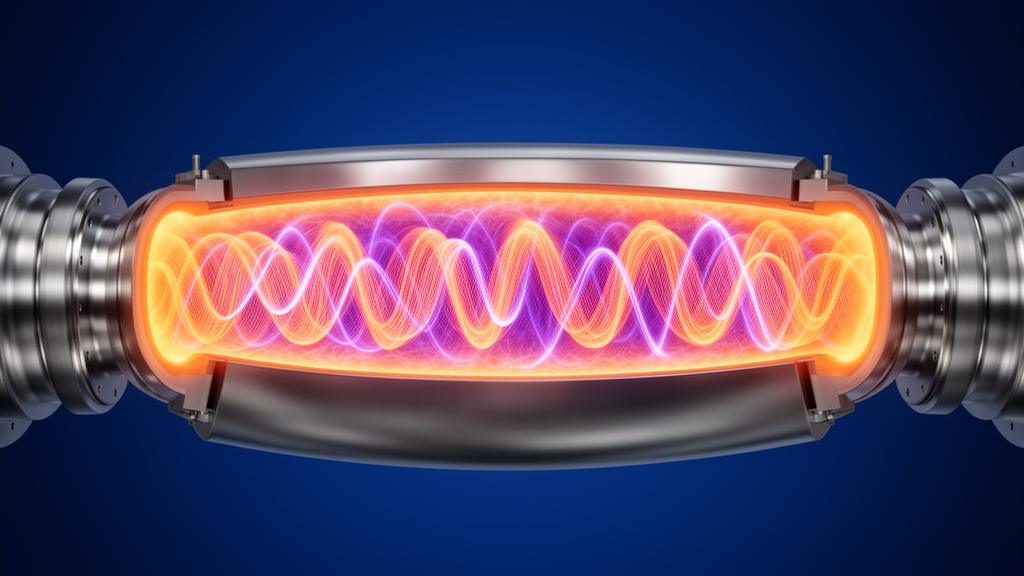
A new theoretical study argues that gravity, usually ignored in the physics of high-frequency plasma waves, should leave a small but systematic imprint on one of the most distinctive wave species in magnetized plasmas: the electron Bernstein wave. The work, published in the journal Discover Space, develops a kinetic framework in which the drift induced by a gravitational field is folded directly into the equilibrium dynamics of electrons and into the wave’s resonance condition, and then quantifies how large that imprint is likely to be.
Electron Bernstein waves, or EBWs, are electrostatic waves that propagate perpendicular to the magnetic field and exist only at harmonics of the electron cyclotron frequency. They occupy a special niche in plasma physics because they can propagate where ordinary electromagnetic waves are cut off, which makes them valuable for heating and current-drive schemes in spherical tokamaks. They are also observed naturally in Earth’s magnetosphere and in the magnetospheres of planets such as Jupiter, often in association with energetic particle populations and kinetic processes.
The authors of the study, Banashree Saikia and Jintu Ozah, start from a simple observation: in a magnetized plasma, a gravitational field forces charged particles to drift in a direction perpendicular to both the gravitational field and the magnetic field, the so-called g-cross-B drift. This drift is a known source of free energy that can drive instabilities and shape wave propagation, yet its effect on high-frequency electrostatic modes like the EBW has, according to the authors, not been thoroughly treated from a kinetic standpoint.
The theoretical construction begins with the Vlasov-Poisson system, the standard pair of equations governing collisionless electrostatic plasma dynamics, extended to include the gravitational force. From this starting point the authors formulate a modified equilibrium distribution function, a Maxwellian adjusted to account for both an equilibrium density gradient and the gravitational potential. The distribution is explicitly a first-order, weakly inhomogeneous equilibrium: it is valid only when the gravitational energy across the density-gradient scale length is small compared with the electron temperature, and when the gravitational drift velocity is much smaller than the electron thermal speed.
Within this framework, gravity enters the wave physics in a specific and traceable way. The unperturbed orbit of an electron is now cyclotron motion plus a steady gravitational drift, so the phase of the perpendicular motion acquires an extra term proportional to K-perpendicular times V-g, the product of the perpendicular wave number and the drift velocity. When the linearized Vlasov equation is integrated along these orbits and expanded in cyclotron harmonics using Bessel functions, the usual resonance denominator, Omega minus n times the cyclotron frequency, becomes Omega minus n Omega-e minus K-perpendicular V-g. In other words, the gravitational drift acts as a Doppler-like correction to the electron-cyclotron resonance condition, and it vanishes smoothly as gravity goes to zero, recovering the conventional Bernstein-wave result.
The formalism goes beyond the linear response. Using the plasma maser formalism, a nonlinear mechanism in which energy can be transferred between resonant particles or waves and a non-resonant wave whose frequencies differ greatly, the authors derive a complete nonlinear dispersion relation containing both direct and polarization coupling terms that describe how low-frequency drift-wave turbulence interacts with the high-frequency EBW. In their setup, the g-cross-B drift itself can act as a primary driver of the low-frequency drift-wave turbulence, providing the free energy that couples the turbulent background to the Bernstein mode.
Notably, however, the numerical calculations in the paper do not evaluate those nonlinear terms. The authors deliberately restrict the computation to the gravitationally modified linear dielectric function, D0, in order to isolate the effect of the gravitational drift on the resonance structure. The nonlinear terms, which govern the dissipative response and would yield growth or damping rates, are reserved for future work. This means the present results concern the reactive dispersion, the real frequency shift, and not instability growth.
The numerical picture that emerges is one of perturbative smallness. Using representative parameters, the authors find that the gravitational drift velocity increases linearly with gravitational acceleration, with a slope of approximately 0.1688 times ten to the minus eleven per unit of g for their chosen magnetic field and particle parameters. The dielectric function itself changes only minutely: over a gravitational acceleration range from zero to 25, D0 rises from about 1.5166638692 times ten to the thirty-seventh to about 1.5166638702 times ten to the thirty-seventh, an absolute increase of roughly ten to the twenty-eighth but a relative change of only about 6.6 times ten to the minus eight percent. The gravitational drift remains substantially smaller than the electron thermal velocity throughout, so the correction stays perturbative.
The study also maps how the linear dielectric response behaves near the first, second, and third cyclotron harmonics. At the first resonance, with the wave frequency at half the cyclotron frequency, D0 peaks at roughly 3.7 times ten to the twentieth near a perpendicular wave number of 0.001, then falls rapidly to about 0.0617 times ten to the twentieth by a wave number of 0.08, a pattern the authors attribute to finite Larmor radius effects. The second and third harmonics show progressively weaker peaks, about 1.48 and 0.98 times ten to the twentieth respectively, indicating that the plasma response weakens with increasing harmonic number. Sweeping the wave frequency instead of the wave number shows the resonance peak shifting systematically toward lower frequencies as the perpendicular wave number increases, with a pronounced maximum of about 4.7 times ten to the twentieth at the smallest wave number considered. Three-dimensional scans over wave number, frequency, and gravitational acceleration confirm that the response is sensitive to both the cyclotron frequency and the gravitational parameter, with the largest values appearing where both are relatively large.
The authors are careful about what these numbers do and do not establish. The astrophysical environments invoked, planetary magnetospheres and solar transition-region conditions, serve only as representative parameter regimes, not as detailed models of specific systems, and the calculations make no environment-specific predictions for Jupiter, Saturn, stellar atmospheres, white dwarfs, neutron stars, or accretion disks. No conclusions are drawn about wave-energy transport, forbidden frequency bands, mode conversion, or observational signatures, since those would require analysis beyond the linear dielectric response. What the paper delivers instead is a mechanism and a scaling: a unified kinetic description in which gravity modifies the EBW resonance condition through the K-perpendicular V-g term, with two dimensionless measures, the drift-to-thermal-velocity ratio and the drift-induced frequency shift relative to the cyclotron frequency, quantifying when the effect matters. In regimes with stronger gravity, weaker magnetic fields, or relativistically hot electrons, the weak-drift, non-relativistic formulation would need environment-specific extension, and the nonlinear growth-rate calculations remain an open task for future study.
Subject of Research: Kinetic theory of gravitationally modified electron Bernstein waves in magnetized plasmas
Article Title: Nonlinear kinetic formulation of gravitationally modified electron Bernstein waves in magnetized plasmas
Article References: Saikia, B., & Ozah, J. (2026). Nonlinear kinetic formulation of gravitationally modified electron Bernstein waves in magnetized plasmas. Discover Space, 130(1), Article 19. https://doi.org/10.1007/s11038-026-09599-x
Image Credits: AI Generated
DOI: 10.1007/s11038-026-09599-x
Keywords: electron Bernstein waves, magnetized plasma, gravitational drift, kinetic theory, Vlasov-Poisson, plasma maser effect, dielectric response, cyclotron harmonics, drift wave turbulence, space plasma, theoretical physics, Nonlinear
Cite Scienmag News
Katie Riggs. (October 27, 2026). Gravity Leaves a Faint Fingerprint on Electron Bernstein Waves, Theory Shows. Scienmag. https://scienmag.com/gravity-leaves-a-faint-fingerprint-on-electron-bernstein-waves-theory-shows/
Katie Riggs. "Gravity Leaves a Faint Fingerprint on Electron Bernstein Waves, Theory Shows." Scienmag, 27 October 2026, https://scienmag.com/gravity-leaves-a-faint-fingerprint-on-electron-bernstein-waves-theory-shows/. Accessed 27 October 2026.
Katie Riggs. "Gravity Leaves a Faint Fingerprint on Electron Bernstein Waves, Theory Shows." Scienmag. October 27, 2026. https://scienmag.com/gravity-leaves-a-faint-fingerprint-on-electron-bernstein-waves-theory-shows/


