


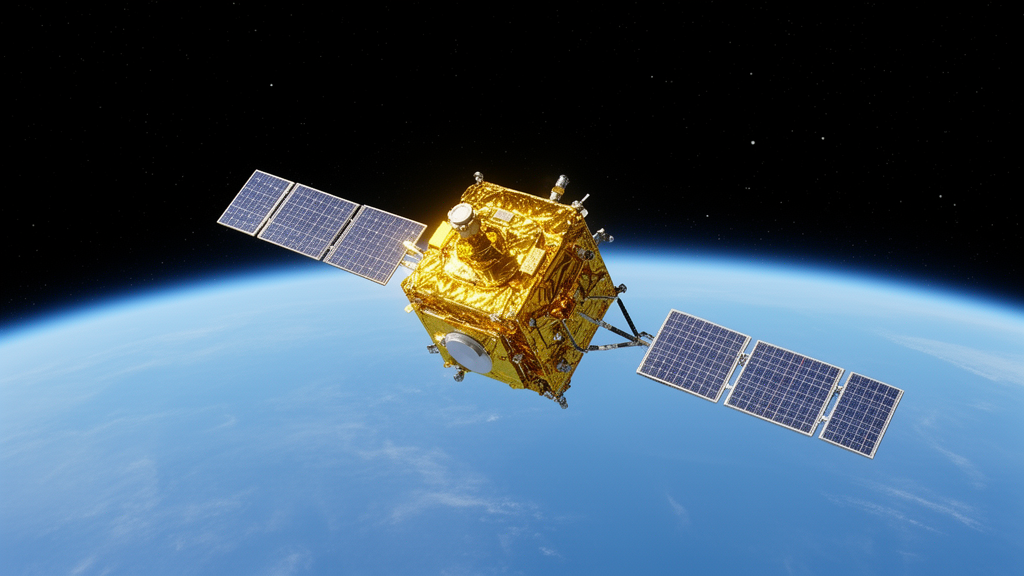
Physicists have laid out a new theoretical blueprint for one of general relativity’s most delicate tests: measuring how gravity slows time itself, using clocks on the ground and in orbit. In a study published in The European Physical Journal C, researchers derived a complete relativistic description of a dual one-way Doppler-cancellation scheme, an observable built from two oppositely directed one-way optical links between a satellite and a ground station, accurate to order c^-3, the precision needed for clock comparisons at the 10^-18 level.
Gravitational redshift is a direct consequence of local position invariance, one of the three pillars of the Einstein equivalence principle. In the weak field of the Earth, a clock at higher altitude runs faster than one lower down. The standard way to parameterize a possible deviation from the general-relativistic prediction is a fractional frequency shift of (1+alpha) times the potential difference divided by c squared, with alpha equal to zero in general relativity. Because a larger gravitational-potential difference produces a stronger redshift signature, satellite-ground clock comparisons are a particularly favorable configuration for high-precision tests, especially when paired with state-of-the-art optical atomic clocks.
The history of such tests stretches from the landmark Pound-Rebka-Snider experiments of the 1960s, which achieved precisions of 1 to 10 percent, through the Gravity Probe A rocket experiment, which reached an uncertainty of 1.4×10^-4. More recently, analyses of eccentric Galileo satellites obtained an uncertainty of 2.48×10^-5, the final RadioAstron analysis confirmed the general-relativistic prediction with an uncertainty of roughly 4×10^-5, and a ground-based experiment at the Tokyo Skytree reached 9.1×10^-5. Together, these results demonstrate the complementarity of ground-based clock comparisons, Earth-orbiting missions, and experiments extending toward cislunar space.
The central obstacle in satellite-ground clock comparisons is the first-order Doppler effect. Relative velocities between satellites and ground stations of roughly 3 to 8 kilometers per second produce Doppler shifts of order 10^-5, several orders of magnitude larger than the gravitational-redshift signal, which typically lies between 10^-11 and 10^-10. Measuring the frequency comparison directly at the 10^-18 level would require velocity measurements at or better than 10^-9 meters per second, beyond current technological capability. Doppler-cancellation schemes exist precisely to sidestep this limitation.
Traditionally, redshift experiments have relied on the triple-link Doppler cancellation scheme, which combines a one-way downlink referenced to the ground clock with a coherent two-way link formed by an uplink and a retransmitted downlink. Because the two-way observable contains approximately twice the first-order Doppler contribution, subtracting half of it from the one-way observable suppresses the Doppler term to second order while retaining the redshift signal. This strategy, employed in experiments such as Gravity Probe A, already has a relativistic description to order c^-3. The new work instead formulates a dual one-way scheme: an uplink received and measured at the onboard clock and a downlink received and measured at the ground clock, with the two datasets combined only in post-processing.
In this configuration, the uplink observable contains the first-order Doppler shift and the gravitational redshift, while the downlink contains the first-order Doppler shift and a gravitational blueshift of opposite sign. Subtracting the uplink observable from the downlink strongly suppresses the first-order Doppler contribution and doubles the gravitational-redshift signal. The authors caution, however, that this doubling of the signal does not by itself imply a factor-of-two improvement in final experimental sensitivity, which remains limited by residual Doppler terms, propagation effects, clock noise, orbit-determination errors, and clock synchronization.
The residual Doppler shift after cancellation is of order 10^-10, far smaller than the first-order term but still enormous compared with the 10^-18 target if left unmodeled. A subtle but critical point emerges here: the instantaneous distance between satellite and ground station at the reception time is not identical to the coordinate distance defined by the emission and reception events, and substituting one for the other would introduce modeling errors that can exceed the 10^-18 level. In an ACES-like clock comparison, this distinction alone can lead to an estimated error of 5×10^-18 in the residual Doppler effect. The residual third-order Doppler term, the authors show, cannot be ignored at the 10^-18 level and must be deducted during data analysis.
Propagation effects also demand careful treatment. The neutral-atmospheric frequency shift of a single one-way optical link can reach the 10^-10 level, but because the uplink and downlink traverse nearly the same atmospheric column, the residual contribution in the dual one-way combination may fall below 10^-18. The ionospheric contribution, dominant for microwave links such as the ACES Microwave Link, is strongly suppressed at optical frequencies by a factor of the carrier frequency squared; at optical frequencies around 10^14 hertz, one total electron content unit corresponds to a delay of order 10^-18 seconds, keeping the ionospheric frequency shift below 10^-18. The Shapiro gravitational frequency shift reaches about 10^-14 on a single link but largely cancels between the nearly symmetric uplink and downlink, while tidal effects, which can reach 10^-17 for low-Earth-orbit satellites and approach 10^-16 for medium and geosynchronous orbits, are doubled in the combination and must be modeled with appropriate tidal models.
The price of the simpler two-link architecture is a stringent clock-synchronization requirement. Because the uplink and downlink are time-tagged by different clocks, the post-processed combination requires knowledge of the relation between the satellite and ground time tags and a common coordinate-time scale. For ACES and China Space Station-like configurations, a clock comparison at the 10^-16 level typically requires synchronization at the 10-nanosecond level, while a 10^-18-level comparison requires synchronization at the 0.1-nanosecond level. As a rough estimate, synchronization errors at the 10-nanosecond and 0.1-nanosecond levels would correspond to fractional uncertainties of about 10^-6 and 10^-8 in a gravitational-redshift test. Recent advances in time and frequency transfer suggest that femtosecond-level synchronization may eventually be achievable, though a complete satellite-ground optical-clock experiment at the 10^-18 level has not yet been demonstrated as an integrated space system.
To quantify the potential, the authors simulated two representative configurations, assuming satellite position and velocity uncertainties of 0.1 meters and 0.1 millimeters per second and a 10-degree observation cutoff elevation. For a low-Earth-orbit configuration resembling the China Space Station or the Atomic Clock Ensemble in Space, at an altitude of about 400 kilometers with a Beijing ground station, the gravitational-redshift signal in the dual one-way observable is approximately 8×10^-11. With a clock-comparison accuracy of 1×10^-16, the expected redshift-test uncertainty is at the 1×10^-6 level; if clock accuracy approaches 1×10^-18 and the residual Doppler uncertainty is suppressed to the 10^-18 level with other systematics below 10^-17, a test at the 10^-7 level becomes feasible. For a geostationary configuration at about 36,000 kilometers altitude, the redshift signal grows to roughly 1.2×10^-9, and clock-comparison accuracies of 1×10^-16 and 1×10^-18 would yield test sensitivities of about 1×10^-7 and 1×10^-8 respectively. In both regimes, the limiting factor is expected to be the accuracy of the Earth’s gravitational field model rather than clock noise itself: the EGM2008 model carries a potential uncertainty of about 1 square meter per second squared, corresponding to a fractional frequency uncertainty near 1×10^-17, reducible perhaps to 0.1 square meters per second squared. Improved redshift sensitivity may also constrain physics beyond general relativity, including long-range fifth forces, dark matter, and Lorentz violation.
Subject of Research: A relativistic formulation of a dual one-way Doppler-cancellation observable for space-based gravitational-redshift tests
Article Title: Relativistic formulation for dual one-way Doppler cancellation scheme observables for gravitational redshift tests
Article References: Qin, C.-G., Liu, T., Li, Q., Li, Y., Gong, Q.-L., Ma, Z.-Y., Tan, Y.-J., & Shao, C.-G. (2026). Relativistic formulation for dual one-way Doppler cancellation scheme observables for gravitational redshift tests. The European Physical Journal C, 86(10), Article 1230. https://doi.org/10.1140/epjc/s10052-026-16367-8
Image Credits: AI Generated
DOI: 10.1140/epjc/s10052-026-16367-8
Keywords: gravitational redshift, general relativity, optical clocks, Doppler cancellation, satellite clock comparison, ACES, China Space Station, geostationary orbit, Shapiro delay, clock synchronization, Earth gravitational model, relativistic modeling
Cite Scienmag News
Grant Pearson. (October 27, 2026). New relativistic framework sharpens satellite tests of gravitational redshift. Scienmag. https://scienmag.com/new-relativistic-framework-sharpens-satellite-tests-of-gravitational-redshift/
Grant Pearson. "New relativistic framework sharpens satellite tests of gravitational redshift." Scienmag, 27 October 2026, https://scienmag.com/new-relativistic-framework-sharpens-satellite-tests-of-gravitational-redshift/. Accessed 27 October 2026.
Grant Pearson. "New relativistic framework sharpens satellite tests of gravitational redshift." Scienmag. October 27, 2026. https://scienmag.com/new-relativistic-framework-sharpens-satellite-tests-of-gravitational-redshift/


