


Phosphorus is a stubborn nutrient in calcareous soils. Carbonate-rich conditions lock it into poorly soluble forms, so crops often cannot access enough of it, while whatever does move through the profile can be lost to leaching. A new laboratory study examined whether calcium phosphate-based nanofertilizers could ease both problems, testing how three such materials released phosphorus compared with a conventional soluble fertilizer.
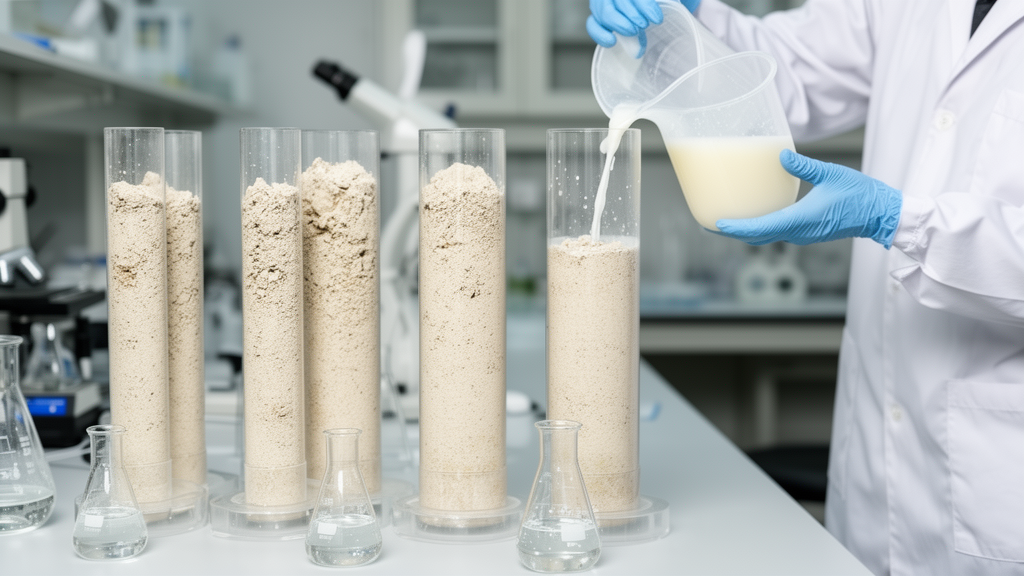
Researchers at Mohammed VI Polytechnic University and collaborators built soil columns filled with calcareous soil and applied four treatments: hydroxyapatite (HA), dicalcium phosphate dihydrate (DCPD), a polyphosphate-modified version of DCPD (DCPD-PolyP), and soluble triple superphosphate (TSP). Over 30 days they tracked cumulative phosphorus and calcium leaching and fitted the results to kinetic models to characterize the release behavior.
The Korsmeyer-Peppas model best described cumulative phosphorus leaching, with R² values above 0.96. The pattern was consistent with predominantly diffusion-controlled release, meaning phosphorus moved out of the fertilizer materials gradually rather than dissolving all at once. Notably, the apparent leaching from the DCPD-PolyP nanomaterial was slower than from TSP.
DCPD-PolyP stood out for what the researchers describe as the most balanced phosphorus dynamics among the materials tested. It combined low phosphorus mobility with higher Olsen-P availability than hydroxyapatite, suggesting that modifying DCPD with polyphosphate can slow movement through the soil without making the nutrient as unavailable as the least soluble phases do.
Statistical analysis reinforced the role of both the fertilizer and the soil in controlling phosphorus behavior. Principal component and correlation analyses indicated that phosphorus leaching was governed by interactions between calcium-phosphate phase solubility and soil physico-chemical properties, rather than by the fertilizer composition alone.
Across the nanofertilizer treatments, calcium phosphate materials tended to reduce phosphorus mobility relative to TSP. After the leaching period, 26 percent of the applied phosphorus remained Olsen-extractable and was concentrated in the surface layer of the columns, while the materials sustained a gradual nutrient supply under the conditions evaluated.
The authors highlight DCPD-PolyP as a promising controlled-release phosphorus source for alkaline soils and frame the work as a basis for designing nanofertilizers optimized for carbonate-rich environments. Because the findings come from a controlled column experiment over a single 30-day monitoring period, they describe release and leaching behavior under those specific conditions rather than field-scale crop performance.
Still, the study offers a concrete comparison of how fertilizer chemistry shapes phosphorus fate in calcareous soil. By matching the solubility of the calcium-phosphate phase to the soil’s fixation capacity, the approach points toward fertilizers that hold phosphorus in place near the surface while keeping a measurable fraction available to plants, addressing the twin challenges of fixation and loss that limit phosphorus use efficiency in these soils.
Subject of Research: Controlled release and leaching behavior of calcium phosphate nanofertilizers in calcareous soil
Article Title: Controlled release and soil phosphorus distribution of calcium phosphate nanofertilizers in a calcareous soil: a column study
Article References: Mansouri, H., Ait Said, H., Noukrati, H., Perreault, F., Oukarroum, A., & Ben Youcef, H. (2026). Controlled release and soil phosphorus distribution of calcium phosphate nanofertilizers in a calcareous soil: a column study. Frontiers in Soil Science, 6, Article 1949827. https://doi.org/10.3389/fsoil.2026.1949827
Image Credits: AI Generated
DOI: 10.3389/fsoil.2026.1949827
Keywords: calcareous soil, nanofertilizers, phosphorus, controlled release, hydroxyapatite, dicalcium phosphate, polyphosphate, leaching, soil columns, Korsmeyer-Peppas, Olsen-P, triple superphosphate
Cite Scienmag News
Alan Morgan. (October 27, 2026). Calcium Phosphate Nanofertilizers Slow Phosphorus Leaching in Calcareous Soil Columns. Scienmag. https://scienmag.com/calcium-phosphate-nanofertilizers-slow-phosphorus-leaching-in-calcareous-soil-columns/
Alan Morgan. "Calcium Phosphate Nanofertilizers Slow Phosphorus Leaching in Calcareous Soil Columns." Scienmag, 27 October 2026, https://scienmag.com/calcium-phosphate-nanofertilizers-slow-phosphorus-leaching-in-calcareous-soil-columns/. Accessed 27 October 2026.
Alan Morgan. "Calcium Phosphate Nanofertilizers Slow Phosphorus Leaching in Calcareous Soil Columns." Scienmag. October 27, 2026. https://scienmag.com/calcium-phosphate-nanofertilizers-slow-phosphorus-leaching-in-calcareous-soil-columns/


