


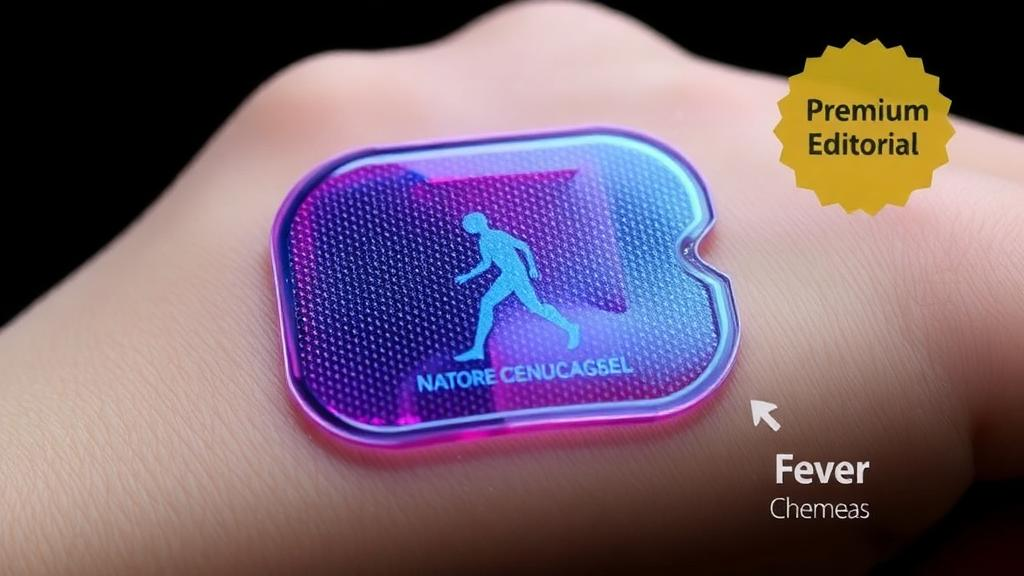
Human skin is a remarkably capable sensor. It stretches, bends, and heals while continuously reporting touch, pressure, and temperature to the brain with a fidelity that no single artificial device has yet matched. A team of researchers at Khalifa University of Science and Technology in Abu Dhabi, working with a colleague at the University of New South Wales in Australia, has now taken a significant step toward replicating that dual capability in the laboratory. In a study published in Advanced Composites and Hybrid Materials, Amaal Romih, Yarjan Abdul Samad, Jang-Kyo Kim, and Andreas Schiffer describe a nanocomposite hydrogel that simultaneously measures mechanical strain and temperature with performance figures that place it among the most capable dual-mode wearable sensing materials reported to date.
The material at the heart of the study is a double-network hydrogel, a class of soft solids in which two interpenetrating polymer architectures share the same water-rich matrix. The first network in this design is built from chitosan, a naturally derived polysaccharide prized for its biocompatibility and its abundance of chemically active terminal groups. The second is a modified polyethylene glycol network, which contributes elasticity and water retention. Suspended within this paired architecture are graphene nanosheets, the atomically thin carbon layers whose exceptional electrical conductivity makes them a favorite filler for flexible electronics. The logic of the design is straightforward: the polymer networks supply the mechanical toughness and stretchability that a skin-like sensor demands, while the graphene supplies a continuous conductive pathway whose resistance changes predictably when the material is deformed or heated.
Double-network hydrogels earn their reputation through a clever division of labor. When the material is stretched, the more brittle of the two networks sacrificially fractures at the molecular scale, dissipating energy that would otherwise tear the sample apart. The more ductile network survives, holding the structure together and allowing it to recover. This energy-dissipating mechanism is what allows the chitosan and modified polyethylene glycol composite to remain mechanically resilient at strains of up to 350 percent, a stretch ratio far beyond what ordinary rigid sensors can tolerate. In practical terms, the hydrogel can be wrapped around a finger, an elbow, or an ankle and endure the full range of human motion without losing its integrity or its electrical function.
The strain-sensing performance is quantified by the gauge factor, a dimensionless ratio that describes how strongly the electrical resistance responds to deformation. For this hydrogel, the researchers report a gauge factor of 13.8, a high value that indicates sharp sensitivity to even small movements. When the material is attached to the wrist, fingers, elbows, or ankles, it converts bending, stretching, and joint flexion into clean, dynamic changes in relative resistance, denoted ΔR/R₀. Crucially, these signals remain stable during motion, and the sensor maintained cyclic electromechanical stability over more than 500 stretching cycles, an endurance benchmark that matters enormously for any device expected to survive daily wear.
Temperature sensing is where the chitosan-based chemistry reveals an additional advantage. The hydrogel exhibits a thermoresistive response, meaning its electrical resistance changes with temperature, and the researchers measured a linear response across the fever-relevant window of 37.5 to 40 degrees Celsius. That linearity is a genuine asset: it means the sensor output can be translated into a temperature reading with simple calibration rather than complex curve fitting. Even more striking is the temperature coefficient of resistance, which the team reports as an ultrahigh negative 5.62 percent per degree Celsius. In plain terms, a one-degree rise in temperature changes the resistance by more than five percent, a sensitivity that allows the sensor to detect fever-range changes in real time. Most commercial thermistors and resistive temperature detectors operate with coefficients orders of magnitude smaller, so this figure represents a substantial leap in thermal resolution for a soft, wearable format.
The dual-mode capability raises an obvious engineering question: how does a single sensor distinguish a change in temperature from a change in strain, when both alter its resistance? The answer lies in the very different signatures the two stimuli produce. Strain-induced resistance changes are typically large, transient, and correlated with movement, while temperature changes produce slower, sustained shifts. By separating fast dynamic components from slow baseline drifts in the resistance signal, the sensor can deliver stable pulse waveforms from the wrist even while the wearer moves, and simultaneously flag a rising body temperature. This decoupling is precisely what a tactile healthcare patch would need: continuous pulse monitoring during exercise, for example, alongside early detection of a fever developing underneath the device.
Another practical hurdle for wearable hydrogels has always been adhesion. Soft gels tend to slide off skin or peel away from substrates after a few minutes of wear. The chitosan network in this material solves the problem chemically. Its terminal hydroxyl and amino groups are prolific hydrogen-bond donors and acceptors, allowing the hydrogel to form spontaneous adhesive contacts with a striking variety of surfaces, including plastic, rubber, glass, metal, and human tissue. This self-adhesion eliminates the need for separate tapes or medical adhesives, simplifying device assembly and improving comfort during extended wear on the skin. It also means the sensor conforms intimately to curved body surfaces, which improves both mechanical coupling for strain measurement and thermal contact for temperature measurement.
The implications for wearable healthcare devices are considerable. A single soft patch that tracks joint motion, captures pulse waveforms, and monitors fever-range temperature could serve applications ranging from postoperative recovery monitoring to athletic performance tracking to continuous screening in clinical settings. Because the material is water-rich and built partly from a biocompatible polysaccharide, it sits comfortably within the emerging paradigm of skin-interfaced electronics that prioritize softness and conformity over the rigid silicon packages of conventional devices. The combination of a 350 percent strain tolerance, a gauge factor of 13.8, more than 500 stable cycles, and a temperature coefficient of negative 5.62 percent per degree Celsius in one material is a rare confluence of specifications in the flexible sensor literature.
The work also illustrates a broader trend in materials science: the deliberate fusion of structural and functional design at the nanoscale. Rather than treating a sensor as a rigid chip attached to a flexible substrate, the researchers engineered the sensing function directly into a soft structural material. Graphene, the conductive filler, does double duty as both the electrical transducer and a mechanical reinforcement within the double-network matrix. The chitosan does double duty as a structural polymer and an adhesive. This multifunctional economy, where each component serves multiple roles, is increasingly recognized as the path toward devices that are simultaneously simpler to manufacture, more robust in use, and more comfortable to wear.
Challenges remain before such hydrogels reach the clinic or the consumer market. Long-term dehydration of the gel, biocompatibility over weeks of continuous wear, and scalable manufacturing all require further study, and the published work reports laboratory characterization rather than clinical deployment. Yet the demonstration stands as a compelling proof of concept. By marrying a tough double-network polymer architecture with the conductivity of graphene and the natural adhesivity of chitosan, the Khalifa University-led team has produced a material that behaves less like an electronic component and more like a piece of engineered skin, one that feels the body move and reads its temperature at the same time. As flexible electronics mature, designs of this kind, documented in the open-access literature and available for the wider community to build upon, may well define what the next generation of wearable health monitors looks like.
Subject of Research: A graphene-integrated double-network nanocomposite hydrogel for dual strain and temperature wearable sensing
Article Title: A multifunctional graphene-integrated double-network nanocomposite hydrogel for dual strain-temperature wearable sensing
Article References: Romih, A., Samad, Y. A., Kim, J.-K., & Schiffer, A. (2026). A multifunctional graphene-integrated double-network nanocomposite hydrogel for dual strain-temperature wearable sensing. Advanced Composites and Hybrid Materials. https://doi.org/10.1007/s42114-026-02106-w
Image Credits: AI Generated
DOI: 10.1007/s42114-026-02106-w
Keywords: wearable sensor, hydrogel, graphene, double-network hydrogel, strain sensing, temperature sensing, nanocomposite, chitosan, flexible electronics, healthcare monitoring, soft materials, 2D materials
Cite Scienmag News
Denise Maddox. (October 1, 2026). Graphene-Infused Hydrogel Skin Senses Stretch and Fever in One Patch. Scienmag. https://scienmag.com/graphene-infused-hydrogel-skin-senses-stretch-and-fever-in-one-patch/
Denise Maddox. "Graphene-Infused Hydrogel Skin Senses Stretch and Fever in One Patch." Scienmag, 1 October 2026, https://scienmag.com/graphene-infused-hydrogel-skin-senses-stretch-and-fever-in-one-patch/. Accessed 16 October 2026.
Denise Maddox. "Graphene-Infused Hydrogel Skin Senses Stretch and Fever in One Patch." Scienmag. October 1, 2026. https://scienmag.com/graphene-infused-hydrogel-skin-senses-stretch-and-fever-in-one-patch/


