


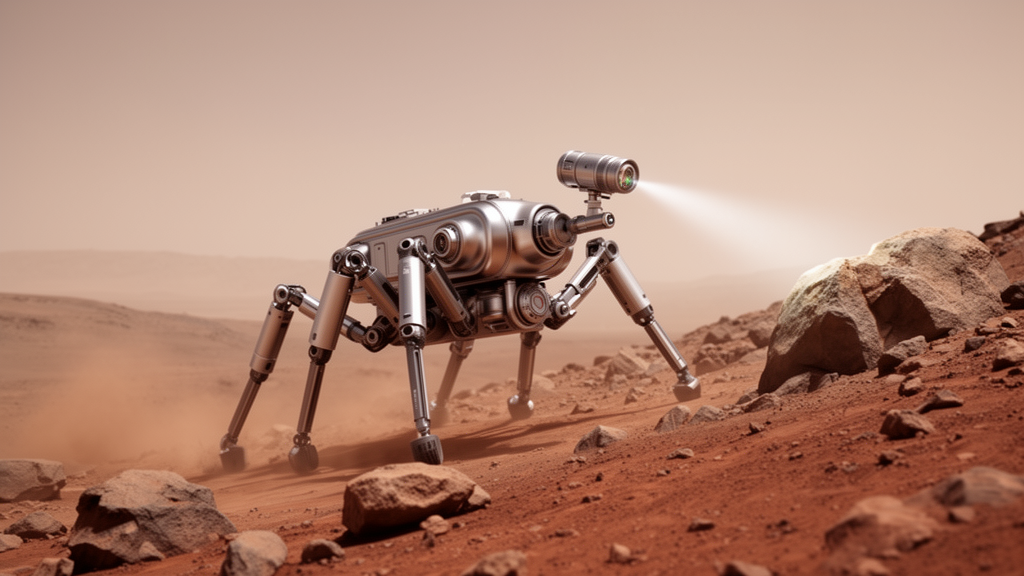
On Mars, a rover cannot simply call home when it gets stuck. Radio signals take between three and twenty-two minutes to travel one way between Earth and the red planet, which means that every scientific decision — where to drive, which rock to inspect, how long to linger — is normally made one cautious step at a time by human operators working a planet away. Now, a team of researchers from the University of Basel, ETH Zurich, the University of Bern, the University of Zurich and the European Space Agency has shown that a four-legged robot can shoulder much of that burden itself, autonomously surveying multiple scientific targets in a single run while carrying a microscope and a Raman spectrometer on its back. The study, published in Frontiers in Space Technologies, offers one of the most detailed head-to-head comparisons yet between semi-autonomous, multi-target exploration and the traditional, human-supervised single-target approach that has defined planetary surface missions for decades.
The robot at the heart of the experiment is ANYmal, a quadrupedal machine developed by ETH Zurich spin-off ANYbotics and adapted by the Robotic Systems Lab for planetary work. Weighing roughly sixty kilograms including its payload, the robot walks on four articulated legs rather than wheels, a design choice that matters enormously for the terrain scientists actually want to explore. Many of the most promising destinations on both the Moon and Mars — volatile-rich pyroclastic deposits near the lunar south pole, clay-bearing outcrops exposed on crater walls, hydrothermal systems and fractured slopes — are steep, rugged and treacherous for wheeled vehicles. Legged locomotion, driven by a reinforcement-learning controller trained to keep the robot balanced on uneven ground, allows ANYmal to clamber across granular, slumping terrain that would stop a conventional rover in its tracks.
Mounted on the robot is a custom six-degree-of-freedom robotic arm called the DynaArm, which carries two scientific instruments. The first, named MICRO, is a compact microscopic imager built in-house that captures close-up images of rock surfaces at wavelengths spanning the ultraviolet, visible and near-infrared, from 395 to 940 nanometres. Its field of view measures just over two and a half centimetres across, and a ring of forty-eight LEDs illuminates the target while a time-of-flight sensor measures the distance to the surface, feeding an autofocus routine that keeps images sharp even when the arm is not perfectly placed. The second instrument is a commercial Raman spectrometer, the MIRA XTR from Metrohm, which fires a 785-nanometre infrared laser at a rock from up to seventy centimetres away and reads back the scattered light. Because every mineral scatters laser light in a characteristic way, the resulting spectrum acts like a chemical fingerprint, revealing whether a rock is made of gypsum, calcite, olivine, sulphur or something else entirely — without the robot ever needing to touch it.
To test whether this combination could actually do useful planetary science, the team transformed an eighty-square-metre laboratory at the University of Basel, known as the Marslabor, into a stand-in for another world. For the Martian simulations, the floor was covered with crushed basalt from the Eifel region of Germany and reddish hematite-rich sandstone made from shredded brick, with lighting tuned to mimic the ratio of direct to diffuse sunlight on the Martian surface. The rock samples were chosen for their scientific relevance: gypsum, which has been detected on Mars and is prized for its ability to entomb organic molecules; carbonate rocks, which form in water and may preserve signs of ancient microbial life; sandstone, one of the most common rock types on Mars; and a sulphur-bearing basalt reminiscent of volcanic deposits altered by water. For the lunar simulation, the lights were switched off entirely. A single 180-watt LED lamp was angled at roughly fifteen degrees above the scene, reproducing the extreme, low-sun lighting and long shadows that any robot would face near the lunar south pole, where permanently shadowed regions may harbour water ice.
The researchers then ran two fundamentally different mission concepts. In the first, designed to simulate a Mars-like scenario with long communication delays, the operator selected three targets from a panoramic overview image and an elevation map, uploaded a pre-programmed sequence of science commands, and then stepped back. The robot executed everything autonomously: it walked to each target in turn, deployed the arm, pressed MICRO against the rock surface, captured a suite of images in six spectral bands, took Raman spectra, and moved on to the next site without any human review in between. In the second concept, simulating a lunar mission where near-real-time control is possible, the operator stayed in the loop, choosing one target at a time, inspecting each image and spectrum as it arrived, and deciding on the spot how many additional measurements were needed before moving on.
The results were striking. Across four identical Martian analogue missions, the semi-autonomous robot completed its full three-target survey in as little as twelve minutes, with an average mission time of just over sixteen minutes. In three of the four runs it correctly identified at least two of the three targets — a success rate of 66.7 percent — and in its best performance it achieved a perfect score, identifying gypsum, a siliciclastic carbonate rock and native sulphur on basalt all in a single cycle. The Raman spectrometer proved remarkably reliable: the characteristic gypsum peak at around 1010 wavenumbers and the sulphur peak near 473 wavenumbers appeared in every mission cycle, matching ground-truth measurements taken beforehand with a handheld instrument. Even when the microscopic imager returned blurred or partially off-target images, Raman spectroscopy frequently compensated, confirming the mineral identity on its own. The two instruments, the researchers concluded, are genuinely complementary — one reveals texture and structure, the other chemistry.
The human-supervised lunar mission told a different story. Taking forty-one minutes, roughly two and a half times longer than the average Martian run, it nonetheless achieved a 100 percent identification rate, correctly classifying a dunite rock by its olivine peaks, an anorthosite sample by its anorthite signal, and rutile-bearing regolith by its diagnostic titanium dioxide peak. Because the operator could review data after every measurement, the robot could be steered closer, the arm positioned more precisely, and the number of Raman measurements tailored to each rock’s complexity — three spectra for the dunite, two for the anorthosite, just one for the homogeneous regolith. The total volume of useful data was nearly 2.6 times higher per mission than in the average Martian run. Yet the efficiency trade-off was equally clear: the semi-autonomous Martian missions collected data up to 22 percent faster per unit time, reaching useful-data rates of around 0.27 data points per minute compared with roughly 0.18 for the supervised lunar mission.
The study also exposed honest limitations. The trickiest target in the Martian scenario — a cluster of carbonate and sandstone rocks partially buried in regolith — was successfully identified in only one of four runs, because the arm was frequently placed off-target when the operator selected it from a distance. The targeting system, originally designed for close-range human supervision of large boulders, struggled when asked to aim at smaller rocks from afar, and the researchers suggest that visual servoing, in which the arm continuously corrects its position using live camera feedback as it approaches the target, could close that gap. Blurred MICRO images, caused by high-frequency vibration of the arm during measurements, were another recurring problem that autonomous blur detection and automatic re-acquisition could fix. And the commercial Raman spectrometer, limited to a detection range of 400 to 2300 wavenumbers, cannot see the Raman signature of water ice, which lies between 3000 and 3500 wavenumbers — a significant constraint for future lunar resource prospecting, though instruments with different laser wavelengths and extended spectral ranges are already being developed.
What makes the demonstration significant is how it compares with the current state of the art. NASA’s Curiosity and Perseverance rovers do possess genuine autonomy — they can navigate around hazards, and Perseverance’s AEGIS software can autonomously pick laser targets for its SuperCam instrument — but their science operations remain fundamentally sequential and ground-controlled. A rover rarely, if ever, completes an entire circuit of multiple scientific targets within a single planning cycle, because each sampling step is treated as too valuable and too risky to chain together without human review. The ANYmal experiments show that a single robot with a compact, arm-mounted payload can coordinate a multi-target survey autonomously, potentially slashing the latency imposed by ground-in-the-loop decision-making and enabling rapid site characterisation before any commitment to detailed sampling.
The researchers are careful to note that the work was conducted in Earth gravity, where arm manipulation is actually harder than it would be on the Moon or Mars, and that the robot’s ninety-minute battery life will demand careful energy budgeting on real planetary missions, particularly on Mars where solar input varies. But the implications stretch well beyond a single robot. The same multi-target, semi-autonomous framework could be transferred to wheeled rovers, aerial drones and swarms of cooperating robots, distributing exploration tasks across challenging terrain and maximising scientific return per sol. For astrobiologists hunting biosignatures in ancient lakebeds, and for resource prospectors scouting water ice and titanium-bearing minerals near the lunar south pole, the message of the study is clear: the next generation of planetary explorers may not need to wait for instructions after every step. Give them a target list, a laser, a microscope and four good legs, and they can start doing real geology on their own.
Subject of Research: Semi-autonomous multi-target planetary exploration using a legged robot with Raman spectroscopy and microscopic imaging on Martian and lunar analogues
Article Title: Semi-autonomous exploration of martian and lunar analogues with a legged robot using a Raman-equipped robotic arm and microscopic imager
Article References: Ligeza, G., Arm, P., Bontognali, T. R. R., Bickel, V. T., Kolvenbach, H., Kuhn, N. J., & Kehl, F. (2026). Semi-autonomous exploration of martian and lunar analogues with a legged robot using a Raman-equipped robotic arm and microscopic imager. Frontiers in Space Technologies, 7, Article 1741757. https://doi.org/10.3389/frspt.2026.1741757
Image Credits: AI Generated
DOI: 10.3389/frspt.2026.1741757
Keywords: ANYmal, legged robot, Raman spectroscopy, microscopic imager, Mars analogue, lunar analogue, planetary exploration, semi-autonomous robotics, astrobiology, in-situ resource utilization, robotic arm, space robotics
Cite Scienmag News
Denise Maddox. (October 16, 2026). A Walking Robot With a Laser Eye Could Change How We Explore Mars and the Moon. Scienmag. https://scienmag.com/a-walking-robot-with-a-laser-eye-could-change-how-we-explore-mars-and-the-moon/
Denise Maddox. "A Walking Robot With a Laser Eye Could Change How We Explore Mars and the Moon." Scienmag, 16 October 2026, https://scienmag.com/a-walking-robot-with-a-laser-eye-could-change-how-we-explore-mars-and-the-moon/. Accessed 16 October 2026.
Denise Maddox. "A Walking Robot With a Laser Eye Could Change How We Explore Mars and the Moon." Scienmag. October 16, 2026. https://scienmag.com/a-walking-robot-with-a-laser-eye-could-change-how-we-explore-mars-and-the-moon/


