


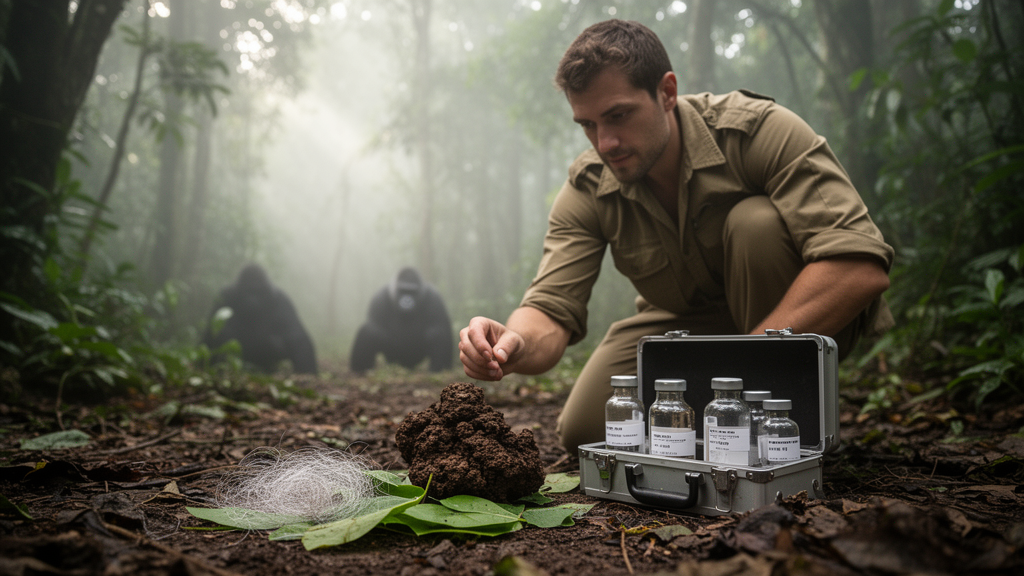
Every confiscated gorilla tells a story that begins somewhere in the forests of Central or East Africa, but for wildlife authorities and conservationists, that starting point has long been a mystery. Young gorillas rescued from the illegal wildlife trade arrive at sanctuaries with no records of where they were captured, and returning them to the wrong population or subspecies can carry serious genetic and ecological consequences. A new study published in Genome Biology demonstrates that the answer may already be lying on the forest floor. By extracting and sequencing genomic DNA from faecal and hair samples collected non-invasively from wild gorillas, an international research team has built a georeferenced genetic map detailed enough to predict where a wild-born gorilla came from, with a mean error of just 65 kilometres.
The research, led by Irune Ruiz-Gartzia and Harvinder Pawar of the Institute of Evolutionary Biology in Barcelona, together with senior author Tomas Marques-Bonet, involved a consortium spanning dozens of institutions across Africa, Europe, North America and Asia. The team assembled genomic data from 280 wild gorillas representing three of the four recognised gorilla subspecies, sampled across large portions of their present-day distributions. Gorillas are currently classified as critically endangered or endangered, and all four subspecies—western lowland gorillas, Cross River gorillas, eastern lowland gorillas and mountain gorillas—face mounting pressure from habitat loss, disease and poaching. Understanding how their populations are structured across the landscape is therefore not an academic luxury but a practical necessity for conservation planning.
Technically, the study represents a significant leap beyond earlier non-invasive genetics. Previous work on wild gorilla populations relied on short mitochondrial or nuclear markers amplified from faeces or hair, which are abundant sources of degraded host DNA but are heavily contaminated with microbial genetic material and the DNA of the animals’ diets. Such markers, while useful, capture only a narrow slice of the genome and may not reflect the broader patterns of nuclear inheritance that shape population structure. The new study took advantage of target capture hybridisation, a laboratory technique in which synthetic DNA probes are used to fish out and enrich specific genomic regions from the low-quality DNA in non-invasive samples. This enrichment step dramatically increases the proportion of endogenous gorilla DNA available for sequencing and allows researchers to read contiguous stretches of the nuclear genome rather than isolated fragments.
With this expanded genomic resolution, the researchers uncovered fine-scale population structure that had previously gone undetected. Among western lowland gorillas, the most numerous and widespread subspecies, the analysis revealed three distinct population clusters. Perhaps most strikingly, the Sangha River and its tributaries emerged as significant barriers to gene flow, carving the continuous forest landscape into genetically differentiated gorilla populations on either bank. Rivers have long been suspected of shaping ape distributions, but demonstrating their effect at this genomic resolution, using samples collected without ever touching or even seeing most of the animals involved, provides some of the strongest evidence yet that waterways actively constrain gorilla movement and mating across Central Africa.
The study also reached back into the past to reconstruct patterns of historical connectivity. The team found genetic evidence of past population links between western lowland gorillas at the north-eastern edge of the subspecies’ range and Cross River gorillas, the most endangered and geographically isolated of all gorilla populations, confined today to a small region on the Nigeria–Cameroon border. This ancient connection may have been facilitated by a migration corridor through the region, and intriguingly, the researchers note that the same corridor appears to have been used by two chimpanzee subspecies, the Central and Nigeria-Cameroon chimpanzees. The implication is that a shared landscape feature once allowed multiple ape lineages to move and intermix, and that understanding these historical routes can inform where habitat corridors should be restored today.
Beyond mapping structure and history, the team tackled a question with immediate forensic value: could they predict the geographic origin of an individual gorilla from its genome alone? Using the georeferenced dataset as a training baseline, they developed a predictive framework and tested it on wild-born gorillas. The results exceeded expectations. The mean prediction error across individuals was 65 kilometres, and for some populations the resolution was even finer. Mountain gorillas, which live in a small and well-sampled habitat in the Virunga Massif and Bwindi, could be assigned to their population with confidence, as could some populations of western lowland gorillas. In practical terms, this means a confiscated infant gorilla could one day be traced to its home region from a single faecal or hair sample, giving authorities the information they need to plan repatriation and to strengthen prosecution cases against traffickers.
The scale of collaboration behind the dataset is itself noteworthy. Samples came from field sites and protected areas across multiple countries, including Gabon, the Republic of Congo, the Democratic Republic of the Congo, Cameroon, the Central African Republic, Nigeria, Uganda and Rwanda, with contributions from national parks agencies, wildlife authorities, the Dian Fossey Gorilla Fund, Gorilla Doctors, WWF programmes and the Pan African Programme: The Cultured Chimpanzee, which supplied gorilla samples collected alongside its chimpanzee-focused fieldwork. Museum collections in Germany and Austria also contributed material. This breadth of sampling is what gives the predictive model its power: a genomic reference map is only as good as its geographic coverage, and few endangered species have ever been sampled this extensively across their range using non-invasive methods.
For conservation managers, the findings carry several concrete implications. The three population clusters within western lowland gorillas suggest that this subspecies, often treated as a single management unit, actually contains genetically distinguishable populations whose connectivity should be preserved. The identification of the Sangha River system as a barrier highlights the importance of protecting remaining crossing points and forest corridors that allow gene flow between populations on opposite banks. And the reconstructed historical link between north-eastern western lowland gorillas and Cross River gorillas underscores how much genetic diversity may already have been lost as that connection was severed, while pointing to the regions where reconnection efforts could yield the greatest benefit. As habitat fragmentation accelerates across the Congo Basin, genomic baselines like this one provide a benchmark against which future changes in population isolation can be measured.
The study also signals a broader shift in what is possible with non-invasive sampling. Great apes are difficult and expensive to sample directly: darting carries health risks, anaesthesia is dangerous, and habituating animals to human observers for blood draws is feasible only for a handful of well-studied groups. Faecal and hair samples, by contrast, can be collected by trackers and rangers during routine patrols, from unhabituated animals, and even from abandoned nests. As target capture and sequencing costs continue to fall, the approach demonstrated here could be extended to other elusive endangered mammals, from forest elephants to pangolins, turning rangers’ patrols into genome-scale biodiversity surveys. For gorillas, the immediate promise is clear: every rescued or confiscated animal can now carry with it a molecular record of its origins, and every pile of dung in the forest is a data point in an ever-sharpening map of one of humanity’s closest relatives.
Subject of Research: Non-invasive population genomics of wild gorillas and geographic origin prediction for confiscated individuals
Article Title: Non-invasive genomic sampling uncovers novel connectivities and origins of confiscated gorillas
Article References: Non-invasive genomic sampling uncovers novel connectivities and origins of confiscated gorillas. (n.d.). https://doi.org/10.1186/s13059-026-04305-6
Image Credits: AI Generated
DOI: 10.1186/s13059-026-04305-6
Keywords: gorillas, conservation genomics, non-invasive sampling, population structure, target capture, wildlife trafficking, Cross River gorilla, western lowland gorilla, mountain gorilla, Sangha River, gene flow, Genome Biology
Cite Scienmag News
Juliet Wilcox. (October 15, 2026). Gorilla DNA From Dung and Hair Reveals Hidden Populations and Pinpoints Trafficked Apes’ Origins. Scienmag. https://scienmag.com/gorilla-dna-from-dung-and-hair-reveals-hidden-populations-and-pinpoints-trafficked-apes-origins/
Juliet Wilcox. "Gorilla DNA From Dung and Hair Reveals Hidden Populations and Pinpoints Trafficked Apes’ Origins." Scienmag, 15 October 2026, https://scienmag.com/gorilla-dna-from-dung-and-hair-reveals-hidden-populations-and-pinpoints-trafficked-apes-origins/. Accessed 15 October 2026.
Juliet Wilcox. "Gorilla DNA From Dung and Hair Reveals Hidden Populations and Pinpoints Trafficked Apes’ Origins." Scienmag. October 15, 2026. https://scienmag.com/gorilla-dna-from-dung-and-hair-reveals-hidden-populations-and-pinpoints-trafficked-apes-origins/


