


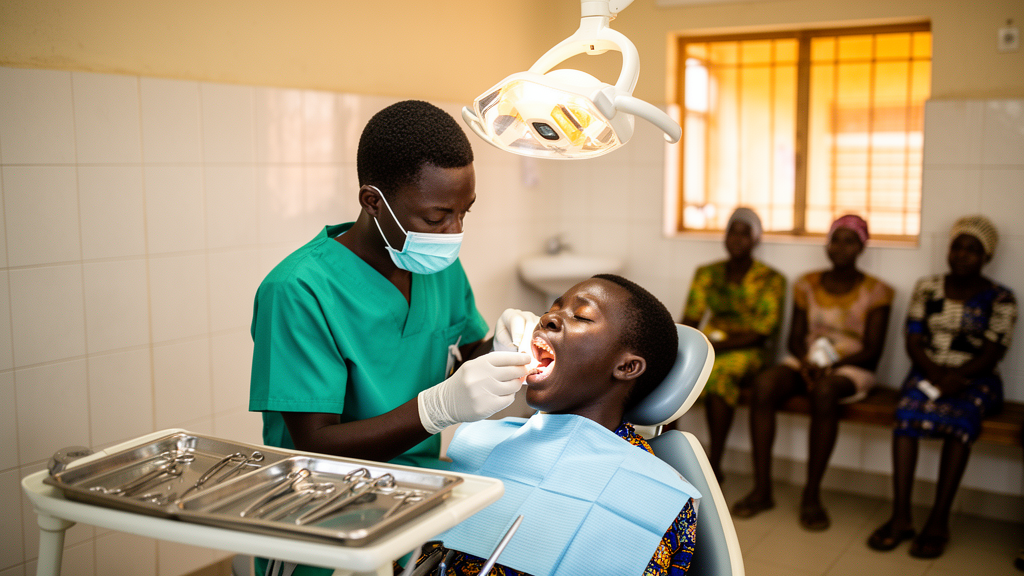
Deep within the jaw and the soft tissues of the face and neck, bacteria that escape from infected teeth can trigger a spectrum of infections ranging from a localized, drainable abscess to rapidly spreading conditions that can close the airway and destroy tissue. A new retrospective study from Sunyani Teaching Hospital in Ghana’s Bono Region has now mapped which of these infection types appear in hospitalised patients, and which social and clinical circumstances travel with them. The findings, published in PLOS One, suggest that unemployment, rural residence and underlying systemic disease are each associated with distinct and more dangerous presentations of odontogenic infection, the term clinicians use for infections that originate in the teeth and their supporting structures.
The research team, led by Kwame Adu Okyere Boadu and colleagues, reviewed consecutive admissions to the hospital’s Allied Ward between January 2021 and January 2025. Of 811 admissions screened, 509 were excluded because the underlying condition was not odontogenic, and a further 16 records were dropped because more than 30 percent of the required clinical fields were missing. That filtering left 286 complete records for analysis. Because every patient in the dataset was already hospitalised, the study does not ask who is likely to develop a dental infection in the first place. Instead, it addresses a subtler question: among people sick enough to be admitted, what factors distinguish those presenting with one type of infection from those presenting with another?
The methodological choices behind that question matter, and they reveal how careful the authors had to be with the data. The researchers first used chi-square tests to compare categorical variables, reporting Cramer’s V as a measure of association strength and turning to Monte Carlo exact p-values where sparse cells made conventional approximations unreliable. But when they attempted a standard multinomial logistic regression, with abscess as the reference outcome, the model exhibited quasi-complete separation, a statistical pathology in which a predictor perfectly or nearly perfectly divides the outcome categories, sending ordinary maximum-likelihood estimates off toward infinity. Rather than report unstable coefficients, the team made a Firth-penalised multinomial logistic regression the primary analysis, a technique that applies a penalty to the likelihood and shrinks estimates back into a range where confidence intervals remain interpretable.
That penalised model adjusted for age, sex, employment status, residence, recorded oral hygiene, systemic comorbidity and alcohol use, and it produced a coherent pattern. Unemployment was associated with higher adjusted odds of Ludwig’s angina, a bilateral, board-hard swelling of the submandibular, sublingual and submental spaces that can push the tongue backward and obstruct the airway, relative to abscess. The adjusted odds ratio was 2.78, with a 95 percent confidence interval of 1.27 to 6.09. Rural residence, meanwhile, was associated with necrotizing fasciitis, the most fulminant entity in the spectrum, in which infection races along fascial planes and kills soft tissue, with an adjusted odds ratio of 3.62 and a confidence interval of 1.33 to 9.80.
The strongest and most consistent signal, however, belonged to systemic comorbidity. Patients with recorded conditions such as diabetes or other chronic disease had markedly higher adjusted odds of presenting with Ludwig’s angina rather than abscess, at an odds ratio of 4.14, and with necrotizing fasciitis rather than abscess, at an odds ratio of 8.72 with a confidence interval stretching from 2.95 to 25.75. Comorbidity was also linked to cellulitis, the diffuse spreading form of infection without a collectable pocket of pus, at an odds ratio of 2.07. The biological logic is plausible: impaired immune function and impaired microcirculation, both hallmarks of conditions like diabetes, are known to blunt host defenses and allow bacteria that a healthy patient might wall off locally to spread instead through fascial planes.
Not every association survived scrutiny, and the authors were candid about one that almost certainly should not be taken at face value. The absence of a recorded poor-oral-hygiene entry was associated with cellulitis at an adjusted odds ratio of 8.05, a figure that might superficially suggest good hygiene raises the risk of diffuse infection. The team interpreted this instead as a documentation artefact. In a retrospective chart review, the absence of a recorded risk factor is not the same as the absence of the risk factor itself, and clinicians may simply document hygiene status more thoroughly in patients with obvious decay and neglected mouths, the very patients who tend to form localized abscesses. The finding, in other words, says more about record-keeping than about biology.
Sex and alcohol use showed no association with infection type once other variables were accounted for. A further candidate variable, the number of children in the household, was the sole source of the separation problem that forced the penalised modelling approach, and it was not retained in the final model because its penalised confidence intervals included the null value of one. These negative results are worth noting in an era when selective reporting often buries them; the study’s conclusions rest on the factors that held up, not on an accumulation of marginal signals.
The clinical implications are sobering. Ludwig’s angina and necrotizing fasciitis are the presentations that kill. Ludwig’s angina demands prompt airway management and surgical decompression of the neck spaces, while necrotizing fasciitis requires aggressive debridement of dead tissue and broad-spectrum antimicrobial therapy, often with repeated operations. Both carry substantial mortality even in well-resourced intensive care settings. If unemployed patients and patients with chronic disease are more likely to arrive at hospital with these severe forms rather than with a drainable abscess, then the point of intervention lies upstream, in the weeks and months when a painful tooth could still be treated in a dental chair rather than in an operating theatre.
The socioeconomic gradient the study describes fits a wider pattern in global oral health. Dental caries is among the most common chronic diseases worldwide, yet access to restorative and endodontic care is deeply unequal, and periurban and rural communities in West Africa often face long travel distances, out-of-pocket costs and shortages of dental personnel. A person who cannot afford or reach definitive treatment may manage a worsening toothache with analgesics and home remedies until the infection breaks out of the bone and into the neck spaces, at which point hospitalisation becomes the only option. Unemployment, in this framing, is not itself a biological risk factor but a marker of delayed access, and rural residence may compound that delay while also exposing patients to different microbial and healthcare environments.
The authors are careful to frame their findings as associational and bounded by design. This was a retrospective, single-centre study of admitted patients, drawing on routinely collected records with the missing-data problems that such records inevitably carry, and the analysis describes variation in infection type among the hospitalised rather than risk of infection in the community. Still, the signal is consistent enough to be actionable. Strengthening primary dental care in periurban and rural Ghana, screening hospitalised patients with chronic disease for odontogenic sources of infection, and improving the documentation of oral hygiene and social circumstances in hospital records could each help shift the balance away from the airway-threatening end of the spectrum and toward infections that are caught early, treated simply and survived.
Subject of Research: Socioeconomic and clinical factors associated with the type of odontogenic infection presenting in hospitalised patients in periurban Ghana
Article Title: Socioeconomic and clinical factors associated with odontogenic infection types among hospitalised patients in Periurban Ghana
Article References: Okyere Boadu, K. A., Asante, L. S., Frimpong, P., Johnson, E. K., Adu, V. W., & Okyere Boadu, R. (2026). Socioeconomic and clinical factors associated with odontogenic infection types among hospitalised patients in Periurban Ghana. PLOS One, 21(10), e0360737. https://doi.org/10.1371/journal.pone.0360737
Image Credits: AI Generated
DOI: 10.1371/journal.pone.0360737
Keywords: odontogenic infection, Ludwig's angina, necrotizing fasciitis, cellulitis, Ghana, hospitalised patients, unemployment, rural residence, systemic comorbidity, Firth-penalised regression, retrospective study, oral health
Cite Scienmag News
Kristina Jarvis. (October 15, 2026). Joblessness and Chronic Illness Linked to Severe Dental Infections in Ghana Hospital Study. Scienmag. https://scienmag.com/joblessness-and-chronic-illness-linked-to-severe-dental-infections-in-ghana-hospital-study/
Kristina Jarvis. "Joblessness and Chronic Illness Linked to Severe Dental Infections in Ghana Hospital Study." Scienmag, 15 October 2026, https://scienmag.com/joblessness-and-chronic-illness-linked-to-severe-dental-infections-in-ghana-hospital-study/. Accessed 15 October 2026.
Kristina Jarvis. "Joblessness and Chronic Illness Linked to Severe Dental Infections in Ghana Hospital Study." Scienmag. October 15, 2026. https://scienmag.com/joblessness-and-chronic-illness-linked-to-severe-dental-infections-in-ghana-hospital-study/


