


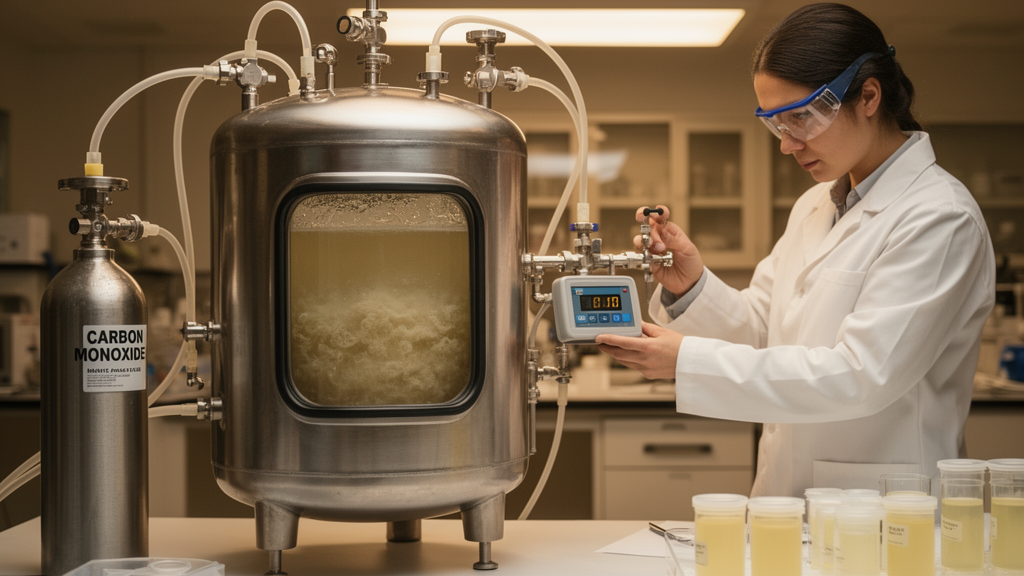
Carbon monoxide is infamous as a silent killer, a colorless gas that binds hemoglobin with deadly efficiency. Yet for a specialized group of microorganisms, this toxic molecule is not a poison but a meal. Researchers at Wageningen University & Research have now shown that carefully constructed microbial communities can simultaneously consume carbon monoxide and acetate, converting them predominantly into butyrate, a valuable four-carbon fatty acid with applications ranging from animal feed additives to bioplastics precursors. The study, published in Applied Microbiology and Biotechnology by Siebe Peek, Martijn Diender, and Diana Z. Sousa, offers a roadmap for steering mixed microbial communities toward targeted industrial products.
The work addresses one of the central challenges in gas fermentation technology: how to reliably convert syngas, a mixture rich in carbon monoxide, hydrogen, and carbon dioxide typically derived from industrial waste streams or gasified biomass, into chemicals of commercial interest. Pure cultures of gas-fermenting bacteria have long been used for this purpose, but they are fragile. Mixed microbial communities, by contrast, are robust and resilient catalysts that can withstand fluctuations in feedstock and operating conditions. The difficulty lies in taming them, because open communities tend to drift toward unpredictable compositions and product spectra.
The theoretical framework behind the Wageningen experiment rests on the complementary metabolisms of two functional groups of anaerobic bacteria. Acetogens, such as members of the genus Eubacterium and the well-studied Clostridium autoethanogenum, possess the Wood-Ljungdahl pathway, which allows them to grow autotrophically on carbon monoxide or on carbon dioxide plus hydrogen, fixing these one- and two-carbon gases into acetate. Chain elongators, most famously Clostridium kluyveri, then take short-chain carboxylic acids like acetate and extend them by two carbon units per cycle, using ethanol or other electron donors, to yield medium-chain fatty acids such as butyrate and caproate. In principle, combining these two activities in a single reactor should allow direct conversion of syngas into higher-value chemicals without the need for sterile, single-species cultivation.
To test this concept, the researchers designed three enrichment strategies and ran them in parallel. The first was a conventional approach using only anaerobic sludge as the inoculum, relying on the natural diversity of the sludge to contain organisms capable of carbon monoxide metabolism and chain elongation. The second strategy augmented the sludge with known syngas fermenters, specifically Clostridium autoethanogenum, Clostridium carboxidivorans, Eubacterium limosum, and Acetobacterium wieringae, with the aim of boosting carboxydotrophic, or carbon monoxide-consuming, activity from the outset. The third strategy added the chain elongator Clostridium kluyveri to the sludge, intending to jump-start the elongation of acetate into butyrate. This comparative design allowed the team to assess whether the starting community composition, rather than the selective pressure of the substrate alone, determines where the enrichment ends up.
The enrichment process itself was deliberately gradual. Batch cultures were supplied with carbon monoxide and acetate, and with each successive transfer the partial pressure of carbon monoxide was increased stepwise until the cultures were growing under a headspace of one hundred percent carbon monoxide at approximately 170 kilopascals. This progressive adaptation is important because high carbon monoxide partial pressures are industrially relevant but biologically challenging; the gas is a potent inhibitor of many hydrogenase and other metalloenzymes, and organisms unaccustomed to it simply fail to grow. Reaching full carbon monoxide headspace in all enrichments was therefore a significant milestone in itself.
The outcome was striking: ultimately, all three enrichment strategies produced cultures capable of growing under pure carbon monoxide while simultaneously consuming the added acetate, and in every case butyrate emerged as the main product. Regardless of whether the inoculum had been plain sludge, sludge plus syngas fermenters, or sludge plus the chain elongator, the communities converged on the same functional outcome. This convergence suggests that the combination of carbon monoxide and acetate as co-substrates exerts a powerful selective force, funneling the community toward chain elongation as the dominant metabolism.
However, the taxonomic story told by the sequencing data was more surprising. Analysis of 16S rRNA gene amplicons and metagenomes revealed that the genus Eubacterium became predominant in the enrichments. Members of this genus are carboxydotrophic acetogens capable of using the Wood-Ljungdahl pathway to fix carbon monoxide, but the findings pointed to something more intricate than a simple division of labor between acetogen and chain elongator. Based on the physiological data and the metagenomic evidence, the researchers hypothesize that Eubacterium itself consumes carbon monoxide and acetate, producing butyrate directly along with extracellular polymeric substance-like material, a class of sticky, carbohydrate- and protein-rich polymers that microbes secrete to form biofilms and protective matrices.
That extracellular polymeric substance hypothesis may be the most intriguing thread in the study. Metagenomic data suggested that several other genera enriched in the cultures, including Aminobacterium, Anaerotignum, Oscillibacter, and Proteiniphilum, none of which are known to ferment carbon monoxide, were likely living off components derived from this EPS-like material, consuming sugars and amino acids released within the community. In other words, the dominant carbon monoxide converter may be sculpting its own micro-ecosystem, excreting polymeric material that supports a supporting cast of scavengers. This kind of metabolic cross-feeding, in which the waste products of one organism become the substrate of another, is a hallmark of stable mixed communities and may help explain why the enrichments remained productive across repeated transfers under increasingly harsh gas conditions.
The practical implications extend in two directions. First, the demonstration that augmentation can steer mixed communities toward targeted product formation is a valuable design principle for gas fermentation bioprocesses. Notably, the researchers found that augmenting the sludge with acetogens shortened the lag phase in the presence of carbon monoxide, meaning the augmented cultures adapted to the toxic gas faster than unamended controls. For industrial reactors, where downtime and long startup periods translate directly into cost, accelerating community maturation through targeted inoculation could be a meaningful advantage. Second, the study highlights that initial culture conditions play a critical role in shaping community composition and functionality, even when different starting points converge on similar products. Understanding which organisms dominate and why gives process engineers levers to pull when a community misbehaves or drifts toward unwanted byproducts.
Butyrate itself is worth the effort. The molecule serves as a feed additive that can partially replace antibiotics in livestock, as a precursor for ester production in the fragrance and food industries, and as a platform chemical that can be further elongated or reduced into fuels and bioplastics building blocks. Producing it from carbon monoxide, a gas that is both an industrial pollutant and a cheap byproduct of steelmaking and waste gasification, aligns with the broader vision of a circular carbon economy in which emissions become feedstocks. The Wageningen study, supported by the Honours Research Programme of the Wageningen Institute for Environment and Climate Research, adds a crucial piece to that vision: evidence that unstructured, self-organizing microbial communities, guided by smart enrichment and augmentation strategies, can perform the conversion reliably under pure carbon monoxide, with Eubacterium emerging as the unexpected workhorse at the center of it all.
Subject of Research: Microbial syngas fermentation for butyrate production from carbon monoxide and acetate
Article Title: Butyrate production from the simultaneous utilization of carbon monoxide and acetate in Eubacterium-dominated enrichments
Article References: Butyrate production from the simultaneous utilization of carbon monoxide and acetate in Eubacterium-dominated enrichments. (n.d.). https://doi.org/10.1007/s00253-026-14063-x
Image Credits: AI Generated
DOI: 10.1007/s00253-026-14063-x
Keywords: syngas fermentation, carbon monoxide, butyrate, Eubacterium, acetogens, chain elongation, mixed microbial communities, metagenomics, Clostridium kluyveri, extracellular polymeric substances, gas fermentation, industrial microbiology
Cite Scienmag News
Morgan Morrow. (October 15, 2026). Microbes Turn Toxic Carbon Monoxide into Valuable Butyrate in Breakthrough Fermentation Study. Scienmag. https://scienmag.com/microbes-turn-toxic-carbon-monoxide-into-valuable-butyrate-in-breakthrough-fermentation-study/
Morgan Morrow. "Microbes Turn Toxic Carbon Monoxide into Valuable Butyrate in Breakthrough Fermentation Study." Scienmag, 15 October 2026, https://scienmag.com/microbes-turn-toxic-carbon-monoxide-into-valuable-butyrate-in-breakthrough-fermentation-study/. Accessed 15 October 2026.
Morgan Morrow. "Microbes Turn Toxic Carbon Monoxide into Valuable Butyrate in Breakthrough Fermentation Study." Scienmag. October 15, 2026. https://scienmag.com/microbes-turn-toxic-carbon-monoxide-into-valuable-butyrate-in-breakthrough-fermentation-study/


