


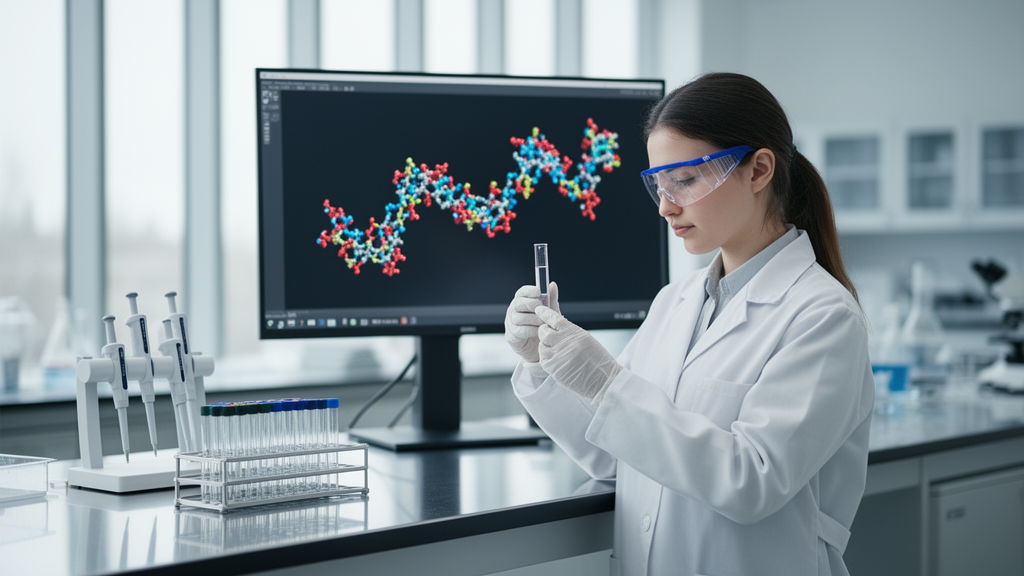
Peptides have quietly become one of the fastest-growing categories in modern medicine. These short chains of amino acids, larger than a conventional small-molecule drug but smaller than a full protein, can be engineered to bind biological targets with remarkable precision and selectivity. Many adults have now tried a peptide drug, and roughly eight percent of newly approved medicines fall into this class. Yet behind that clinical success lies an uncomfortable truth: peptide discovery remains stubbornly slow, because the field has never assembled the kind of shared data infrastructure that transformed other areas of computational biology. A team at the University of Toronto, backed by a $2.3 million USD award from Google.org, is now trying to close that gap with a new open platform called OpenPep.
The project is led by Joseph Brown, assistant professor at the Leslie Dan Faculty of Pharmacy, together with co-investigators Keith Pardee, also of the Leslie Dan Faculty of Pharmacy, Philip Kim of the Donnelly Centre for Cellular and Biomolecular Research, and Chris Ing, co-founder and chief scientific officer of the Toronto-based company ProteinQure. Their funding comes through the Google.org Impact Challenge: AI for Science initiative, which pairs early-stage capital with artificial intelligence to support foundational science that traditional funding streams often overlook. The award will finance both the generation of large-scale experimental data and the construction of AI models trained on that data, with the ultimate goal of predicting which peptides will bind to which disease-relevant proteins.
The logic behind OpenPep mirrors one of the most celebrated success stories in AI-driven science. AlphaFold, the protein structure prediction system that reshaped structural biology, was built on decades of openly shared experimental data. No comparable resource exists for peptides. Discovery in this field has progressed almost exclusively through individual experiments, with the resulting measurements scattered across academic laboratories, individual projects, and private companies. That fragmentation means each new peptide campaign starts nearly from scratch, and the collective knowledge embedded in thousands of past experiments never accumulates into a generalizable model. Brown describes the problem bluntly: the field simply does not have enough existing data for peptide discovery, which is why developing peptide medicines is still remarkably slow.
OpenPep’s answer is to generate that data deliberately and at scale. Pardee’s group will draw on its expertise in accessible cell-free systems from synthetic biology to produce up to 500 disease-relevant proteins, a curated snapshot of the human proteome. Brown’s team will then deploy specialized mass spectrometry to experimentally test large libraries of peptides against those target proteins, measuring which peptides bind and how strongly. This pairing of protein production and high-throughput binding measurement is what turns a collection of isolated assays into a structured dataset suitable for machine learning. Every measured interaction becomes a training example, and the aggregate becomes something no single laboratory could produce on its own.
Once the experimental data begins to accumulate, the team will build and train AI models capable of predicting how well peptides bind to proteins that have never been tested in the lab. This is where the economics of drug discovery begin to change. As Ing explains, artificial intelligence can convert thousands of individual peptide experiments into generalizable rules about how peptides interact with proteins. Those rules can then be used to predict and design peptides for targets the consortium has not yet explored experimentally, allowing the value of each measurement to extend far beyond the specific peptide and protein pair that produced it. Predictions that prove accurate feed back into the database, refining the models further in a continuous loop of generation, prediction, validation, and improvement.
The platform is also designed to be shaped by the community it serves. As data generation gets underway, the researchers will crowd-source suggestions of proteins to target from collaborators at hospitals, pharmaceutical companies, and research institutes, with particular interest in pediatric and rare diseases, cancer, neurodegeneration, and cardiovascular disease. Any researcher can nominate a discovery target through a webform on the team’s website, openpep.com. This approach ensures that the 500-protein starting panel is not chosen in isolation but reflects genuine unmet needs across therapeutic areas, including those rare conditions that commercial incentives often leave behind.
Openness is not an afterthought for the project; it is the central design principle. Once established, OpenPep will function as an open database that the founding team and outside researchers can continue to contribute to, steadily improving the underlying models. Ing argues that some of the biggest advances in biology have been built on open scientific resources, and that no single laboratory can explore the full diversity of peptide chemistry and disease biology. Making the resource open gives it the potential to grow through contributions from the broader scientific community, in the same way that shared genomic and proteomic databases became indispensable infrastructure for entire fields.
For Google.org, the investment reflects a deliberate strategy of funding high-risk, high-leverage foundational resources. Leslie Yeh, Director of Scientific Progress at Google.org, notes that AI has the potential to transform how researchers understand biology and accelerate the discovery of new therapeutics. By pairing targeted, early-stage funding with advanced AI, the initiative aims to give researchers the runway to take bold risks on foundational science that traditional sources of capital may overlook. In Google.org’s framing, OpenPep is intended to break down fragmented data barriers so that scientists around the world can openly share knowledge and build on one another’s discoveries, advancing a more open and collaborative model of AI-powered scientific research.
The practical payoff for drug discovery teams could be substantial. With access to a large body of experimental data and trained predictive models, researchers will be able to identify and optimize promising peptide molecules more efficiently, shortening the path from a disease target to a potential therapeutic candidate. Brown emphasizes that the scale of data the consortium plans to assemble does not exist anywhere else, and that the Google.org support provides the momentum needed to commit to the dedicated data generation efforts the field has lacked. In his view, the funding unlocks a fundamentally different, AI-powered paradigm for peptide discovery rather than an incremental improvement on existing workflows.
Importantly, the team is careful not to oversell what the models can do. Brown stresses that AI will not replace experiments; instead, it will help researchers choose better ones by identifying the peptides most worth testing in the lab. The consortium’s stated vision is to turn experiments into open data, and open data into AI, giving more scientists a better place to start and accelerating the discovery of new peptides for the benefit of everyone. If that vision holds, OpenPep could do for peptide therapeutics what open structural biology databases did for protein science: convert a scattered, artisanal craft into a predictive, cumulative, and openly shared engineering discipline.
Subject of Research: AI-powered open-access peptide-protein interaction database for drug discovery
Article Title: Google.org awards $2.3 million USD to University of Toronto researchers to advance AI-powered peptide drug discovery
Article References: Google.org awards $2.3 million USD to University of Toronto researchers to advance AI-powered peptide drug discovery. (n.d.). Original publication
Image Credits: AI Generated
DOI: Not provided
Keywords: peptide drug discovery, OpenPep, University of Toronto, Google.org, artificial intelligence, mass spectrometry, protein binding prediction, open science, AlphaFold, therapeutic peptides, cell-free protein synthesis, machine learning
Cite Scienmag News
Louis Brooks. (October 15, 2026). Google.org backs University of Toronto team with $2.3 million to build OpenPep, an AI engine for peptide drug discovery. Scienmag. https://scienmag.com/google-org-backs-university-of-toronto-team-with-2-3-million-to-build-openpep-an-ai-engine-for-peptide-drug-discovery/
Louis Brooks. "Google.org backs University of Toronto team with $2.3 million to build OpenPep, an AI engine for peptide drug discovery." Scienmag, 15 October 2026, https://scienmag.com/google-org-backs-university-of-toronto-team-with-2-3-million-to-build-openpep-an-ai-engine-for-peptide-drug-discovery/. Accessed 15 October 2026.
Louis Brooks. "Google.org backs University of Toronto team with $2.3 million to build OpenPep, an AI engine for peptide drug discovery." Scienmag. October 15, 2026. https://scienmag.com/google-org-backs-university-of-toronto-team-with-2-3-million-to-build-openpep-an-ai-engine-for-peptide-drug-discovery/


