


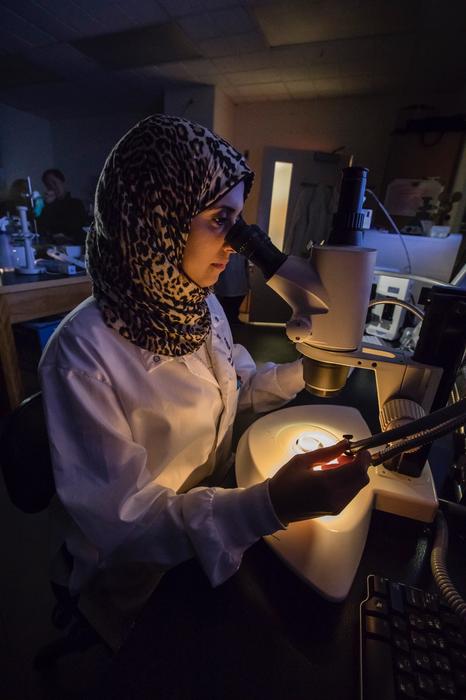
Researchers have consistently shown that prenatal exposure to Di (2-ethyhexyl) phthalate harms the reproductive system in male mice and causes fertility defects. In a new study, scientists from the University of Illinois Urbana-Champaign have shown that the combination of DEHP and a high-fat diet in pregnant mice can cause more damage to pups than each factor alone.

Credit: Fred Zwicky
Researchers have consistently shown that prenatal exposure to Di (2-ethyhexyl) phthalate harms the reproductive system in male mice and causes fertility defects. In a new study, scientists from the University of Illinois Urbana-Champaign have shown that the combination of DEHP and a high-fat diet in pregnant mice can cause more damage to pups than each factor alone.
Male reproductive disorders are a growing issue due to the global decrease in sperm count and quality. Concerningly, chemicals like DEHP, which can be found in food storage containers, pharmaceuticals, and building materials, have been found to be one of the contributing factors. The toxicity of DEHP is due to its ability to mimic the hormones in our bodies, leading to long-term effects on health.
“The scientific community is aware of the fact that the current generation of men produce half as much sperm compared to the previous one,” said CheMyong Jay Ko (EIRH), a professor of veterinary medicine. “Although it is shocking, not much attention is paid to understanding the causes.”
The researchers used the Barker hypothesis as a guiding principle for their study. Proposed by the British physician and epidemiologist David Barker, the hypothesis argued that the nine months in utero are one of the most critical periods in a person’s life and can shape their future health trajectories.
“The Barker hypothesis primarily focuses on nutrition and we wanted to test whether the mother’s diet could change the health of the next generation,” Ko said. “Additionally, unlike the previous generation, we are constantly exposed to chemicals like DEHP, which can alter how our bodies function. We wanted to ask whether the exposure to both these factors can cause growing babies to have lesser functioning reproductive systems.”
In the past, both the Ko lab and other research groups have shown that prenatal exposure to DEHP decreases testosterone levels and causes fertility defects in male mice. Additionally, scientists have shown that maternal high-fat diet can also decrease sperm counts in male offspring. However, the effects of both together had not been studied.
The researchers used four groups of pregnant mice; one was a control and the other three were either exposed to DEHP, or a high-fat diet, or a combination of the two. They then followed each litter, which contained an average of 6 male and 6 female pups.
“Surprisingly, we found that a high-fat diet had a more damaging effect on the male reproductive systems compared to DEHP alone and the pups born from mothers who had been treated with both had the worst outcomes,” Ko said.
The researchers measured the weight of the body and different reproductive organs in pups during different stages of growth and puberty. They found that although the body weight of pups born from moms on a high-fat diet alone or in combination with DEHP was higher than the other pups, the weight of the reproductive organs was lower. They also found that these mice produced less sperm and had lower testosterone levels. By staining the tissues, the researchers found that the reproductive organs had abnormal cells, which were contributing to the gonadal dysfunction.
“In our studies, we used these mice as a model. Although we need to confirm these results in humans, this study should serve as a warning to our generation that we need to be careful about our environment and diet during pregnancy,” Ko said.
The study “Prenatal exposure to Di(2-ethylhexyl) phthalate and high-fat diet synergistically disrupts gonadal function in male mice” was published in Biology of Reproduction and can be found at https://doi.org/10.1093/biolre/ioae029. The work was funded by the National Institute of Environmental Health Sciences.
Journal
Biology of Reproduction
Method of Research
Experimental study
Subject of Research
Animals
Article Title
Prenatal exposure to Di(2-ethylhexyl) phthalate and high-fat diet synergistically disrupts gonadal function in male mice
Article Publication Date
24-May-2024
Cite Scienmag News
Ophelia Keating. (June 14, 2024). Gonadal function in male mice disrupted by prenatal risk factors. Scienmag. https://scienmag.com/gonadal-function-in-male-mice-disrupted-by-prenatal-risk-factors/
Ophelia Keating. "Gonadal function in male mice disrupted by prenatal risk factors." Scienmag, 14 June 2024, https://scienmag.com/gonadal-function-in-male-mice-disrupted-by-prenatal-risk-factors/. Accessed 7 September 2026.
Ophelia Keating. "Gonadal function in male mice disrupted by prenatal risk factors." Scienmag. June 14, 2024. https://scienmag.com/gonadal-function-in-male-mice-disrupted-by-prenatal-risk-factors/

