


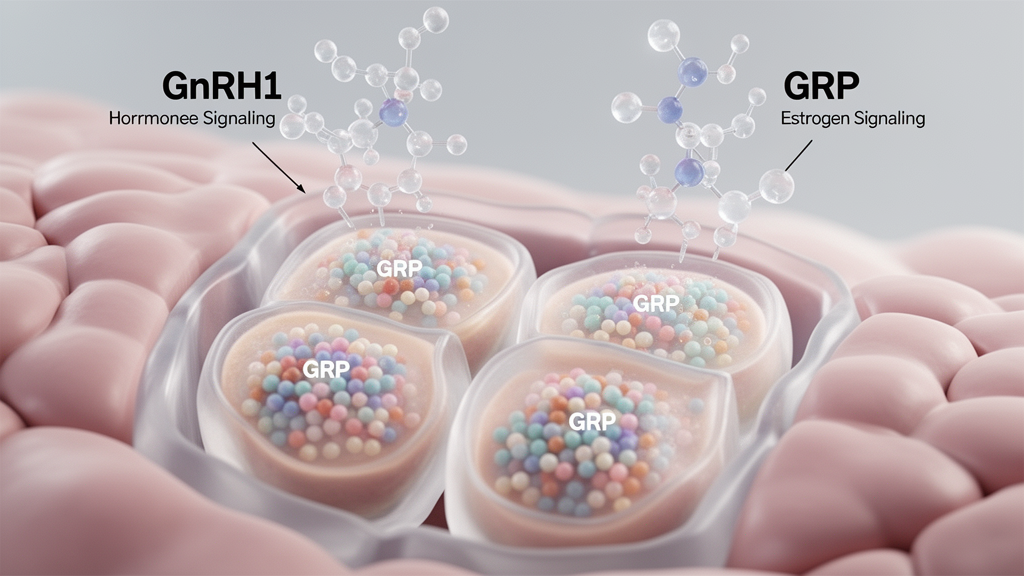
Chicken gastrin-releasing peptide (cGRP) expression in pituitary cells rises in response to hypothalamic gonadotropin-releasing hormone 1 (GnRH1), according to experiments with primary cells from one-week-old chicks. The hormone also increased GRP messenger RNA in a dose- and time-dependent manner. Pharmacological evidence indicated that the response involved both the adenylyl cyclase, cyclic AMP and protein kinase A pathway, and the phospholipase C, protein kinase C, mitogen-activated protein kinase kinase and extracellular signal-regulated kinase cascade. The study further found that sex steroids exerted contrasting effects: 5α-dihydrotestosterone and progesterone reduced GRP expression, whereas 17β-estradiol increased it. These findings position cGRP as a regulated pituitary signal that may connect hypothalamic and ovarian inputs to chicken reproductive function, although the researchers did not demonstrate an effect on egg production itself.
The researchers began with a previously published single-cell RNA-sequencing atlas of adult chicken anterior pituitary tissue. In that dataset, GRP was detected primarily in gonadotrophs from female chickens, with additional expression in lactotrophs and folliculo-stellate cells. This distribution was consistent with an earlier report that GRP-immunoreactive cells in the chicken pituitary largely overlap with luteinizing hormone-positive cells. The researchers also consulted a domestic chicken multi-tissue expression database, which showed abundant GRP and GnRH receptor 2 messenger RNAs in the anterior pituitary of adult chickens. Because GnRH1 is a central regulator of reproductive hormone synthesis and secretion, the localization of GRP in gonadotrophs made it a plausible target for GnRH control.
To test this possibility, investigators dispersed and cultured anterior pituitary cells collected from one-week-old chicks. The cells were initially maintained in serum-containing medium and then transferred to serum-free conditions before hormone treatments. Quantitative real-time polymerase chain reaction was used to measure GRP messenger RNA, with β-actin and GAPDH serving as reference genes. GnRH1 at 100 nanomolar increased GRP expression in the cultured cells, with the strongest response after six hours. A concentration series showed that 0.1–100 nanomolar GnRH1 produced a dose-dependent increase, with a statistically significant response at the lowest tested concentration. The experiment therefore established a direct response in cultured pituitary cells rather than demonstrating regulation in an intact bird.
Drug experiments were then used to probe the intracellular pathways associated with the GnRH1 response. Forskolin, an activator of adenylyl cyclase, mimicked the increase in GRP expression and did so in a dose-dependent manner. Blocking adenylyl cyclase with MDL-12,330A completely abolished the effect of 10 nanomolar GnRH1 after six hours and also reduced basal GRP expression. The protein kinase A inhibitor H89 markedly suppressed the GnRH1 response and likewise lowered basal expression. These results support participation of the adenylyl cyclase–cyclic AMP–protein kinase A pathway, although the study did not directly measure cyclic AMP or protein kinase A activation.
A second set of inhibitors indicated that another signaling route also contributed. Phorbol 12-myristate 13-acetate, a protein kinase C activator, reproduced the dose-dependent stimulation produced by GnRH1. Inhibition of phospholipase C with U73122, inhibition of protein kinase C with calphostin C, or inhibition of mitogen-activated protein kinase kinase with PD98059 significantly reduced GnRH1-induced GRP expression. The authors therefore proposed involvement of the phospholipase C–protein kinase C–mitogen-activated protein kinase kinase–extracellular signal-regulated kinase pathway. The pharmacological design supports pathway participation but cannot establish every molecular interaction directly, and the experiments did not determine which GnRH receptor subtype mediated the response or whether GRP protein secretion changed alongside its messenger RNA.
The sex-steroid experiments produced distinct regulatory patterns in the same culture system. The androgen 5α-dihydrotestosterone reduced GRP messenger RNA after 48 hours, with stronger inhibition as concentration rose from 1 to 100 nanomolar. Progesterone also reduced GRP expression in both time- and dose-dependent tests: 100 nanomolar progesterone had an effect over a 12–48-hour interval, and concentrations from 1 to 1,000 nanomolar produced progressively lower expression after 48 hours. By contrast, 17β-estradiol increased GRP expression. Its largest response occurred after 12 hours, and a concentration series showed stimulation at 0.1–100 nanomolar. Diethylstilbestrol, an estradiol analogue, also increased GRP expression dose dependently.
Blocking the estradiol response with 4-hydroxytamoxifen, an estrogen-receptor antagonist, indicated that the increase depended on receptor-mediated signaling. The investigators then cloned 1,914 base pairs of the chicken GRP gene’s 5′ flanking region and analyzed it with promoter-prediction tools. The sequence had a reported GC content of 57.26 percent. Two predicted estrogen-receptor-binding sites were located at positions −914 and −411 base pairs relative to the transcription start site. A full-length promoter fragment produced approximately 16-fold more luciferase activity than an empty control vector in chicken DF-1 cells and approximately 12-fold more in human HEK293 cells. Removing the region upstream of −914 base pairs did not significantly reduce basal activity, placing most of the measured promoter activity in the proximal 915-base-pair region.
Estradiol also increased activity of the GRP promoter in DF-1 cells, while the authors then used site-directed deletions to test the two predicted receptor sites. Estradiol significantly stimulated the intact construct and a construct lacking the first site, but no significant response was detected when the second site was deleted or when both sites were removed. Responses from the second-site and double-deletion constructs were also significantly lower than that of the intact promoter. These results provide a functional basis for estrogen regulation of the GRP gene, though they do not prove direct receptor occupancy. The authors noted that receptor-specific loss-of-function or knockdown experiments would be needed to distinguish direct effects from other sequence elements, spacing effects and transcription-factor interactions.
The steroid results also revealed that estradiol did not regulate all gonadotroph signals in the same way. In cultured pituitary cells, 17β-estradiol reduced follicle-stimulating hormone beta messenger RNA while increasing GRP messenger RNA. The divergence is notable because both products are associated with gonadotrophs and ovarian follicle development. Earlier work had shown that the GRP receptor is abundant in granulosa cells of small chicken ovarian follicles and that GRP can promote granulosa-cell proliferation and follicle survival. The authors proposed that increased pituitary GRP might therefore support the survival of small follicles that could later enter the preovulatory hierarchy, whereas reduced FSH beta expression reflects a different arm of estrogen feedback.
That reproductive interpretation remains a hypothesis rather than a demonstrated outcome. The researchers suggested a possible positive-feedback model in which growing follicles produce more estradiol, higher estradiol stimulates more pituitary GRP expression, and GRP then helps preserve additional small follicles. This model was linked to an earlier association between circulating estradiol-to-progesterone ratios and egg production across eight chicken genetic stocks, but the present experiments neither manipulated egg laying nor measured follicular survival after altering GRP. The study also did not measure GRP secretion, establish whether secretion varies among breeds, or test gene knockout. These limitations are important because the experiments were performed in cultured cells, often from young chicks, whereas the proposed reproductive role involves adult ovarian function and whole-animal physiology.
Taken together, the results identify cGRP as a molecular target of GnRH1 and sex-steroid feedback in chicken pituitary cells. GnRH1 increased GRP expression through pathways that probably include cyclic AMP–protein kinase A and phospholipase C–protein kinase C–mitogen-activated protein kinase kinase–extracellular signal-regulated kinase signaling. Androgen and progesterone suppressed the transcript, while estradiol increased it through a response involving two potential estrogen-receptor-binding sites in the proximal promoter. The work provides a detailed regulatory map for a proposed chicken pituitary hormone and connects it mechanistically to the previously reported survival-promoting effect of GRP in small ovarian follicles. Whether that regulatory circuit actually changes follicle selection, egg production or reproductive performance will require studies in living chickens, including direct tests of GRP secretion and loss of function.
Subject of Research: Hormonal regulation of gastrin-releasing peptide expression in chicken pituitary cells and its possible role in ovarian follicle survival
Article Title: Regulation of gastrin-releasing peptide gene expression in chickens
Article References: Tang, K., Tian, X., Yuan, X., Li, Y., Zhang, J., Wang, Y., & Li, J. (2026). Regulation of gastrin-releasing peptide gene expression in chickens. Frontiers in Physiology, 17, 1940305. https://doi.org/10.3389/fphys.2026.1940305
Image Credits: AI Generated
DOI: 10.3389/fphys.2026.1940305
Keywords: chicken, gastrin-releasing peptide, pituitary gland, GnRH1, estrogen, sex steroids, gene regulation, ovarian follicles, egg production, Regulation, gastrin-releasing, peptide
Cite Scienmag News
Juliet Wilcox. (October 21, 2026). GnRH1 and estrogen regulate chicken pituitary GRP expression. Scienmag. https://scienmag.com/gnrh1-and-estrogen-regulate-chicken-pituitary-grp-expression/
Juliet Wilcox. "GnRH1 and estrogen regulate chicken pituitary GRP expression." Scienmag, 21 October 2026, https://scienmag.com/gnrh1-and-estrogen-regulate-chicken-pituitary-grp-expression/. Accessed 21 October 2026.
Juliet Wilcox. "GnRH1 and estrogen regulate chicken pituitary GRP expression." Scienmag. October 21, 2026. https://scienmag.com/gnrh1-and-estrogen-regulate-chicken-pituitary-grp-expression/


